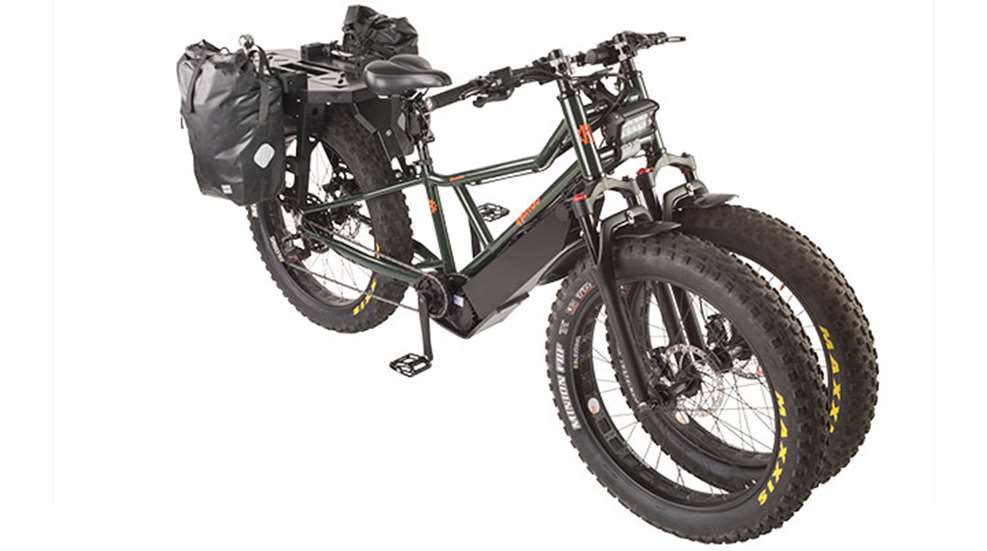
Yes, you’re seeing double. Two front wheels on this Rungu Dualie virtually eliminate the wipeouts that can occur when you encounter deep mud or sand on a single-wheel bicycle. It’s an e-bike powered by an electric motor made by a company that takes its Swahili name from the club carried by Masai warriors in warfare and for hunting. That’s fitting as Rungu makes bikes for hunters.
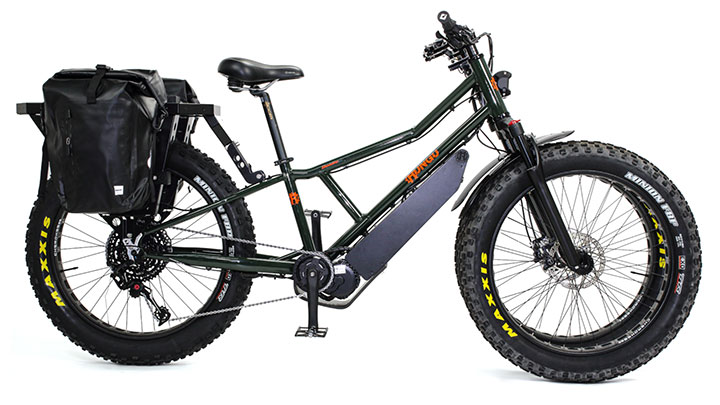
E-bikes have aroused my curiosity because they are cheaper to buy and easier to transport than an ATV, so I was happy to accept an invitation from Peter Godlewski, president and founder of Rungu, to test and evaluate a Dualie.
E-bikes seem to provoke the ire of some hunters and backcountry users who must view them as a means of “cheating.” They are not allowed in wilderness areas, but in 2019, the Bureau of Land Management allowed them on all bicycle trails. They come in three classes. Class 1 and 2 are exclusively pedal-assist. The Dualie is a Class 3 e-bike made for offroad use with pedal assist, a throttle and a top speed of 26 mph. Its Bafang motor is a nominal 1,120-watt unit with a 52-volt modification to create roughly 1.9 hp. Says Godlewski: “Think of it as a dirt bike—an extremely quiet dirt bike that’s not quite as fast.”
Of course you should check local regs, but if wheels are allowed on public hunting ground a Dualie is likely allowed, too. A hunter could park at a trailhead at 5 a.m. instead of 3 a.m. ride his Dualie 10 miles into the backcountry on timber roads, pedaling the same ground in an hour it would take him three hours to hike, stash the bike, hunt on foot all day then ride out at dark.
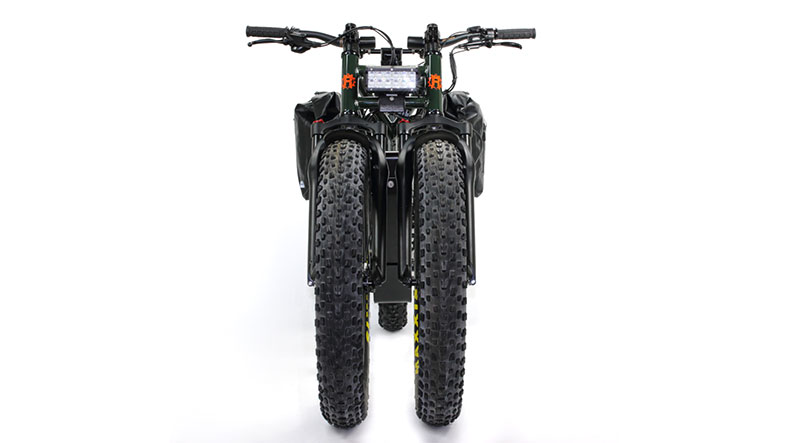
It’s hard to control a two-wheeled bike on slick or soft ground. In a turn, all the force on the front tire is directed through a narrow strip of tread that follows the turning circle. If that strip can’t grip it skids. At that point, if the rider doesn’t straighten the front wheel he’ll wash out or worse, flip over the handlebars.
To solve the problem Godlewski, whose background lies in mechanical and robotic engineering, employed a form of Ackerman Steering, created for automobiles, so the center of the turning circle is the same for all three wheels of a Dualie. The bike always keeps one tire on the inside of the turning circle, so the entire surface of the tire maintains contact for maximum traction. The front wheels are spaced 9 inches apart. Any closer and they wouldn’t provide enough stability. Any wider and they wouldn’t allow a rider to lean into turns.
The step-through frame creates a low, 26.5-inch standover height to avoid “crotch crunch.” A 75/25 percent weight distribution keeps more weight on the front tires than a normal bicycle to maintain traction. The center of gravity is far forward to help you climb steep hills without rising from the saddle.
On the left handlebar is the control panel. Turn on the motor to cycle through power levels from 1-5. On dry pavement, Level 1 helps you pedal with little effort. Level 5 is best to climb hills. Information on the digital dashboard includes power level, battery level, speed, distance traveled and more.
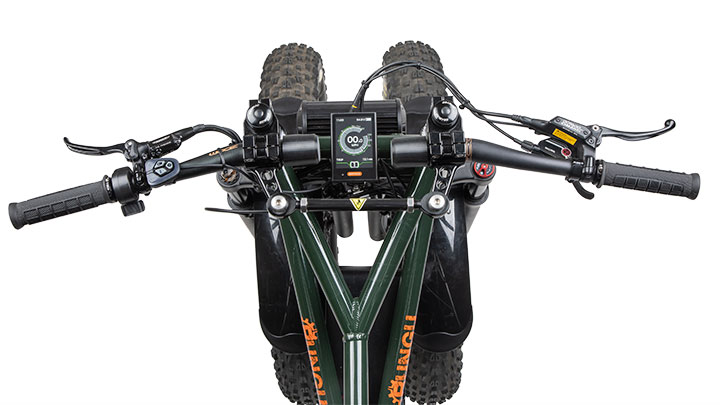
Start pedaling. You’ll feel the motor kick in and help. Alternately, you can just push the throttle to start moving silently then begin to pedal after you climb on the saddle. When traveling at 10 mph on level ground without pedaling and without stopping, range is about 20 miles, but that’s deceiving. Mileage is affected by terrain, tire inflation and other factors that affect battery life. When the motor works hard during offroad use it drains the battery quickly; 20 miles may be about all you can count on if the going is tough regardless whether you pedal. But pedaling in Level 1 on easy terrain may produce 100 miles of range. The battery is charged in less than three hours.
Godlewski says his bike will climb a 40 percent grade before losing traction while other e-bikes begin to slip at about a 20 percent grade. I’ll let you know when I reach such a threshold. For now, climbing is easy; I select Level 5 power, shift into a low gear and pedal. Descents are made comfortable, and safer thanks to a long wheelbase that keeps your weight back on the frame.
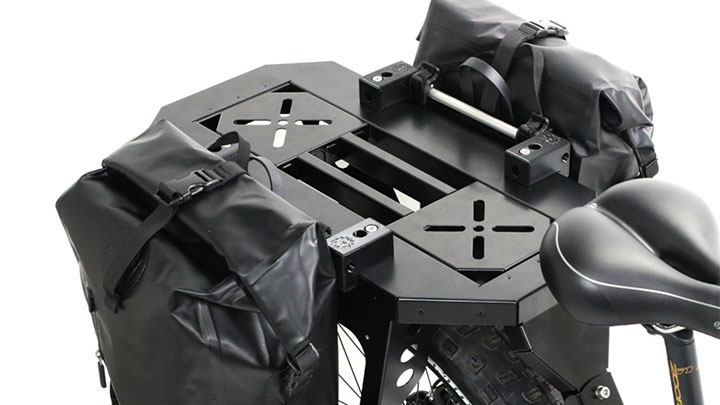
Our test unit is the Dualie Rugged, which costs $6,700 outfitted with a cargo rack, panniers and an upgraded gear-change system. A standard Dualie costs $4,500, a top-of-the-line XR Rubicon Trail edition $7,800 (XR means extra range with a second battery). Colors include Midnight Black, Forest Green and Winter Slate. Options include a hitch ball to tow a trailer and cargo weighing as much as 300 pounds, a trailer and more. A two-year warranty applies to all components.
The bike turns on massive, 26-inch alloy wheels and Maxxis Minion tires. It’s built on a 14.5-inch frame, sufficient for most adult riders. Overall length is 84 inches. Weight is a hefty 103 pounds, which isn’t too heavy to lift, one end at a time, into a truck bed.
Powering through soft sand, snow up to 9 inches deep, through mud and over trail obstacles—it’s all made possible by the dual front wheels of a Rungu Dualie. But as of this writing I am loath to push beyond my comfort zone. I’d like to avoid a dislocated shoulder. But I will continue to use it, and learn to ride it better. Stay tuned for an update at a later date. In the meantime, learn more about the Rungu Dualie at riderungu.com.