There are great archers, and then there are deadly ones. Great shots might stack a quiver of arrows in the 10-ring at 40 yards; deadly shots stack game in the back of the truck season after season. Both of these guys practice the fundamentals of shooting, but deadly shots realize the woods is not a static archery range. Rather, it’s as unpredictable as the wind, and that’s why deadly shots stay cool under pressure, read each situation and adapt to it in less time than it takes a buck to snort and wheel. Here are some tips from deadly shots.
Michael Waddell is more than just a celebrity hunter with a Georgia accent. He’s a straight-up killer. He says that killers don’t wait for the perfect shot.
“I hear guys say, ‘Man, I thought he might come closer so I didn’t shoot’—but that don’t happen much to me. If I see a buck at 42 yards and I know I can kill him, I kill him at 42 yards.”
Waddell’s also big on confidence. “When I decide to shoot,” he says, “I don’t wonder if it’ll end well—I know it will.”
Hank Tassitano was killing big whitetails before Waddell was playing patty-cake. His bow is merely his tool; it’s not new or flashy, just deadly.
“The adrenaline rush can cause hunters to lose focus,” he notes. “To combat it, I shut my eyes for a second and take a deep breath to try to slow things down. As I open my eyes, I focus on the spot I want to hit and not antlers. Then I tell myself to follow through as I release.”
Tassitano is big on practice, but not only on the range. “What has also helped me over the years is practicing drawing on deer that I don’t intend to shoot,” he says. “It helps me stay calm for the real moment of truth, and it also teaches me how to draw without getting busted.”
Matt Fleming works for the NRA in its Hunter Services department and is a master traditional archer. His approach to making a shot count under pressure is all business.
“When I make the decision to shoot, I pick up my bow with the same mindset as I pick up a rake or shovel to do yard work,” Fleming says. “It’s ‘work’ mode instead of ‘I just won the lottery’ mode. I’ve taught myself to execute the shot on a big buck like I am doing a chore! It distracts me from the excitement that might otherwise screw me up. So I just pick up the shovel and dig the hole.”
David Fischer is a guy who will get whupped by your 14-year-old on the target range. But put a longbow in his hand and a big buck in front of him, and he’s lights out. For him, the biggest issue is drawing at close ranges—often under 15 yards—with his stickbow. Whereas new hunters often try to get a shot by reacting to the deer as it cruises through the woods, salty dogs like Fischer mentally stay a few steps ahead of the buck and pick the place where they’ll kill him.
“I anticipate what tree the buck will go behind and ease my body into position beforehand,” Fischer explains. “I draw as his eye is shielded behind it then shoot as soon as his vitals are exposed.”
After that, he doesn’t over-think the shot; he just focuses on a spot on the deer and lets her rip. Like a world-class athlete, pressure seems to sharpen his focus. Fischer and the rest of these guys all say that becoming a deadly shot is mostly mental after the fundamentals are mastered, but there are several things bowhunters can do physically to increase their odds when Mr. Booner shows.
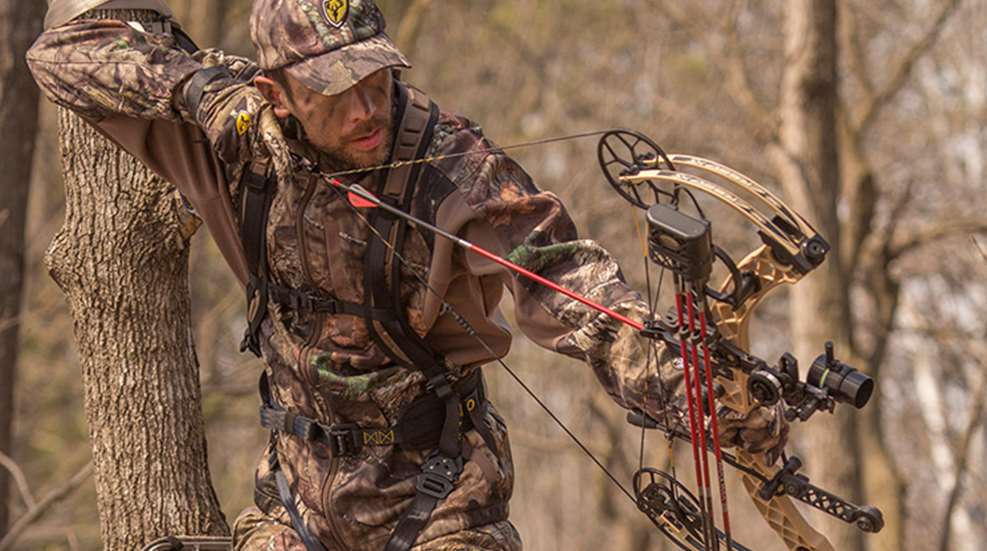
For example, many hunters fail to practice from elevated positions, and they aren’t prepared for shooting from a treestand when the time comes to kill a deer. If you merely lower your bow arm to accommodate for the downward angle, the relationship between your anchor point and the sight changes, and therefore the shot will be off. So, draw the bow normally as if shooting from the ground, find your anchor and lock your arm position. Then bend at the waist to align your sight with the deer and shoot.
Practice just like you hunt, which means wearing your hunting clothing during range sessions. Don’t go to Kansas in December wrapped in layers of camo you’ve never worn while shooting and then wonder why you miss a buck by 3 feet. If you’re going to hunt when it’s cold, don full winter clothing when you practice. Consider wearing an arm guard or a compression sleeve to prevent the bowstring from hitting your arm, and beware of binocular straps, zipper flaps and drawstrings that could snag.
Your bow can also be optimized for deadliness. This means doing away with fine, target-style accessories such as tiny peep sights. For hunting, a peep with a 3/16- or 1/4-inch aperture is best. Of course target archers will howl with disdain, but the reality is this: Your eye naturally centers the pin within any circle, but not if you can’t see it. Big deer tend to appear in low-light situations, and when combined with tunnel vision induced by adrenaline, a target peep sight will fade your vision to black. So install a large hunting peep, and keep both eyes open if possible to increase your situational awareness and depth perception.
Finally, consider where you aim on a buck. Many experienced hunters think 20- to-30-yard shots are toughest because they are close enough to startle the buck, but far enough away that he has time to duck. For these shots, bury the pin low in the chest, at heart level. This way if he ducks, you’ll have a double-lunger, and if he doesn’t, it’s heart. Either way, it’s a deadly shot.
Is Your Bow Too Fast?
Do you know why competitive smallbore shooters often use subsonic ammunition? It’s because match-grade ammo that produces muzzle velocities just under the sound barrier is often more accurate than faster loads. A similar phenomenon occurs with arrows. Blake Shelby from PSE believes there is a speed of diminishing returns at which arrows become less accurate when they’re shot with broadheads, even if the bow is precisely tuned. “Over the 280 fps mark, arrow flight can become erratic due to violent air disruptions caused by the broadhead in front of the fletching,” says Shelby. “So super-tuning becomes critical at those speeds—and the effort could even be wasted.”