Smartphone conversations aside, talking to someone without seeing them creates an uncomfortable atmosphere. It makes you attempt to adjust your position for a look behind the curtain. Whether they hide behind a veil of shadows or simply pull the Wilson, fence-blocking move as seen on weekly reruns of “Home Improvement,” you want to put a face with the voice.
For predator hunters, decoys provide that icebreaker. They give your toothy opponent a look at that noisy neighbor.
I noted that turkey and waterfowl decoys assisted my calling efforts. (I am sure they helped many of you, too.) After that, I outfitted myself with pronghorn, deer and elk decoys. They all added realism when conversing with or provoking big-game targets. It only makes sense to extend the deception to predators.
Getting Tough Out There
Twenty or 30 or more years ago, predators raced to the calls. They needed nothing more than the sound of distress to come looking for lunch. Although you can still experience that rush in the early season, during the heart of prime fur season, predators, mainly coyotes, think long and hard about rushing to any sound.
You can easily see why predators think twice nowadays. Sporting goods stores have aisles of predator hunting equipment to sell. Social media ignites with predator content after the first of the year and at least in my neighborhood, seeing or meeting other predator hunters in the field has become the norm, not the anomaly it was a decade or more ago. With the pressure ramping up and predators receiving Ivy League degrees in evasive moves, decoys could add another tricky play to your playbook.
Why A Visual?
Seeing is believing, so the saying goes. Hearing something could send a message of excitement, like the sound of the ice cream truck. Of course, hearing something, like a bump in the night, could also create a horrific vision. Seeing the ice cream truck or your cat leaping from a dresser confirms either scenario. And hopefully it was just your cat.
Realism ranks first in the reason to use decoys. Whether you utilize prey sounds or coyote vocalizations, the sight of the expected boosts confidence. Coyotes particularly need that encouragement, but even a sly bobcat watching a flitting, bouncing bird eventually lets out its inner housecat to pounce with conviction.
Predator decoys intrigued me early on, and I jumped at the chance to add a battery-operated rabbit to my setups. Although the technology was a bit sketchy then; when a coyote saw the vibrating bunny, the decoy almost always drew it closer. That stands as reason No. 1 to incorporate a decoy: Instill confidence and bring it closer. Even coyotes that have been hide branded with a V-Max near miss might drop their guard and slink in closer to investigate a fluttering decoy or yellow-eyed coyote copycat.
The next reason to utilize a decoy is to spark competition. This could be between any predator, but coyote hunters experience a run for the roses more often than other predator pursuits due to pack behavior. Adult coyotes have no aversion to a rivalry run toward dinner, but when you encounter a pack of pups-of-the-year and they observe an easy meal, Katie bar the door. Trouble is headed your way in the form of fast-moving canines. Several times multiple coyotes have rushed me in haste to compete for a dancing prey decoy or to confront a bold, trespassing coyote decoy.
Predator Or Prey?
Innovation rocks, especially with decoy technology built into numerous modern electronic callers. Many include remote operated sounds and decoy action complete in one package. E-caller decoys resemble wounded birds or rodents. You have the option to activate the decoy or power it off and go with sounds alone. Designs, like the combination Western Rivers Mantis Pro 100 and Mantis Pro Decoy open a world of deceit options.
Several companies also manufacture standalone prey decoys including rabbits, whitetail fawns and pronghorn fawns with popular lightweight options by Montana Decoy Company. These team well with an electronic caller void of decoy accessories and create the ideal partner for hand calls.
Top time periods to use a prey decoy include almost anytime, but consider these windows of opportunity. Early in the season, distressed sights and motion appeal to all young predators. Youngsters continue to hone their hunting skills and focus on an easy meal like a fawn or rocking rodent. This ruse can continue into early winter, but by midwinter a switch might be in order. Throughout most of the country, February marks coyote breeding season. Courting kicks off in January and by February coyotes have paired with breeding ensuing.
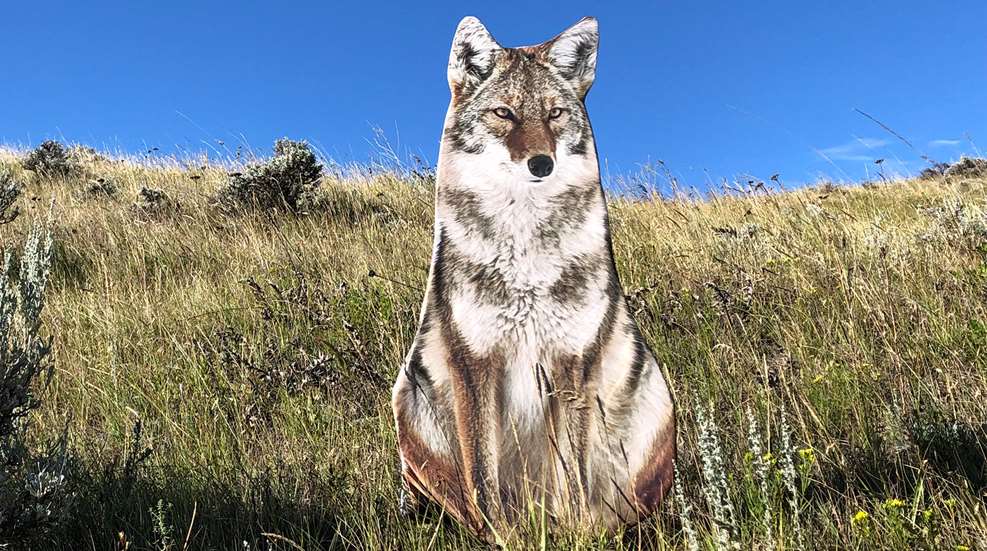
Coyote vocalizations and 3D or photo-realistic coyote decoys spark outrage among pairs with set territories. Coyotes still looking for a last-minute hookup may arrive to investigate and walk into the trap when they spy a fellow canine staring back at them.
As winter wanes, returning to a food source makes sense. In northern latitudes coyotes are at the end of a long winter and could be lean. In all environments the prey base has been depleted as Mother Nature prepares to restock the cupboards with bunnies, fawns, hatchlings and the likes. Plus, as denning commences, the male coyote becomes the primary provider until mom cannot stand the den disorder any longer with rowdy pups.
If you cannot afford a decoy, find a feather. A fluffy feather, the bigger the better, attached to a stake with lightweight fishing line is an attention grabber. When the breeze blows, it flutters. Make sure vegetation does not block the action or view for predators.
Where To Place Your Partner
The entire predator decoy plot revolves around making certain the decoy is seen. First, determine the wind. Your decoy acts like a steering wheel in combination with the wind direction. Also evaluate the surrounding terrain to determine the most likely approach a predator will make to your setup site. Now get your protractor out and measure wind angles.
With wind in mind and the theory that most predators approach with the wind in their face, determine if you wish to aim your firearm where the wind is blowing, or with the wind in your face. With a setup blowing toward your shooting lane, set the decoy approximately 100 yards upwind, making sure you have ample shooting openings on either side. A predator may race in straight with its nose in the wind, but odds are high it will approach from the side and circle. As it does, shoot before it hits the direct downwind alley.
Hunting with the wind in your face, set the decoy again approximately 100 yards away in an opening with good coverage on either side. Any predator will swing downwind with a high chance of crossing between you and decoy with all eyes on the fake intruder.
Decoys add another dimension to predator calling and possibly a way to increase the assurance that the scenario is as real as a stinky, road-killed deer.