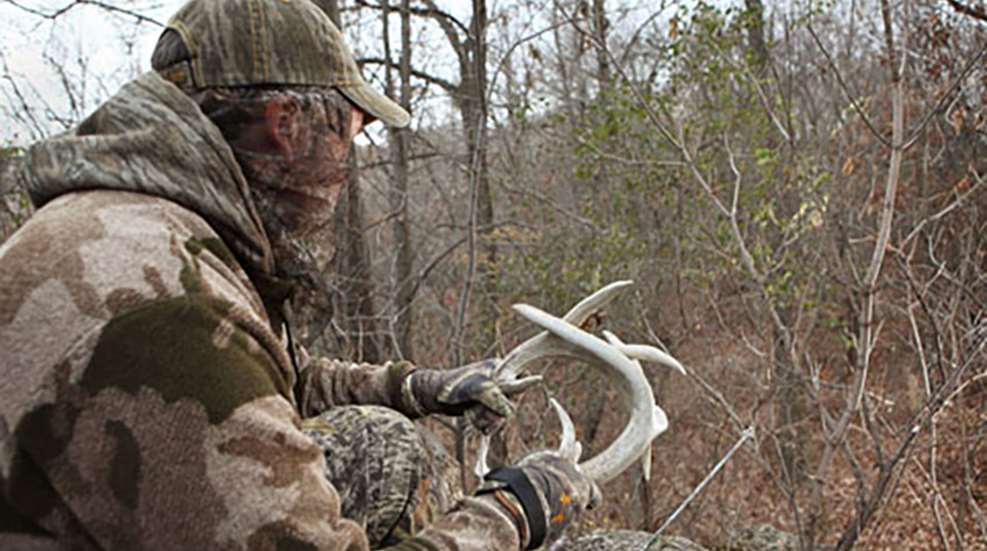
With this time of year comes some of the best whitetail hunting action in the country. Many hunters are content to climb into a stand and simply sit back and wait for a bruiser to walk by, which certainly can work. But to improve your odds and take a more active role in bringing in that buck try rattling to simulate a battle between bucks.
Rattling is nothing new. It’s a tactic that began decades ago in Texas and spread across the whitetail’s range, accounting for many fallen bucks over the years. Yet, grunting remains the primary strategy for many hunters, with rattling seen as ineffective or not practical in many areas. Not true. It can work anywhere, though there are certainly times and places where it can be more effective.
Whitetail biologist Mick Hellickson says the results of one study revealed rattling can be very effective during the rut. In fact, there was a two- to three-fold increase in response to rattling during the peak of the rut, when deer are actively breeding, over the pre-rut and post-rut. The downside was that most of the bucks that responded during the rut were not considered among the most mature deer of the area. Hellickson’s results showed more young or middle-aged bucks coming to check out the ruckus. If your goal is to bring in only the most mature deer, rattling during the pre-rut and post-rut is a better time—though you shouldn’t expect deer to come charging in like they do might during the peak.
Hunter’s Specialties Pro-Staffer Rick White says to not get discouraged just because it doesn’t work one day.
“One day I rattled in 12 bucks before 9 a.m. and next day I didn’t rattle in a single one,” said White, who once helped me rattle in a 146-inch Oklahoma whitetail from several hundred yards away.
On the opening day of Virginia’s firearm season two years ago, I rattled in a half dozen bucks, five of them smaller than what I wanted to shoot, but one of them now hangs on my wall. From that same stand, I have rattled repeatedly without a single response. Like any tactic, it doesn’t always work. But over the years, it’s proven too reliable not to try.
Basic Rattling Know-How
1. Check the Wind—A buck will almost always approach the sound of rattling (or any calling for that matter) from downwind, so try to set up in a way that disrupts that approach or makes him more visible as he enters the area. Set up at the edge of a field with the wind blowing into the field, or just upwind from a wide river, bluff or other hard to traverse area.
2. Take Cover—Don’t leave yourself exposed when rattling as a buck will be looking keenly for the source of the noise. He’s coming in on alert, not passively wandering. Many hunters rattle from in a treestand or rattle from a groundblind, while others, particularly ones looking to keep on the move, will simply set up on the ground. If attempting the latter, whether using a gun or bow, set up next to a deadfall or beside a large tree to break up your outline. Use brush for concealment, but not so much that you can’t draw or aim.
3. Sound Check—When rattling for the first time from a new setup, grunt a few times and tickle the antlers softly together. If a buck is nearby, it may come check the noise. Start out loud, and you’re apt to spook the deer and send him running the other way. Hit the antlers or rattling softly with a few grunts, before waiting a few minutes to see if anything shows. If all is quiet, begin a true sequence.
4. Start Slow—Bloodline’s Alex Rutledge notes that bucks don’t start out sparring with a single big crash of the antlers. Bucks size each other up first, sometimes grunting or even growling (a deep almost guttural grunt) and then push their antlers together, tickling them before building up in intensity. Do the same in your sequence, starting slowly at first, and working up in volume and aggression until you are smacking and twisting antlers together in a loud, echoing manner.
5. Make It Real—When fighting, bucks crash through brush and leaves, rake trees and grunt as they strain. Do the same, hitting the tree you’re against and raking leaves with your feet if on the ground. Keep a grunt tube in your mouth as you rattle and hit it periodically throughout the sequence.
6. Rattle Time—How long should you rattle? As noted, initial rattling should be of low volume and only last 10 to 20 seconds. Wait a couple of minutes and if nothing shows, jump into a more intense one to two minute sequence and wait at least 20 minutes before rattling again to give distant bucks time to make their way to you. When rattling right off a key bedding area, where a deer is apt to stand up within eyesight, keep sequences shorter, rattling 20 to 30 seconds at a time every four or five minutes—building up intensity with each new effort.
7. Keep Alert—Deer might be close and come running right in, or they might be cautious and come from a distance. Either way don’t let a successful rattle session end in getting busted. As you rattle and rake, stay alert to the sound of an rustling leaves, cracking brush and grunting, indicating that you have a visitor quickly approaching. Stop moving as soon as you hear or spot the buck and get ready for your shot, using the grunt call to coax him in the rest of the way if necessary. Most of the time it won’t be.
Real Antlers vs. Rattle Bag
Whether you use antlers taken from a past trophy or go with one of the manufactured rattling bags, both can be effective.
Real Antlers—These certainly can sound more realistic with a heavier clack, making them ideal when hunting exclusively for big bucks, in windy conditions or to make the sound carry, something outfitter Pat Gaffney with RAM Outfitters pointed out to me while recently attempting to rattle up a Minnesota bruiser. On the downside, they are more of a pain to carry because of their bulk, and if you don’t remove the brow tines, can mash your thumbs or palm when being used.
Rattle Bag—These sound just as real to a buck, are easy to pack because they are more compact and can be more discreet to use, because you can rattle with one hand if necessary. On the downside, they are less effective on windy days when you need more volume and they make it difficult to rake limbs and brush around you for that added realism.