A buck I’d left overnight gutted in the snow up a steep mountainside was gone. Just gone. Wait, a bit of hair, blood. I kneeled in the 18 inches of fresh December snow. My deer was there, some of it, under piled-up snow. There were claw marks in the snow where something had worked around the deer kicking up a pile of the stuff. There were coyote tracks in the snow all around the carcass. I didn’t know coyotes did this. Cougars bury kills, sure. But coyotes?
I pulled the buck’s head out of the snow. Its 8-point rack gleamed wet in the early rays of sun. I didn’t expect coyotes to find the buck on that mountainside on that cold December night. After I cut its head away I looked around and wondered, How much do coyotes affect deer populations?
Wildlife biologists are now finding some astonishing answers.
DNA of a Predator
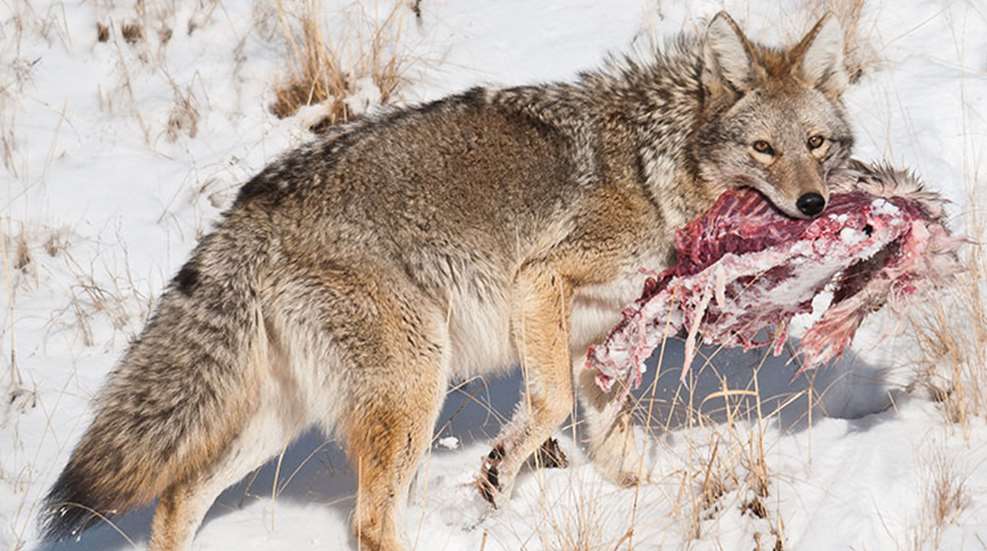
The Eastern coyote most deer hunters deal with is a coyote-wolf hybrid. The hybrid, or Canis latrans var., is larger than “pure” Western coyotes. It also tends to have longer legs, a larger jaw, smaller ears and a bushier tail. Still, the taxonomy is not simple and many biologists are debating this, as there are dog genes also involved in various hybrids hunting from the Canadian border to the Gulf of Mexico. Basically, while wolves were being exterminated in the eastern United States, coyotes began colonizing the habitat; as they did, they bred with wolves just enough to make them bigger and a little different than their Western cousins.
What this means to hunters is these larger coyotes can be more successful at hunting deer when certain factors are in their favor, but wherever they live, coyotes are opportunists.
How Coyotes Kill Deer
A study done in Yellowstone National Park in the early 1990s, before wolves were reintroduced to the park, found coyotes in deep winter preying on deer and elk. In one cited example, Eric M. Gese and Scott Grothe wrote they watched two coyotes “chase a lone adult female elk through a grassland” in 16 inches of snow. The “coyotes clasped their jaws onto the elk’s rump. The elk ran into deep snow at the base of a gully, struggled to get away, and went down. ... They fed on the live elk which frequently struggled to stand, but could not get up.” They later examined the tooth wear and bone marrow on the elk and determined it was a healthy 2-year-old.
Studies on coyote predation in Maine and Nova Scotia during bad winters have found that coyotes can have major, if localized, impacts on deer populations by running them into deep snow. A 1995 study concluded that coyotes account for about 30 percent of Maine’s annual deer mortality. In areas where deer yard up, coyotes can have a devastating impact on a herd.
Still, biologists haven’t found that predation on mature whitetail deer occurs enough to impact most herds. What can have a major impact on whitetail herds is coyote predation on deer in their first few months of life.
Biologists have found that coyotes can be particularly hard on fawns in the Southeast. In South Carolina, for example, a three-year study at the U.S. Forest Service’s Southern Research Station, a 300-square-mile area, found that only 16 of 60 radio-collared fawns lived past nine weeks—just 27 percent of the fawns lived that long. Researchers confirmed that coyotes killed at least 65 percent of those fawns and were probably responsible for 85 percent of the fawns killed. Other studies in the Southeast have found predation rates on fawns to be well over 50 percent.
Most other areas of the country don’t generally seem to be as affected by coyote predation on fawns.
“Results from several Midwestern and Northeastern studies indicate that coyotes are responsible for taking, on average, 10 to 20 percent of fawns,” says Dr. Karl V. Miller, a professor of wildlife ecology and management at the University of Georgia. “This level of fawn predation likely has minimal impact on the overall recruitment rates, particularly in highly productive herds.”
A comprehensive study of available research by Duane Diefenbach, adjunct professor of wildlife ecology and leader of the Pennsylvania Cooperative Fish and Wildlife Research Unit based at Penn State, found that in the East “an average of one in two [fawns] survives its first three months of life, which is when most mortality occurs. Predation by coyotes, black bears and bobcats accounts for most mortality.”
Though he found that half the fawns are being killed by predators, Diefenbach determined that the number of fawns that survive “generally is adequate to sustain nearly all populations.” He says, “Coyote predation—even at the highest levels reported—is not significant enough to cause deer populations to decline if doe harvests are reduced. In fact, in most places in North America, continued doe harvest is required to stabilize deer populations.”
Diefenbach and Miller both say that the only place where whitetails might not be able to maintain or grow their populations due to coyote predation is in areas of the Southeast.
A Predator-Prey Balance
So why the high predation rate in areas of the Southeast? Habitat might be the answer, as much of the areas being studied have been pine plantations. These areas often have little undergrowth beneath the trees. The pines are also planted in rows, which makes it easy for coyotes to walk the rows looking for fawns. (Anyone who has trapped coyotes will tell you coyotes love to walk on paths.)
What all the deer managers agree on is the coyote is here to stay. Many studies have determined that 75 percent or more of coyotes have to be removed from a population to cause it to decrease; in fact, in a coyote-saturated area, beta males and females actually might not breed unless available habitat with food sources opens to them.
For these reasons wildlife biologists recommend assessing your local deer herd to see if more than half the fawns are avoiding predation. If greater than half are being killed, the first thing to do is, if possible, create overgrown, brushy areas where fawns can hide. The next step is to hunt or, even better, to trap coyotes in the months before does drop their fawns. Studies have shown that fawn survival rates skyrocket when these two methods are successfully employed, but it’s not a one-year proposition. Coyote management is an annual problem—or, seen another way, it’s an annual benefit, as predator hunting is a challenging and exciting part of the cycle of the seasons.
Coyotes, after all, are an awesome part of the ecosystem. Last fall, when I was deer hunting on a cold December day, I heard footsteps loud on the ice-frozen leaves. Something four-footed was coming. Wait, there were two, no three of them. A rabbit I’d been watching in the briers under my stand dashed across frozen leaves. The incoming footsteps stopped. The rabbit hopped onto a stone wall and went silently, rock to rock, before disappearing beneath a log. The four-footed animals started again fast, and I saw them. They were three coyotes spread in a skirmish line. They started and stopped in unison, hoping to flush the rabbit. They moved right by me and missed the rabbit, and I was so intrigued I didn’t shoot any of them.