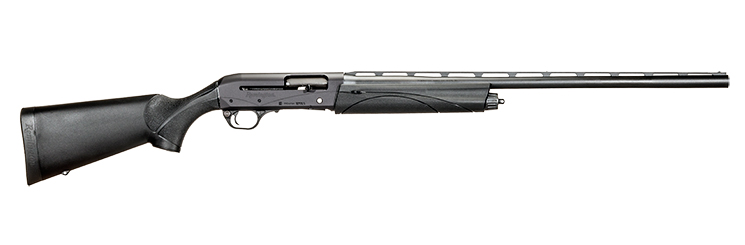
One thing you should know about me: I’m a Remington man. It’s a congenital trait. My father was a Remington man, and so was his father. Of course, like any young man trying to find his way, I rejected my lineage by taking up with the Turks and Italians for a few years. But when Remington introduced the Versa Max in 2010, I accepted my heritage. Much of what wooed me back to Remington with the Versa Max can now be found in an even more affordable, if not as versatile, package with the new Remington V3 Field Sport shotgun.
Much like the Versa Max, the semi-automatic V3 utilizes Remington’s unique Versaport gas-operated system, although in a new, upgraded version built on a slimmer, shorter receiver designed for 3-inch shells (vs. the Versa Max’s 31/2-inch capability). In case you’re not familiar with it, the Versaport design relies on the shell itself to regulate the amount of gas used to reliably operate the action. A 2 3/4-inch shell leaves all eight gas ports open, utilizing as much gas as possible to cycle the bolt. A 3-inch shell covers half of those ports, bleeding off the excess gas through a pair of compensators in the gas block. New to the design, the compensators are there to ostensibly further ease impact on both the shotgun and the shooter.
It was that significantly reduced recoil that hooked me on the original Versa Max. I’m not alone in believing it is one of the lightest-recoiling shotguns on the market, maybe even the absolute lightest, and I was expecting that same kind of shoulder-friendly performance from the V3. So, I was somewhat shocked when the V3 nearly leapt from my hands the first time I pulled the trigger on a Remington Nitro Pheasant No. 5 load at a going-away rooster. What I forgot was that a full pound of weight was missing from the Versa Max I am used to shooting, which makes the V3 a bit snappy with magnum loads.
Still, the V3 is a lot softer on the shoulder than an inertia-operated gun and even other gas semi-autos on the market, and I’ll take a bit of kick as a sacrifice for a lighter gun, especially at the end of a long day in the uplands. On a digital scale, the V3 weighs in at a hair under 7.25 pounds, putting it in the same class as Benelli’s venerable Montefeltro and the Browning Maxus. However, the location of the V3’s gas system just in front of the receiver, rather than stretching down the magazine tube, places the balance closer to the shotgun’s center point and presents an overall lighter, and more instinctual, feel.
As I expected, the V3’s most notable feature was its reliability. After going through several boxes of light 23/4-inch, 1-ounce target loads on the five-stand field, I stuffed the shotgun with those 3-inch Nitro Pheasant No. 5’s and took to the prairie for some late-season roosters. I’d like to say I performed as flawlessly as the V3, but I’m in the truth-telling business. There were plenty of misses until I got used to the balance of the lighter, weight-centered shotgun. However, in time, the V3 became natural to point and swung with much less effort than a standard, weight-forward semi-auto. (It also stopped quicker, a factor to which I attribute my early struggles.) Throughout several days of pheasant hunting and subsequent testing at the range, the V3 never hiccupped or failed to cycle.
It’s worth noting the V3 shoots surprisingly clean, too, thanks mostly to the self-scrubbing pistons. Should you feel the need to give the gas system a thorough cleaning, it’s easily accessible by removing the fore-end. The pins holding the pistons in place tap right out with a punch or nail.
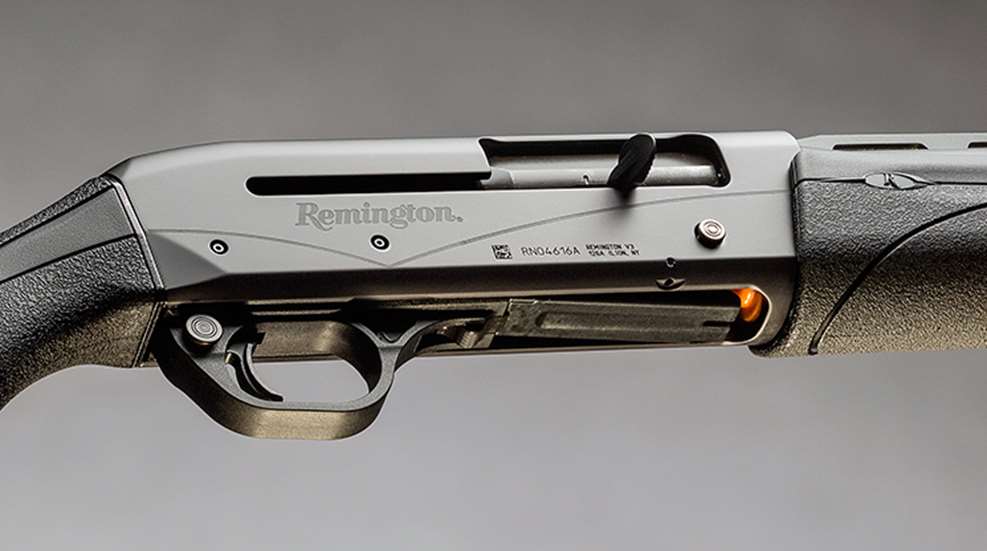
Other than the improved Versaport system, perhaps the coolest new feature of the V3 is a neat three-position magazine cutoff. A button ahead of the polymer trigger guard slides forward, locking the shell carrier in a middle position. This allows the hunter to shuck the shell in the chamber without feeding the next one—great for safe-handling practices when crossing a fence or passing the gun to a friend. Lock the carrier all the way up, and the magazine can be unloaded quickly without having to cycle the action repeatedly.
The V3’s synthetic stock is available in two choices of Mossy Oak camo—Blades for waterfowlers and Break-Up Country for turkey hunters—or, like the one I tested, synthetic black. Curvy panels of molded-in texture provide grip, and the buttstock has an integral sling-attachment point.
It’s natural to wonder where the new V3 Field Sport shotgun fits in Remington’s storied semi-automatic lineage. Officials at Big Green are quick to tell you it’s not a baby Versa Max, though it shares a lot of that gun’s technology. In terms of price, it falls closer to the 11-87 and in fact may be designed to fill a hole in the market between that gun and the more expensive Versa Max. However it shakes out, what is true is the V3 is a reliable, affordable semi-auto shotgun with an American heritage that could only come from Remington. ah
Technical Specifications:
• Type: gas-operated semi-automatic shotgun
• Gauge/Chamber: 12/3"
• Barrel: 26", 28" (tested); vent rib; threaded for choke tubes
• Sights: twin beads
• Trigger: 5-lb., 9-oz. pull weight
• Safety: cross-bolt
• Stock: synthetic; black (tested), Mossy Oak Blades, Mossy Oak Break-Up Country; LOP 14.25", drop at comb 1.5", drop at heel 2.44"
• Metal Finish: matte black (tested), Mossy Oak Blades, Mossy Oak Break-Up Country
• Overall Length: 49"
• Weight: 7.2 lbs.
• Accessories: 3 choke tubes (IC, M, F)
• MSRP: $895