Many if not most American hunters believe German hunting rifles are too expensive. Well, they are when compared to the typical mass-produced American hunting rifle. It’s more valid to compare them to the typical modern American custom rifle, consisting of a mass-produced factory action with the slop machined out, fitted with a lapped match-grade barrel, a “bedded” aftermarket synthetic stock and a new trigger. German factory rifles normally come with precisely made actions, match-grade barrels, well-bedded stocks and excellent triggers. That’s because Germans expect hunting rifles to work extremely well directly from the factory.
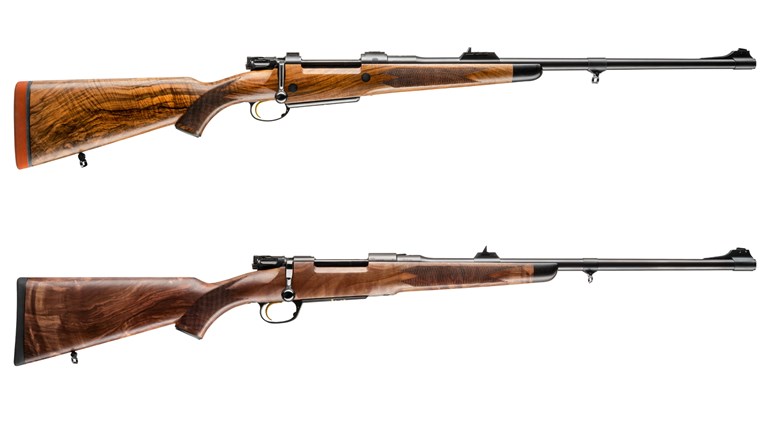
The new Mauser Model 12 made a favorable impression right from the start. Many European rifles require scope-mounting bases rarely found here, even by Googling the Internet, but the Model 12 actually uses bases made for—gasp!—the Model 98 Mauser, available from every manufacturer in America. With a well-proven Meopta MeoPro 6x42 in Leupold mounts, the rifle weighed an ounce over 8 pounds, a very nice weight for a walnut-stocked .300 Winchester Magnum.
Most American hunters favor three-shot groups these days, partly because we believe a hunting rifle’s barrel will warp if shot more than three times without allowing it to cool. This doesn’t happen, however, with a stress-free barrel, and several five-shot groups reveal more about a rifle’s accuracy potential. I fired five, five-shot groups with three different kinds of American factory ammo, and all the groups averaged 1.35 inches.
Three-shot groups normally are about two-thirds the size of five-shot groups. (This isn’t due to barrel warping, but the laws of chance.) For those shooters unfamiliar with five-shot accuracy, this means three-shot groups would average under an inch, with factory ammo. There was no tweaking of the stock bedding, adjustment of the triggers, and the stock screws were all tight. That’s how German rifles arrive.
The trigger pull had almost no creep or over-travel, and on a Timney trigger gauge averaged exactly the advertised 2 pounds, varying no more than 1 ounce. The trigger mechanism itself is a typical modern “enclosed” design with a couple of hex-head screws for adjustment, though none was needed.
A Hawkeye bore scope revealed the barrel to be as finely finished as hand-lapped American custom barrels. Even with close to 100 rounds fired without cleaning, only faint traces of jacket fouling appeared. The barrel is press-fit into the action, and the bolt’s six locking lugs fit into recesses in the rear of the barrel itself, instead of the action. No doubt both the fine barrel and press-fitting contribute to the fine accuracy.
The lugs are machined from the round bolt, and triangularly arranged in two rows. Some shooters used to two-lug bolt-actions with screwed-in barrels will probably whine about the 60-degree bolt lift, or not being able to have their local gunsmith change barrels. But the desire to change the chambering of your rifle every few months is far from universal, even in America, and if you happen to shoot enough to wear out a Mauser Model 12 barrel then you can also probably afford to send the rifle back to Germany for a replacement.
Triangularly arranged lugs typically distribute firing stresses more evenly than classic two-lug actions, also promoting accuracy, and they make scope-mounting easier. It’s common for bolt handles on two-lug actions to interfere with mounting exactly the scope we want, and with a 60-degree bolt lift this almost never happens. Yeah, a 60-degree lift gives up some leverage, but not enough to make any difference if we don’t shoot handloads that turn a .300 Winchester Magnum into a .300 Weatherby.
In several ways the Mauser Model 12 is more American than German, not surprising since it was designed specifically for the American market. The three-position safety strongly resembles the Model 70 Winchester’s, considered by many American shooters to be the best bolt-action safety ever designed—though it’s basically just a horizontal version of the safety on the 1898 Mauser.
Like the Model 70’s safety, the Mauser 12’s safety allows the bolt to be easily field-stripped. With the lever in the middle position (just like on the Model 70 Winchester) remove the bolt from the action. Push rearward on the spring-loaded plunger on the side of the bolt shroud then turn the shroud toward the bolt handle. The shroud and firing pin assembly essentially pop out, instead of taking several screw-turns to remove as on the Model 70 and 98 Mauser.
The spring-loaded extractor resembles the post-’64 Model 70 Winchester’s, but there are two plunger ejectors. During development of the action, occasional ejection problems arose due to empty cases not flying out at quite the right angle. The solution was a pair of ejectors to precisely flip cases in the same direction, every time.
Some purists will also probably object to the cast aluminum floorplate with a detachable polymer magazine. However, both contribute to the rifle’s relatively light weight, and the stock is shaped in the “classic” American style. It won’t fit everybody, but I’m a rather typical American male with a relatively short neck and square shoulders. Even the relatively light .300 Winchester Magnum was comfortable to shoot, partly due to the soft recoil pad.
The wood wasn’t extra-fancy, but with the rather thick finish over the surface, the grain shows up nicely. The 24-line-per-inch checkering’s very good, with only a few flat-topped diamonds and no run-overs, and appears in four panels on both the fore-end and grip for thorough coverage.
Rounds could either be dropped on top of the cartridge follower for single-loading, or pushed into the top of the magazine—not always possible with detachable magazines. And yes, ejected cases all went in precisely the same direction, and checking the trigger pull after the tests resulted in exactly the same results. Good adjustable open sights can be ordered as an option, and they’re high enough to work reasonably well with the high-combed stock, which slopes down slightly from heel to comb.
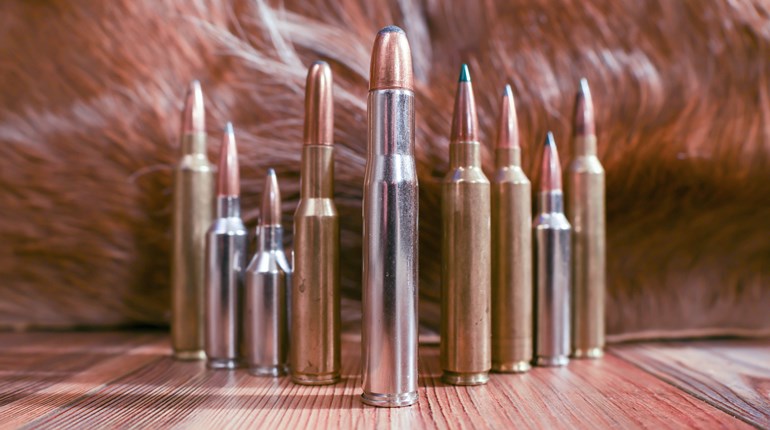
Aside from the usual American suspects from .22-250 Remington to .338 Winchester Magnum, both rifles are also available in four traditional European cartridges: 6.5x55, 7x64, 8x57IS and 9.3x62. If I were going to buy one of the rifles for heavier game, the choice would be the 9.3x62 rather than the .338. I’ve been hunting with a 9.3x62 for more than a decade now, and it’s pretty much replaced my .338 Winchester Magnum and .375 H&H Magnum for animals larger than deer, because it’s just as effective but recoils noticeably less—and my 9.3x62 weighs only 8 pounds scoped.
Yes, the Mauser Model 12 costs more than the average walnut-stocked American factory rifle, but that’s because it’s made more like a custom rifle.
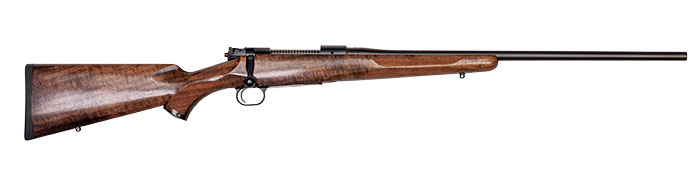
Technical Specifications:
Type: bolt-action, centerfire repeating rifle
Caliber: .22-250 Rem., .243 Win., 6.5x55, .270 Win., 7x64, 7mm Rem. Mag., .308 Win., .30-06, .300 Win. Mag. (tested), 8x57IS, .338 Win. Mag., 9.3x62
Barrel: 22" (std.), 24.5" (mag.); 6-groove, 1:10" RH twist; carbon steel
Trigger: 2 lbs., adjustable
Magazine: detachable box; cap. 4 rnds.(std.), 5 rnds. (mag.)
Sights: none (optionally available); drilled and tapped for Mauser Model 98 bases
Safety: horizontal, 3-position Smooth-Roll (SRS)
Stock: oil-finished walnut (synthetic is optional); LOP 145/16"; drop at comb 1/2"; drop at heel 1/4"
Overall Length: 44.375"
Weight: 6 lbs., 14 ozs.
Metal Finish: matte black
Accessories: none
MSRP: $1,799 (wood stock), $1,499 (Extreme synthetic stock)