“Buy the best scope you can afford” is good optics advice because you almost always get what you pay for, but what if you have only a couple hundred dollars to spend? Surely you’re not going to miss a season while you save for a scope that you can’t currently afford. No, you’re going to look for something in your price range, and you may be surprised at what you’ll find in the KonusPro M-30 2.5X-10X-50mm riflescope, which is available at many retailers for about $220.
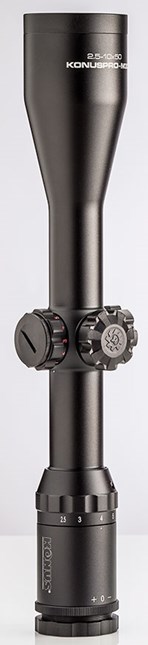 Based in northeastern Italy, Konus is a family-operated company formed in 1979 to provide optics such as telescopes and microscopes to researchers, teachers and inquisitive consumers. Ten years ago founder Giuseppe Alberti expanded into the hunting market by offering riflescopes, and now the company’s seven KonusPro lines include almost three-dozen fixed- and variable-power models at prices within most budgets. The new 2.5X-10X-50mm M-30 strikes me as a good general-purpose big-game scope, and its features reveal Konus and the Alberti family have a solid grasp on what American hunters want.
Today’s market shows that deer and elk hunters are increasingly drawn to scopes with a 30mm maintube, 50mm objective lens and fast-focus eyepiece, and the M-30 I tested has all these characteristics. You won’t have to compromise in these major areas to stay within your means. Nor will you have to sacrifice durability, as the M-30 is guaranteed to be waterproof, fog-proof and shockproof. It’s backed by a lifetime warranty; if the scope leaks, fogs or breaks under normal use, Konus will replace it.
Lenses are fully multi-coated. “Multi” means at least two but could be many more, and Konus doesn’t specify how many coatings it applies. The best way I could judge the quality of the M-30’s coatings and glass was to compare the view through it to that of other scopes with the same specs. I purposefully chose two models with suggested retail prices that were higher than that of the M-30 to see what a hunter would surrender, if anything, by going with the lower-priced scope. One of the comparison models cost $130 more than the M-30; the other was $680 more.
During midday under an overcast sky, I couldn’t see much difference in light transmission between the three scopes. Images presented by the M-30 appeared to be just as bright as those of the other two models. As light dwindled toward evening, the M-30’s view seemed to grow darker at a faster rate than the higher-priced scopes, but it was still bright enough to make a shot 30 minutes after sunset—the end of legal shooting hours in many states.
I noticed the biggest differences in contrast and sharpness during the test, and the more expensive scopes distinguished themselves in these areas. The edges of white letters
on black road signs 75 yards away weren’t as crisp when viewed through the M-30, and the detail in the gray bark of willow trees at 100-200 yards wasn’t as defined. To be practical, though, you’re not likely going to need this level of resolution in a riflescope, as a binocular is a much better observation device. More resolution is always a good thing if you can afford it, but you’re not looking to count hairs when you point your rifle at a buck. The M-30 will show you the contours of his anatomy and help you find a place on his hide at which to aim, and that’s usually sufficient in the precious seconds you have to make the shot.
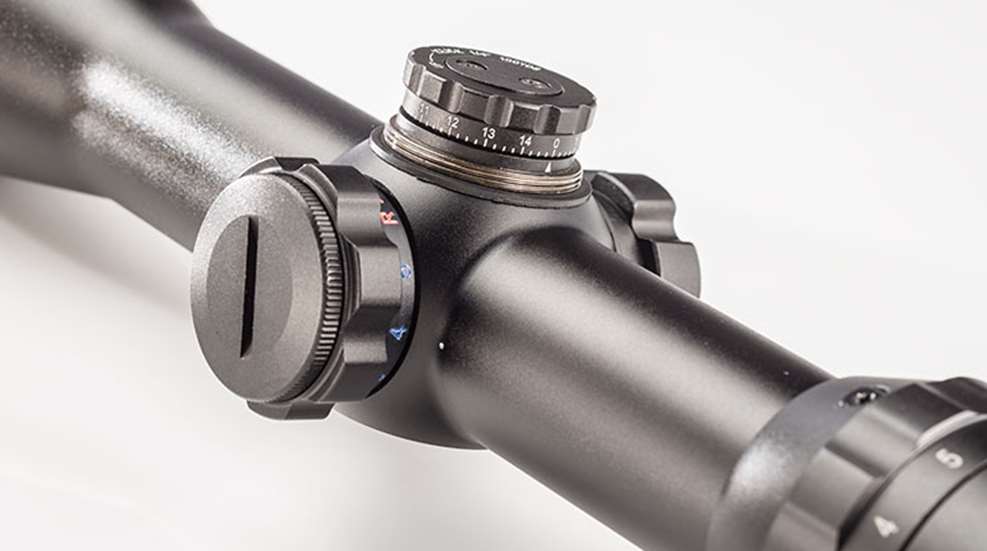
The M-30 further helps you direct a bullet with its illuminated reticle. The design follows the familiar stepped configuration, with the inner 15 percent of the crosshair being narrower than the rest. A dot serves as the central aiming point, and a rheostat on the left side of the scope provides five levels of illumination—in both red and blue. I was puzzled by the blue feature; it doesn’t appear as bright as red and seems unnecessary. But then I thought of a friend who is red/green colorblind—red colors look black to him—and realized hunters with the same condition might find blue illumination very useful.
Lower-priced scopes usually expose their weaknesses when it comes time to make adjustments. They don’t track accurately or consistently. Initially, the feel of the M-30’s adjustments didn’t give me confidence. Each .25-inch click was audible, but there was some turret slack to the left and right of each tick mark on the dials. Nonetheless, the turrets moved the crosshair precisely over 96 clicks of windage and elevation. When shooting a 24-inch box drill with a Bergara B-14 in .270 Win., the final group landed virtually on top of the first. Then I rotated each turret three full turns and returned to zero by alternating rotations between windage and elevation. Again, the group I shot after the adjustments covered the initial one.
The KonusPro M-30 2.5X-10X-50mm gives you a clear view of the target in shooting light, provides a well-defined aiming point with accurate adjustments and is built to withstand the elements. In practical terms, it meets the needs of most big-game hunters at a price hundreds of dollars less than other riflescopes. I call that a value.
Technical Specifications:
• Type: variable-power riflescope• Magnification: 2.5X-10X
• Objective Lens Diameter: 50mm
• Eye Relief: 3"
• Exit Pupil: 14mm (2.5X), 5mm (10X)
• Field of View @ 100 Yds: 37.3' (2.5X), 9.4' (10X)
• Reticle: second focal plane; 30/30 w/illuminated center dot
• Adjustments: .25"
• Coatings: fully multi-coated
• Dimensions: tube diameter 30mm; length 13.3"; weight 21.6 ozs.
• Construction: one-piece aluminum tube; CR2032 battery-powered rheostat; waterproof, fog-proof, shockproof
• Accessories: flip-up lens covers
• MSRP: $349.99