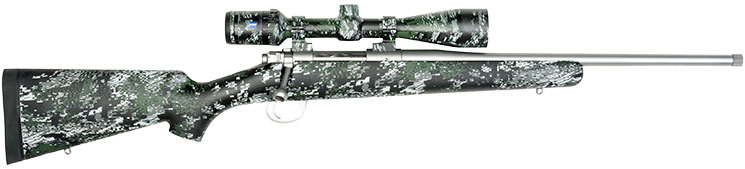
Two hundred yards is a long way to crawl on hands and knees, let alone squirm on your belly. The afternoon stalk through the sparse vegetation of Namibia’s Central Plateau gave me plenty of time to consider the rifle that I was trying my best to keep out of the red sand. Although this particular bolt gun at first seemed an unlikely choice for a safari—it was named for a mountain range in upstate New York and designed for hunting heavily timbered terrain—the minimal dimensions and balance of the Kimber Adirondack proved an easy-handling rifle has a place on any continent.
To be sure, the Adirondack is decidedly a woods rifle meant for hunting whitetail deer and black bear in the eastern United States, but it’s at home in any environment that complicates the act of carrying a rifle, let alone taking a shot. With an 18-inch barrel and a weight of just 4 pounds, 13 ounces (when chambered for .308 Win.), the rifle gives up some velocity in favor of maneuverability on par with classic lever-actions. With an overall length of 37.25 inches, the Adirondack is the shortest rifle in Kimber’s lineup, and it’s also among the lightest.
The Adirondack’s design is in many ways similar to the company’s Montana and Mountain Ascent rifles. All three take advantage of scaled actions, thin barrels and feather-like stocks to make for easy carrying. Kimber builds the Adirondack on the petite 84M receiver, which is CNC-machined from stainless steel bar stock to dimensions just large enough for the .308 Win. family of cartridges. The two-lug bolt has a Mauser-style claw extractor for controlled-round feeding from the Adirondack’s four-round blind magazine.
Wide, spiral fluting on the bolt body and a hollowed bolt handle knob reduce some weight but are largely aesthetic; the Adirondack bolt weighs only .81 ounce less than that of the 84M Montana. That said, it is by removing fractions of ounces here and there, as well as shortening the barrel, that Kimber is able to arrive at a rifle weighing less than the Montana.
No doubt the fluting on the bolt will turn heads, but it also introduces a minor flaw. As with all 84M actions, the lugs on the Adirondack’s bolt ride twin opposing rails machined into the internal walls of the receiver. The blade ejector, pinned to the bottom of the receiver’s left side slightly behind the ejection port, brushes the bolt during cycling. The spring-loaded ejector moves up and down as it travels across the fluting, which makes the bolt cycle feel slightly bumpy. This drawback is manifested more in perception than function, as the Adirondack fed and ejected rounds without fail during testing, but I still prefer a bolt that feels slick when it’s cycled.
Two things that haven’t changed from previous 84M rifles are a three-position, Model 70-style safety and a crisp trigger. Although Kimber specifies a trigger pull weight of 3.5-4 pounds, the trigger on my test Adirondack broke at 4.5. Since the trigger is adjustable this isn’t a big deal. The important thing is the trigger on the test rifle broke consistently with no creep.
The most distinguishing feature is the stubby barrel, which has a light sporter contour and is threaded at the muzzle to accept a brake or suppressor. It starts with a diameter of 1.05 inches just ahead of the recoil lug, tapers to .67 inch at its midpoint and, except for the one on the .300 AAC Blackout version, measures .59 inch near the muzzle behind the thread. The Blackout barrel flares near the muzzle to provide enough diameter for a 5/8x24 thread, the industry-standard pattern for .30-caliber barrels that permits direct attachment of thread-on suppressors. The other barrels have a 7/16x28 thread, which accepts a muzzle brake similar to the one Kimber provides on the Mountain Ascent or a 5/8x24 thread adaptor. Both are optional; the Adirondack comes with a thread cap.
More than any other feature, the Adirondack’s abbreviated barrel characterizes it as a “brush” gun. The odds of a barrel hanging up while plowing through rhododendron or it coming to a jarring stop against a sapling while swinging on a deer are directly related to its length. Of course the Adirondack’s shorter-than-average barrel means slower velocities, but the ranges at which most shots are taken in heavy undergrowth make this loss practically negligible. It’s a fair tradeoff, especially considering the speed at which the bullet travels means nothing if the rifle snags and the bullet never leaves the bore.
Besides its short barrel, the Adirondack owes much of its weight savings to its stock. Like its lightweight Kimber predecessors, the Adirondack wears a synthetic stock made of Kevlar and carbon fiber. It offers aluminum pillars fore and aft of the action and glass bedding in the recoil lug area to enhance accuracy. Including the polymer buttstock spacer and 1-inch Pachmayr Decelerator recoil pad, the stock weighs a hair more than 1.5 pounds. The major difference between it and other Kimber synthetic stocks is the W.L. Gore Optifade Forrest digital-camo finish.
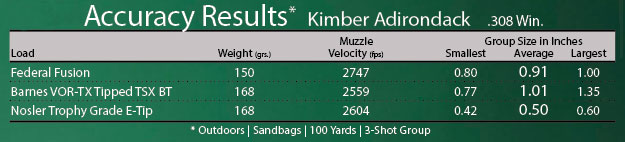
Kimber guarantees the Adirondack will produce sub-MOA, three-shot groups in the hands of an experienced shooter using quality factory ammunition. My test rifle lived up to that promise, shooting several groups with three brands of ammo that measured well under an inch.
But where the Adirondack truly excels is in handling. It’s easy to keep at the ready whether side-hilling up a steep hollow, ducking under and around laurel, or sliding over sand on one’s softer parts, as I discovered in Namibia. PH Jamy Traut and I eventually closed to within 60 yards of the skittish springbok, and the Adirondack came quickly to my shoulder—just as it will this fall in the mountains where flighty whitetails are the game.
Technical Specifications:
• Type: bolt-action centerfire rifle
• Caliber: 6.5mm Creedmoor, 7mm-08 Rem., .300 AAC Blackout, .308 Win. (tested)
• Barrel: 18"; stainless steel; 4 grooves, 1:12" RH twist; threaded muzzle
• Trigger: single-stage, adjustable; 4.5-lb. pull weight
• Magazine: internal blind box; 4-rnd. capacity
• Sights: none; drilled and tapped for optics
• Safety: three-position wing
• Stock: Kevlar, carbon-fiber composite; W.L. Gore Optifade Forrest finish; LOP 13.63"
• Overall Length: 37.25"
• Metal Finish: matte stainless
• Weight: 4.81 lbs.
• MSRP: $1,768