Released just in time last year for me to take aim at December teal in Venice, La., the latest addition to the Hevi-Shot family, Hevi-X, is a compressed-tungsten waterfowl load for the masses. No doubt most hunters are familiar with the use of tungsten in turkey loads; modern iterations contain shot that typically has high tungsten content, somewhere in the range of 90 percent. The reason: tungsten is dense, and it provides the mass needed to deliver lethal energy with smaller shot. Tungsten is also a federally approved alternative to lead, making it a perfect choice for waterfowl hunters.
So why not load compressed shot with high tungsten content for waterfowl? The simple answer is price. A 90 percent tungsten load would cost too much to shoot in volume. The original Hevi-Shot, with what’s considered high tungsten content for waterfowl loads and a density somewhere in the realm of 12 grams per cubic centimeter (g/cc), can price more than a few hunters out of the game. Hevi-X is the alternative: a mid-range tungsten-based load that has a much higher density than steel, performance characteristics closer to lead and a price tag that waterfowl hunters, even cheap ones like me, can be happy with.
While I couldn’t wrangle the exact recipe from the cooks at Environ-metal, I was able to glean some insight as to the density of Hevi-X shot and its potential energy on target. The makeup of the shot is a proprietary recipe consisting of tungsten powder mixed with polymers, and it’s regarded a grander secret than the Colonel’s fried chicken. The density of Hevi-X is also proprietary, but the folks at Environ-metal say it’s closely comparable to the density of bismuth, which is about 9.8 g/cc. Standard steel shot, on average, has a density of only about 7.86 g/cc and a mass of around 3.55 grains per No. 2 pellet.
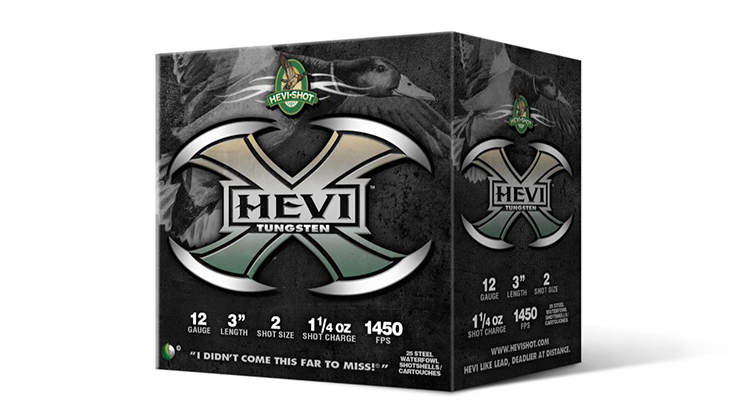
My math says each No. 2 steel pellet traveling out of the barrel at 1450 fps produces about 17 ft.-lbs. of kinetic energy. That’s a tried-and-true mallard slayer all day long. An “average” No. 2 Hevi-X pellet, with an approximate density of 9.8 g/cc and a mass of 5.72 grains, pushed out of the barrel at 1450 fps carries a whopping 27 ft.-lbs. of energy.
Now, it’s important to note that due to the non-uniform shot size of Hevi-X, the “No. 2” pellets I measured varied in mass from 2.7 grains all the way up to 7.5 grains, with the majority being 4.9-7.5 grains. That variation provides an average kinetic energy of 27 ft.-lbs., but the load’s larger, 7.5-grain pellets, of which there are plenty, deliver upwards of 35 ft.-lbs. of energy. That’s more than double the energy steel No. 2’s produce, and because of these pellets’ density, they will deliver more energy at greater distances than similar-size steel, too. If you need more debate than that, well, you’ve got a stubborn waterfowl hunter’s blood running through your veins.
The awesome energy of Hevi-X allows us to scale down pellet size, and in turn, increase the number of skull-cracking pellets we send skyward with each shot. Say you shoot steel BBs at geese. Hevi-X No. 2 loads produce adequate kinetic energy, increase pellet count and pattern density, and are giant goose showstoppers. If you shoot No. 2 steel for ducks, switch to Hevi-X No. 4 for the same reasons to bag a strap full of sprigs.
It’s imperative to consider the hardness of tungsten-based shot and what that may do to your gun’s barrel. Tungsten is harder than steel, and it can destroy barrels, especially in older guns. Do not shoot Hevi-X out of those guns. Modern waterfowl shotguns, with barrels designed for harder-than-lead steel shot, can handle the blend, though repeated use will still wear out your barrel faster than a blue-wing over a bayou duck blind. To combat this, Hevi-X utilizes a beefy, thick-hulled, full-length wad that protects your barrel as the shot exits.
Hevi-X sits right at a sweet spot where performance and price meet to offer the average waterfowl hunter a premium shell he can afford to shoot. You should be able to increase your distance and trust that a good hit with Hevi-X is going to result in a bird in hand. Way to go, Hevi-X, you’ve just made shotshell snobs of us all.
Technical Specifications
• Gauge/Length: 12/2¾″, 12/3″ (tested), 12/3½″ (tested), 20/3″
• Payload: 1¼, 1⅜ ozs. BB, No. 2, No. 4
• Pellet: compressed tungsten alloy
• Muzzle Velocity (advertised fps): 1450 (12/3″), 1500 (12/3½″)
• MSRP: $28.99-$39.99 per 25 rnd. box; hevishot.com