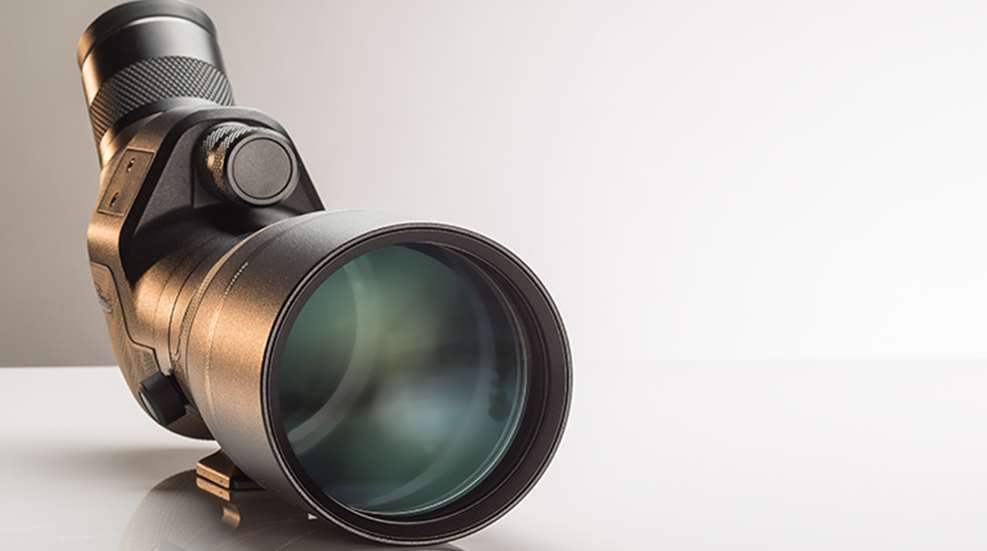
I’d say my eyes aren’t what they used to be, but that’d be a lie—I’ve worn eyeglasses since the tender age of 9. My eyes were never any good. So picking out game animals—what with their nasty habit of blending into natural terrain—at extended ranges has always been something of a challenge. Fortunately, like many hunters before me, I discovered the spotting scope. Perhaps the epitome of the “don’t think you need one until you’ve used one” accessory, spotters can be a game-changer, be your target furry or papery in nature. Burris’ new Signature HD Spotting Scope is one of the latest pieces of glass available to consumers, and also serves as a return to the marketplace of sorts for the Burris brand.
Namesake Don Burris, who’d gotten his start as a design engineer for Redfield, originally founded the Colorado-based company in 1971. Over the decades, Burris became known and respected for its hunting-driven optics, and produced, among other things, the first constantly centered, non-magnifying reticle in variable-power scopes. In 2002, Burris was purchased by the Beretta Holding Company, and joined a growing group of brands. A few years later, in 2008, fellow optics manufacturer Steiner was welcomed to the same family.
In time, Steiner and Burris began to work as sister brands, each company making use of the history and areas of expertise the other offered. Four or five years ago, the idea of sharing customers was floated, and Burris dropped its observational equipment lines, instead focusing on riflescopes and red-dot sights. The idea: Burris fans that needed those products—notably binoculars—would turn to Steiner. It didn’t work out that way. Burris’ customers remained loyal to the Burris brand. The company caught flack about dropping product lines, and consumers didn’t necessarily turn to Steiner by default. So Burris decided to re-enter the observational market with the addition of two new product lines: Droptine and Signature HD. Both include binoculars, and the Signature HD series sports the spotting scope in question.
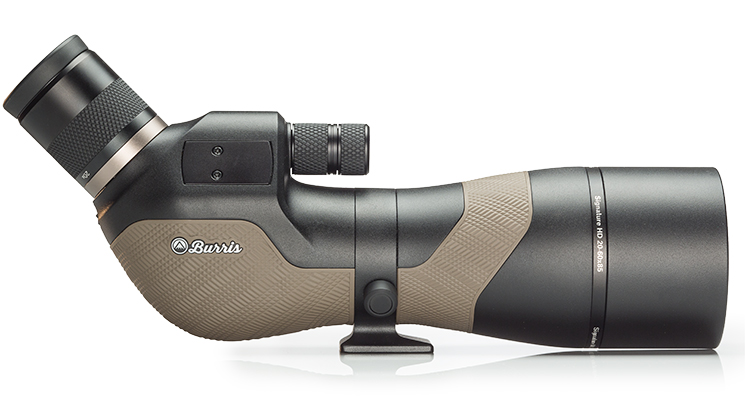
On the surface, the Signature HD offers a 20X-60x magnification range, a lightweight, durable die-cast magnesium body, an angled eyepiece, HD lenses and an apochromatic lens system. Burris has also thrown in a few perks in the form of an attachment for the company’s FastFire red-dot sight and a neoprene carry case and protective cover.
You might be wondering what Burris means by HD lenses—given that “high definition” is a term more often applied to televisions nowadays. It’s largely marketing jazz—folks know that HD typically means high quality, so Burris went with it. It’s actually ED glass, which means extra-low dispersion. I don’t want to bore you with a science lesson, so I’ll keep things simple. When light hits a prism—like the prism found in any sporting optic—it’s broken up, or dispersed, into its component colors, all of which travel on their own wavelength. That can be problematic if you’re looking through a binocular or spotting scope at extended ranges, because your wavelengths aren’t all arriving on a common focal plane. Color becomes inconsistent, and the image resolution suffers. If you’ve ever used an older or lower-end bino, you probably know what I’m talking about. The optics industry calls it color-fringing. Extra-low dispersion glass is designed to counteract that trait. ED glass makes use of an apochromatic lens system to bring three of the most common wavelengths—red, blue and green—to a common focal plane. The result is a clearer, crisper image with fewer aberrations. ED glass was once exclusive to high-end optics, but has become something of a staple in recent years.
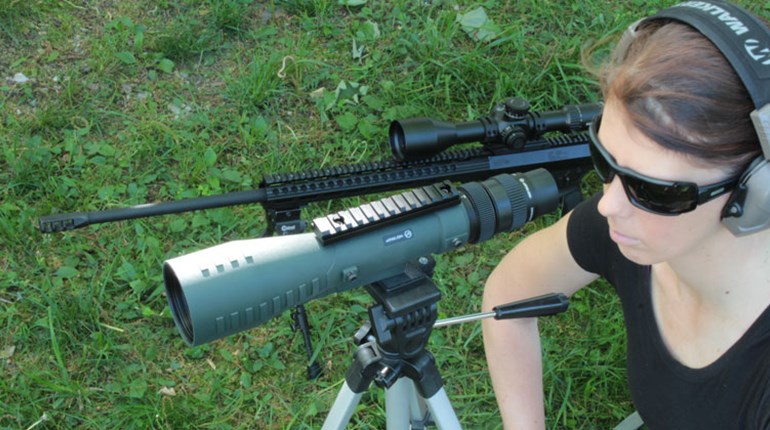
And sharp the Signature HD’s picture is: I experienced no aberrations, even at extended ranges, and was impressed with the clarity it provided. The remaining physical attributes of the spotting scope are just as commendable. The body is armored and built to take a reasonable beating, which is always a risk afield. The armor is textured and easy to handle. It has been argon-gas purged to keep it waterproof and fogproof. A built-in sunshade reduces glare and is meant to protect the objective lens from precipitation. The FastFire mount is a nice perk. Mount Burris’ popular little red-dot on the side of your spotter and you won’t be struggling to find your target through the magnification. Use your naked eye to put the red dot as close as you can get to your intended target, and then look through the angled eyepiece of the scope. You’re either going to be on target, or very close. Fixed, 30x eyepieces are sold separately, including models with mil and MOA reticles, in the case that you want to pair your spotter with a favorite riflescope. The whole package weighs a little over 4 pounds.
Though the Signature HD Spotting Scope isn’t budget-priced, it’s also not budget-built. It pairs good glass with a feature-packed body, resulting in a strong return to the observational market for the Burris brand.
Technical Specifications:
• Type: roof-prism spotting scope
• Magnification: 20X-60X
• Objective Lens Diameter: 85mm
• Focusing Range: 30'-infinity (20X), 33'-infinity (60X)
• Eye Relief: 20mm (20X), 18mm (60X)
• Exit Pupil: 4.25mm (20X), 1.4mm (60X)
• Field of View @ 1,000 Yds: 105' (20X), 54' (60X)
• Coatings: fully multi-coated
• Dimensions: length 15.3"; width 3.84"; weight 67.2 ozs.
• Construction: die-cast magnesium body w/rubber armor, HD glass lenses; Schmidt-Pechan prism; angled eyepiece; argon purged; waterproof, fogproof
• Accessories: lens covers, neoprene carry case, carry strap
• MSRP: $1,895