I remember the first time I went black bear hunting. I had heard all the stories about bears and bear attacks, about how black bears were giant, rough-and-tumble animals that could take your best shot and keep coming. Being young and inexperienced, as well as somewhat lacking in funds, I had few rifles from which to choose and no option for buying a new one. So I brought along a battered old pre-64 Winchester Model 70 in .30-06, stuffed with some handloads featuring the 180-grain Nosler Partition bullet. It proved to be a wise decision.
I was on a spot-and stalk hunt in western Montana, a trip on which I saw far more elk and mule deer than I did bears. When I finally got my chance, I shot a medium-sized bear (about a 200-pounder) at 150 yards. He didn’t go 75 yards before piling up.
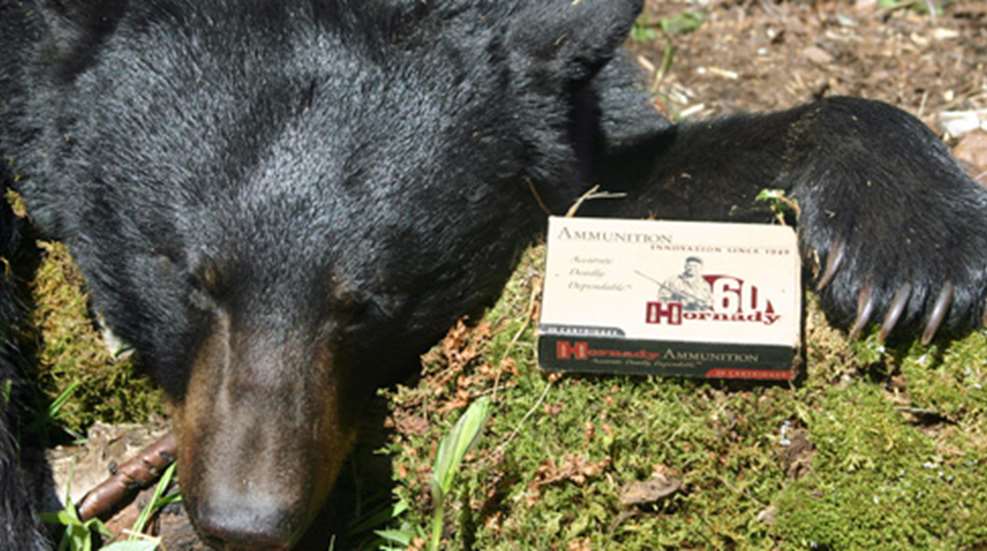
Since that time I have seen something in the neighborhood of 75 black bears taken with firearms of all shapes, sizes and descriptions. The two largest calibers I’ve seen used are the .375 H&H Mag.—not an uncommon occurrence in Alaska or British Columbia—and .338/.378 Weatherby Magnum, an incredibly powerful, flat-shooting cartridge as suitable for hunting small automobiles as big game. The smallest was a .243 Win., used by a Rocky Mountain deer hunter who happened to have a bear tag in his pocket when we glassed a bear one crisp fall afternoon. After all that, I’ve come to believe that black bears are not indestructible tanks that can take shot after shot and keep going. There are much tougher big-game animals out there. But bears are bears, and a poorly hit bear that escapes into thick cover and must be tracked is a scenario to be avoided.
Match the Cartridge to the Hunt
Generally speaking, black bears can be cleanly taken with most standard deer-hunting cartridges. The prudent sportsman will make his final cartridge choice based on the specific hunt he will be taking. Considerations include the type of hunt, the terrain, and the size of the bears expected to be encountered.
First off, all black bears are not created equal. The average bear taken on many central Canadian bait hunts weighs maybe 150 pounds. These bears are nothing like the 300- to 450-pound beasts taken on the Alaskan and British Columbia coast, or the huge-bodied bears found in more southerly states like California and North Carolina, where 800-pound bears have been weighed on certified scales. Bigger bodies are better taken with larger bullets and more kinetic energy.
Bears hunted on spot-and-stalk hunts or from tree stands and ground blinds overlooking large cornfields should be hunted with a flat-shooting cartridge that permits precise bullet placement at extended distances. This is especially true in areas where the escape cover is as thick as coastal fog. On the other hand, where shots will be short—this includes most bait hunts and when you are following hounds, where shots will probably be less than 30 yards—using a medium-velocity cartridge featuring a large-caliber bullet that makes a big hole makes more sense.
Specific Cartridge Choices
Regardless of the size of the bears being hunted, in my mind, the minimum cartridge should be some sort of .25 caliber—.25-06 or .257 Wby. Mag.—using bullets weighing between 117- and 120-grains. Cartridges in the .270/.30-06/7mm Mag. class are better, and excellent for bear hunting coast to coast. However, I personally prefer .30 caliber-and-up for the larger wound channel these rounds create. These include the .308, .30-06, and the various .300 magnums.
There’s really no reason to use more powerful cartridges unless you simply want to.
Perhaps the best overall black bear cartridges I have personally used are considered “tame” by some experts. These are .348 and .358 caliber cartridges like the .348 Win., .358 Win. and .35 Whelen, rounds that use relatively heavy bullets with a large frontal section traveling at medium velocity. At the ranges where most bears are taken—200 yards and under—this combination produces a wallop that really gets their attention and a big hole that facilitates blood trailing.
On hunts where you have to move quickly, and the shots will be short—hound hunts come immediately to mind—a light rifle that’s easy to carry makes sense. Many rifle hunters choose light lever-action rifles chambered for classic cartridges like the .30-30, .300 Savage, .348 Win. and .358 Win. These rifle/cartridge combinations are also excellent choices for most bait hunts.
What About Bullets?
Regardless of the type of bear hunt I am on, I always use stout bullets. There are so many high-quality “premium” bullets on today’s market that finding one designed for both controlled expansion and deep penetration is easy as pie. Black bears have legs like steel pipes and thick, dense shoulder, back and leg muscles. These bullets are designed for maximum penetration while retaining a high percentage of their original weight, a superb combination for this type of physique as well as shot angles that are less than ideal. The last thing you want is to use a “soft” bullet that expands too quickly, fragmenting on the hide or just inside the shoulder muscles before getting inside the boiler room. And if you have to take a follow-up shot at the south end of a northbound bear, you’ll really appreciate this deep-penetrating design.
Finally
Keep in mind that, as is the case in all big-game hunting, shot placement is much more critical to success than the caliber rifle used. It is far better to go bear hunting with a rifle/cartridge combination with which you are familiar and shoot well than to go out and buy a new rifle in a larger caliber that you end up being scared of or do not take enough time with it on the practice range to become fully competent.