It started in California. After the state spent millions of dollars breeding and reintroducing its oversized buzzard, commonly known as the condor, a researcher allegedly determined one or two had consumed at least part of a lead-core bullet from a hunter-shot game animal’s gut pile and succumbed to lead poisoning. Just like the late 1970s and ’80s with waterfowl consuming lead shot, lawmakers have chosen to broadly ban something rather than address localized issues. Today, in much of California—anywhere a condor might be present—it is illegal to hunt with ammunition containing lead.
The notion that this naturally occurring element is poisoning the landscape is spreading. Some states already openly encourage hunters to use lead-free ammo. Likely, it’s a matter of time before lead-bullet bans become the law of the land. If there is any good news here, it’s that manufacturers are better prepared to offer viable alternatives than they were when the lead-shot ban for waterfowl was first thrust upon us.
So, when CCI introduced its Green line of lead-free rimfire ammo this year, I thought I’d give it a whirl.
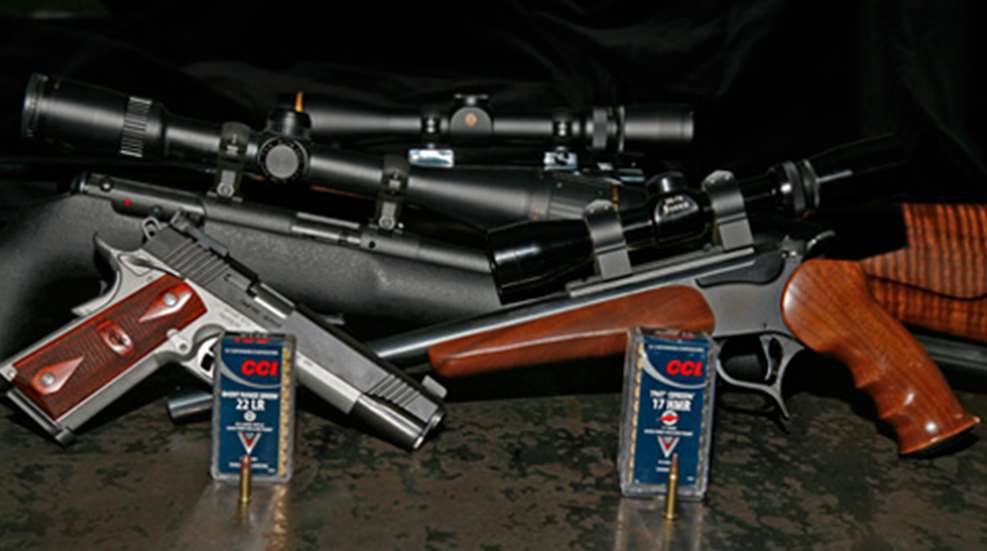
CCI’s TNT Green in .17 HMR features a 16-grain TNT bullet made from granulated copper in a proprietary carrier within a copper jacket loaded to a nominal 2,500 fps. Shooting it across my Oehler 35P chronograph yielded an average velocity of 2,525 fps in my T/C G2 Contender pistol with a 14-inch barrel. In a Savage Model 93 bolt-action rifle with a 22-inch barrel the clock registered 2,555 fps. During those all-too-brief periods absent of wind each gun dumped five shots into 7/8 inch at 100 yards. As expected, the wind raised havoc with the tiny bullets, opening up groups to 1 1/4 inches or so. However, performance on ground squirrels was excellent out to 125 yards. Terminal results for closer shots on the vermin were spectacular, since these bullets are designed to disintegrate on impact.
CCI introduced its Short Range Green .22 LR ammo with a 21-grain bullet made from compressed copper powder in a polymer matrix, according to Brett Olin of CCI who designed the bullet. The bullet profile is that of a truncated cone with an approximate .070-inch-wide driving band where the bullet meets the case. Atop the bullet is a .068-inch diameter hollow point. Because of the bullet profile, Short Range Green ammo will not chamber in a match-dimensioned chamber without forcing it—not recommended. Designed for plinking and hunting out to 50 yards—the most common range for .22 LR firearms—it clocked an average velocity of 1,365 fps in a Kimber Rimfire Super with a 5-inch barrel and 1,632 fps in my Kimber SuperAmerica sporter rifle with a 22-inch barrel. At 50 yards my groups hovered at just a bit more than an inch in the rifle, but again, the wind rarely subsided enough in my shooting session to provide the best environment for testing. Accuracy testing for the pistol was done at 25 yards with groups averaging 1 3/8 inches. The light bullets could not cycle the relatively heavy slide of the 1911-style rimfire pistol, though it functioned flawlessly in my Ruger 10/22 rifle. Olin told me that some semi-autos will not function with this ammo, including the 10/22 with a high-capacity magazine. There is enough spring tension against the underside of the bolt with a full 25-round magazine that it will not cycle using Short Range Green. The ground squirrels dropped quite satisfactorily with this ammo in the rifle—though not as dramatic as with the .17 HMR—but because of the functioning issue, I did not try the pistol. I’ll try it in a revolver on my next varmint safari and report the results in my blog.
I am less than fully convinced of an empirical need for lead-free bullets, but since it is already the law in some places—and likely will expand to a greater or lesser extent—it is heartening to see manufacturers like CCI step up and get ahead of the curve in providing quality products to fulfill shooters’ needs. Olin said that research is continuing to make the product even better. In the meantime, if you hunt or shoot in an area that mandates lead-free ammo, these are two excellent choices for rimfires. Fifty rounds of Short Range Green .22 will lighten your wallet by $5.99, while the .17 HMR TNT Green ammo has an MSRP of $13.99 for a 50 round box.