The Brunton company of Riverton, Wyo., first became known for its “Pocket Transit,” a sophisticated compass useful for field work patented by geologist David W. Brunton in 1894. Even in the 21st century, with GPS technology affordable by almost everybody, the Pocket Transit is still being produced, but the Brunton company has branched out in many other directions, including hunting optics like riflescopes.
My test scope was a 3x-9x-40mm Brunton Eterna with a BDC reticle. Its box was clearly marked “Made in Japan,” and the scope appeared to be a pretty conventional 3X-9X with a black matte finish and a fast-focus eyepiece. On an electronic scale it weighed exactly 1 pound, a little heavier than most 3X-9X-40mm scopes. The eye relief, tested with a flashlight and a ruler, was 3 inches at 3X and 2.6 inches at 9X—on the short side of average.
I mounted the Eterna on my primary scope-test rifle, a .30-06 New Ultra Light Arms, useful because of its accuracy and light weight. With the Eterna mounted in Talley steel rings the rifle weighed 6 pounds, 11 ounces. The handload included the 168-grain Berger Hunting VLD and Hodgdon H4350 powder, which not only groups very well at 2950 fps but, according to Sierra’s Infinity ballistic program, produces 30 ft.-lbs. of recoil energy, enough to shake the innards of any scope.
The first test involved shooting the square at 100 yards to check the quarter-MOA click adjustments. After the first shot landed on the target about 3 inches to the right of the bullseye, four more shots were fired, with the scope’s adjustments clicked 24 times between each shot, first left, then down, then right and up. The last shot landed half an inch from the first shot, the five bullet holes forming an almost perfect square about 6 inches on each side.
So far so good, but repeating the pattern resulted in the windage adjustment only moving an average of 41/2 inches after 24 clicks, while the elevation adjustment continued to move 6 inches. The end result: Four groups printed under an inch, but with a flier 11/2 inches to the left of each left-hand group. Over the years I’ve encountered quite a few scopes with adjustments that took a number of shots to settle down, but I’ve never seen quite this variation before. After the first five shots, however, the results were very consistent. The windage clicks moved the reticle an average of .19 inch at 100 yards.
The Eterna’s elevation clicks did average the advertised quarter MOA (.26 inch), and were extremely repeatable. The top of the turret is a hash-marked, numbered cap that can be pulled up slightly to release it from the adjustments and turned to “0” then pushed back down to re-engage the adjustments. This makes it easy to click the elevation up and down for shooting at different distances, as many hunters do these days.
For hunters who prefer to hold higher at longer ranges, the Eterna’s BDC (bullet drop-compensating) reticle has three stacked crosshairs (Brunton calls them “bars”) below the small center dot, in a Christmas tree pattern. Each crosshair is longer than the one above, to allow for aiming in crosswinds.
The Brunton website includes a ballistic program to match the reticle with a particular bullet and velocity, and unlike some such programs, altitude, barometric pressure and temperature can be entered. It was easy to use, and suggested that with a 200-yard zero the bullet would be on at 249 yards with Bar 1; on at 310 yards with Bar 2; and on at 377 yards with Bar 3. I’ve shot this load quite a bit at ranges out to 400 yards from a 200-yard zero, and that’s just about what it does.
Like most multi-point reticles, the Brunton BDC is etched on glass. Etched reticles are generally considered stronger than wire or laser-cut foil reticles, but have one slight disadvantage: The reticle’s glass isn’t coated, so it scatters a tiny amount of light. I’ve tested a bunch of scopes using my nighttime optical test, done at 25 yards on an illuminated chart with 10 black-and-white lines of decreasing width, and all the scopes tested so far have rated between 5 and 8, with the 8’s all costing $1,000 and up. I’ve also tested a number of scopes of the same model but with different reticles, and scopes with etched reticles tend to rate slightly dimmer than the same scope with a wire reticle. The Brunton rated a 6+, about average for fully multi-coated scopes in the Eterna’s price range. Some other scopes in the same price range have rated 7 or 7+, though all had wire or foil reticles.
After the range and brightness tests the scope was taken off the rifle and placed in a freezer overnight then dunked in a sink full of warm water with the turret caps removed. The warmth expands the gas inside the scope, revealing any leaks with a string of bubbles. The scope didn’t leak and only showed the normal amount of interior fogging afterward, which dissipated in a couple of minutes. (It’s impossible to keep all atmospheric water out of a scope forever. Filling a scope with dry gas at the factory only ensures there’s no interior moisture when it leaves the factory. Every scope I’ve tortured with the freeze-and-dunk test showed brief interior fogging afterward, but in the field we never go from zero to 100 degrees in a few seconds.)
Despite the mystery of the windage adjustments, the Eterna 3X-9X-40mm proved itself to be a rugged scope, providing two fine options for longer-range shooting. Brunton also offers the Eterna in 4.5X-14X-50mm and 6.5X-20X-50mm models, both with BDC reticles, and a 6X-24X-40mm with a mil-dot reticle.
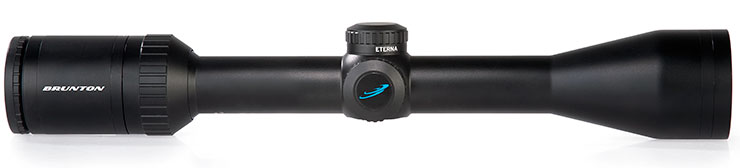
Technical Specifications:
Type: variable-power riflescope
Magnification: 3X-9X
Objective Lens Diameter: 40mm
Focusing Range: 25 yds. to infinity
Eye Relief: 3" @ 3X; 2.6" @ 9X
Exit Pupil: 13.3mm @ 3X; 4.4mm @ 9X
Coatings: fully multi-coated
Dimensions: length 12.4"; weight 16 ozs.
Construction: black matte aluminum
MSRP: $700