When discussing the Nitro Express cartridges, my mind is immediately drawn to East Africa in the first few decades of the 20th century. Exploration, heat, thirst, heavy ivory and dangerous beasts all go hand-in-hand with the term “Nitro Express”—itself derived from the Cordite propellant (nitro) and the power of a train (express)—but there are modern developments which fill a niche. One such is the .500/416 3 ¼-inch Nitro Express developed by Kreighoff at the end of the 20th century.
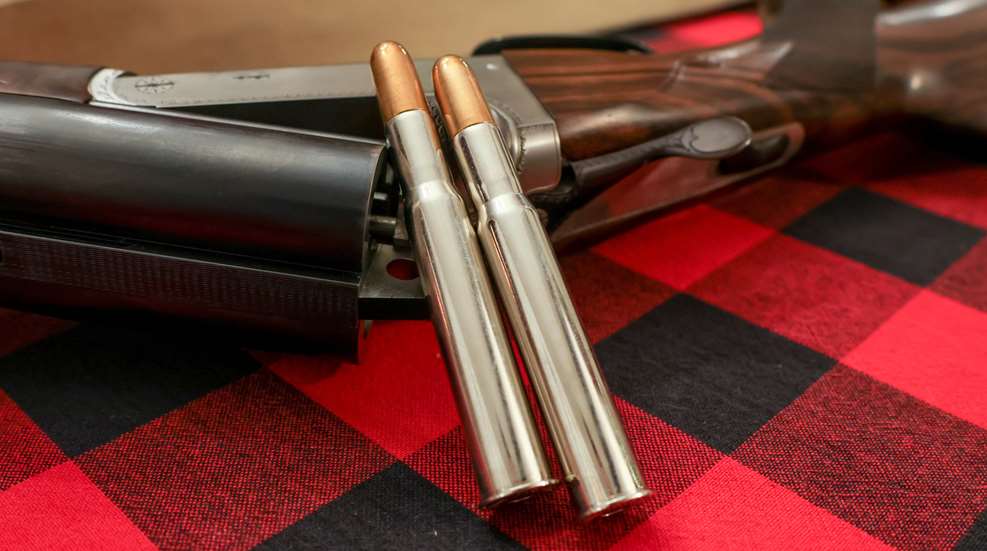
Unlike the American system of naming a cartridge derived from an earlier design—the .25-06 Remington, 7mm-08 Remington and .338-06 A-Square come quickly to mind—where the new bullet diameter comes before the parent cartridge, the British method uses the parent cartridge name before the new bullet diameter. The .450/400 NE is the .450 Nitro Express necked down to hold .400-inch (actually .411-inch) diameter bullets; the .500/465 NE used by Teddy Roosevelt is the .500 Nitro Express cartridge necked down to hold .465-inch-diameter bullets; and so on and so forth. Kreighoff mated the case of the .500 Nitro Express with the abundant bullets of the .416 Rigby, resulting in the .500/416 Nitro Express, a well-balanced cartridge which makes a sound choice for dangerous game.
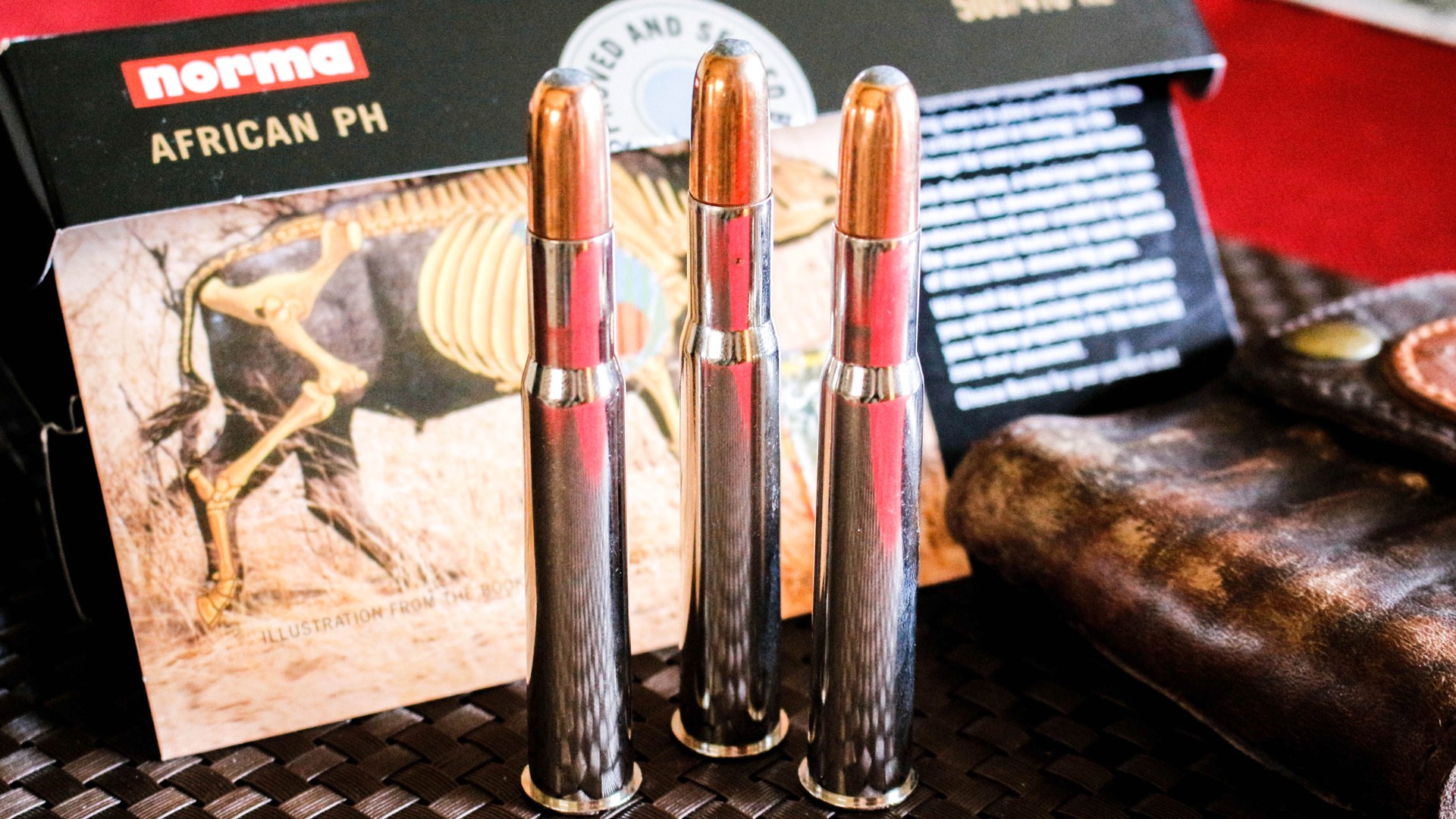
Looking at the ballistics of the .500/416 NE, you might recognize the formula: a 400-grain .416-inch-diameter bullet at a muzzle velocity of 2,300 to 2,350 fps, generating 4,700 to 4,900 ft.-lbs. of energy at the muzzle. These figures are common to the .416 Rigby, .416 Remington Magnum and .416 Ruger, and are certainly more than adequate for any and all game species on earth. A 400-grain bullet of this nominal diameter possesses a Sectional Density figure of .330; anything above .300 is considered perfectly acceptable to deliver the penetration needed for taking thick-skinned dangerous game, and modern premium bullets are even more effective in the field. In fact, for the visiting sportsman using the services of a Professional Hunter, this formula is just about as perfect as you could ask for, and just might represent the quintessential balance of striking power and ease of shooting, especially in a double rifle which has a little more weight to it.
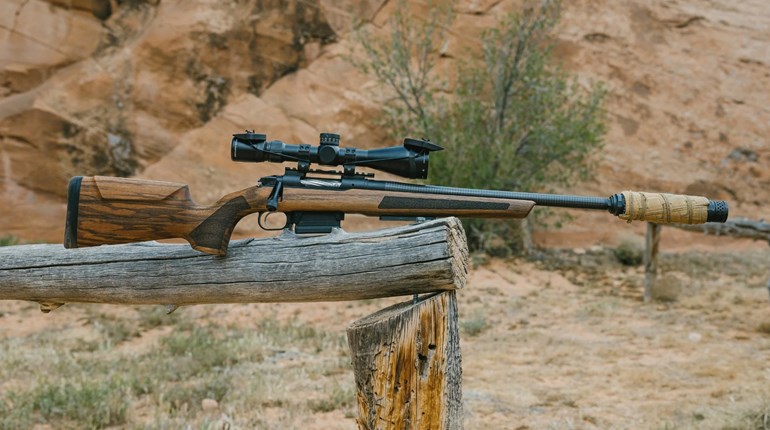
The .500/416 NE shares the 3 ¼-inch case length and 4.00-inch overall length of its father, with a 14-degree 50-minute shoulder, in opposition to the .500 NE’s straight-walled case. Though that shoulder and the resultant cartridge neck (which measures 0.691 inches) gives plenty of neck tension, headspace is handled by the rim; because the cartridge is designed for single-shot and double rifles, the rim poses no issues as it might in a box magazine bolt-action gun. Kreighoff still offers this cartridge as an option in its Classic “Big Five” Double Rifle, equipped with the Kickspanner manual cocking/de-cocking device.
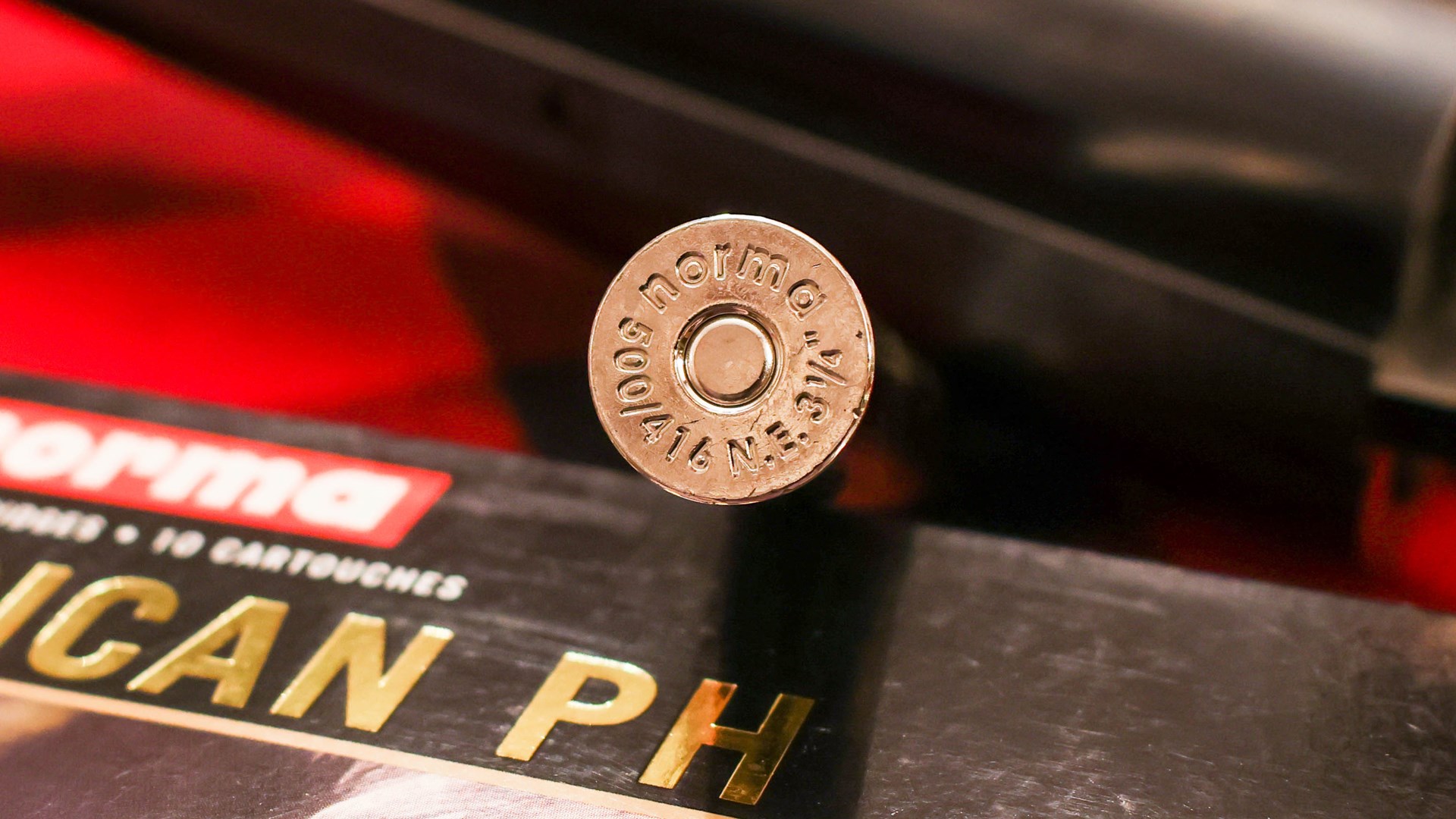
The .500/416 NE sits right between the popular .450/400 3” NE—which drives its 400-grain bullet at a sedate muzzle velocity of 2,050 fps—and the benchmark .450 NE, sending a 480-grain slug at a muzzle velocity of 2,150 fps. It is no secret that the .416-inch-diameter bullets, especially at 400 grains and heavier, have a stellar reputation for penetration. Though the 400-grain .411-inch-diameter bullet of the .450/400 3-inch NE has a slightly better Sectional Density figure, the added velocity of the .500/416 3¼-inch NE will certainly make a visible difference when used on game animals like Cape buffalo and elephant. Also, in comparison to the .450 NE and .470 NE, the recoil of the .500/416 should be a bit less, and the rifle it is chambered in can be made a bit lighter. Yes, 500-grain bullets will carry a bit more energy, and the larger frontal diameter will result in a bigger wound channel, but modern projectiles have made the .416s just that much more effective. Essentially, anything a .416 Rigby rifle can do, a .500/416 NE can duplicate.
In direct competition with the .500/416 3¼-inch NE is the .416 Rigby No. 2, a rimmed variant of the classic .416 Rigby. Released in 2019, the .416 Rigby No. 2 is perfectly suited to the Rigby Rising Bite rifle, and carries that prestigious name. And while the Kreighoff rifles remain a popular and affordable choice, there are definite signs that the .500/416 3¼-inch NE is struggling to hang on. Hornady once produced ammunition, featuring first their DGX then their DGX Bonded softpoint, as well as their DGS solid, though it seems as though the products are discontinued. Nosler offered ammunition as well, at one time or another offering a 400-grain monometal solid and a 400-grain Partition, yet neither of those are currently listed on their website. Grizzly Ammunition lists a 400-grain Barnes TSX and 400-grain Barnes Banded Solid in their lineup, and boutique shops like Hendershot’s can custom load ammunition for you if needed.
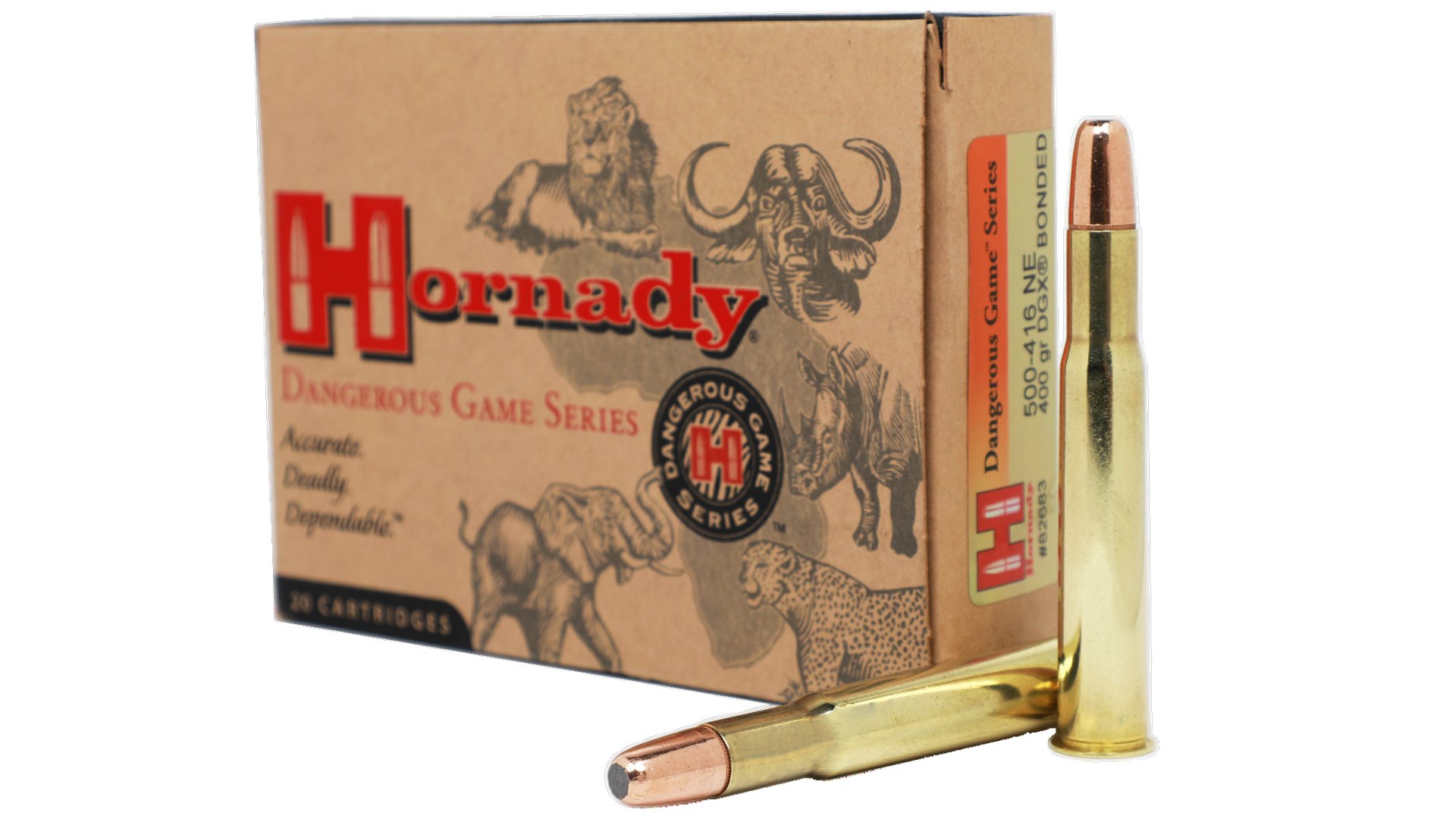
Because of the difficulties with factory-loaded ammunition, handloading the .500/416 NE is probably a smart route to take. Loading for the cartridge is straight forward, though for the double rifles, you’ll be aiming for the regulation velocity in order to get the best performance from your rifle. Look to slower-burning powders like Hodgdon’s H4831SC and H1000, and a large rifle magnum primer; there is no shortage of .416-inch-diameter component projectiles to choose from. I like a good roll crimp on double-rifle cartridges, to avoid having the bullet pull outward under recoil.
The .500/416 3¼-inch NE is a perfectly viable cartridge for any and all dangerous-game hunting, and in spite of the waning popularity, I wouldn’t hesitate to use a rifle so chambered. Yes, it will always be difficult to post up against the timeless classics like the .450/400 3-inch NE, .470 NE, and .500 NE, but variety is the spice of life. Hopefully there will be enough of an interest to see the ammunition manufacturers put this cartridge back on their production lists.