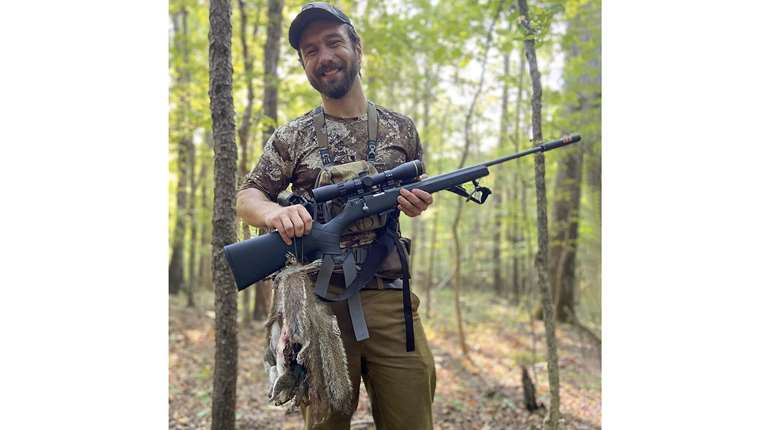
We had been in the blind for maybe a couple of hours, and the deer were just starting to show up. There were three eight-pointers—nothing really big—perusing the does, when he showed up, from the right side of our view. Now, it wasn’t a Boone & Crockett record book deer—having injured his right side resulting in a tall seven-point rack—but for this particular area of Texas he was certainly a shooter. My guide, Ben “Brother” Lawrence, uttered a perfunctory phrase, which we both knew was fruitless. “Phil, I can probably put you on an even eight-pointer, but that’s a good deer.” He was twice as tall as any other buck I saw on that ranch. The Savage rifle came to shoulder, and one look told Brother I was shooting this deer. The .243 Win. barked, and the buck fell in his tracks, stone dead.
 The famous gunwriter Warren Page was integral in the development of a 6mm-.308 wildcat, necking down the case shortly after the .308 Win. was released in 1952. Its purpose was to offer the hunter a cartridge that could easily do double duty on both predators/varmints and deer-sized game alike. It delivered, and then some. The heavier 90 and 100-grain bullets will handle deer and pronghorn antelope neatly, and the lighter bullets are absolute hell on woodchucks, prairie dogs, coyotes and foxes alike. The recoil of the .243 is a mere fraction of that of the larger deer cartridges like the .30-’06 Springfield, .270 Win. and 7mm Rem. Mag., allowing shooters to place their shots accurately, no matter what level of recoil sensitivity they may possess.
There are projectiles available for both classes of game animals; highly frangible bullets for the varmints and predators, and stout bullets for deer-sized animals. Among the cartridges that can cover both of these applications, I feel the .243 Win. is just about the best available, offering a perfect fit for a short-action rifle, with enough case capacity to push even the heaviest bullets to a muzzle velocity of just about 3000 fps, and the lightest to 4000!
It was rivaled, early on, by Remington’s .244 cartridge, which was a bit bigger, being based on the .257 Roberts and 7x57mm Mauser. The .244—by all accounts—should’ve been the more successful cartridge, having the larger case capacity, but Remington made one little mistake: they produced the rifle with a 1:12” twist rate, and that won’t stabilize bullets heavier than 90 grains. The .243 Win., with its 1:10” twist, can stabilize the 100- and 105-grain bullets, which the hunting public wanted for deer and other big game. Not that you can’t hunt deer with a 90-grain bullet, but the hunting market is what it is, and the .244 fell far behind the .243, with Remington renaming its cartridge the 6mm Remington.
The .243 also had the benefit of being chambered in two fantastic rifles—the Rifleman’s Rifle, the Model 70 and the Model 88 lever action. Both of these were very accurate rifles—I've had the pleasure of shooting a nice pre-’64 Model 70 in .243—and could deliver the precise shot placement varmint hunters need.
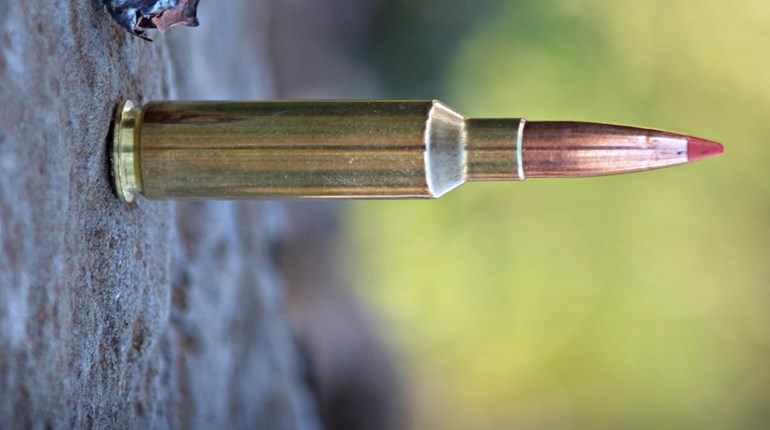
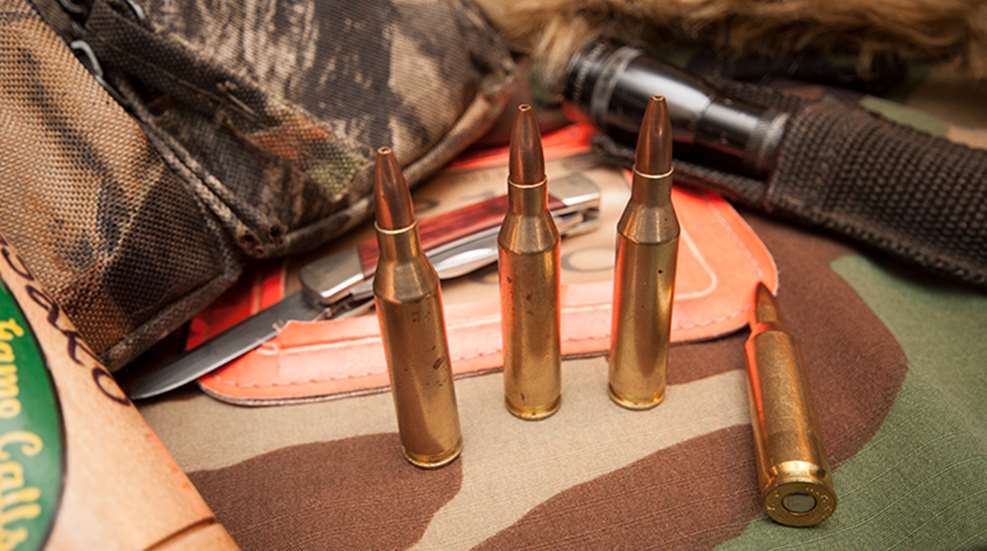
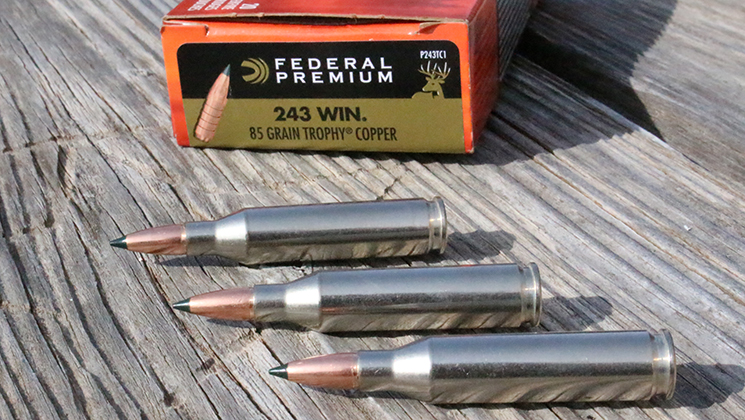
Modern advancements in both powder and bullet technology have done nothing but enhance the capabilities of the .243 Win. Both bonded-core and monometal expanding bullets have made a huge difference, as they will take full advantage of the high muzzle velocity the .243 can generate. That Texas buck I told you about was dropped with a Federal Premium 85-grain Trophy Copper load—the bullet expanded perfectly and put the buck down literally in his tracks. At 85 grains, it’s perhaps a bit lighter than most of the deer loads that have been used in the past, but the monometal construction kept the bullet together in spite of striking a rib. The 100- and 105-grain softpoints are still available in brands like Winchester, Hornady and Federal. Nosler offers the 90-grain AccuBond, for a good long-range choice, and Norma loads their 100-grain Oryx bullet, which may be one of the best all-around hunting bullets available. Swift loads the 90-grain Scirocco, and I’ve had nothing but good results with this bullet.
For the varmint crowd, there are plenty of modern frangible softpoints, like the 55-grain Nosler Ballistic Tip, which will most definitely generate the famous red mist. Hornady’s Superformance Varmint, built around their 58-grain V-Max bullet will do the same; I think you’re seeing my point here, the .243 Win. is a very versatile tool.
The handloader can easy fuel his or her .243; there’s really no big secret to dealing with the .308-based case. I’ve had good results with medium-burning powders like IMR4064 and IMR4320 with the lighter bullets, and I’ve had superb accuracy with 100-grain bullets and IMR4350 and Reloder-19.
While there are many cartridges that can handle the deer/antelope/coyote class of animals, the .243 Win. sits at the top of the heap for good reasons: it’s accurate, easy on the shoulder and delivers enough energy for the task at hand.
Looking for previous installments of Behind the Bullet? We've got you covered.
• .338 Winchester Magnum
• .357 S&W Magnum
• 6.5-284 Norma
• 8x57 Mauser
• .38 Smith & Wesson Special
• 7x57mm Mauser
• 9 mm Luger
• .35 Whelen
• .454 Casull
• .375 H&H Magnum
• .45 Colt
• .22-250 Remington
• 10mm Auto
• .308 Winchester