Is the future filled with AI robots using facial recognition to check your hunting license? Will a cloud of “smart” drones launch on opening day? And why can’t hunters buy one of those robotic mules designed for the Marine Corps to haul big game out of a wilderness?
Don’t believe all doom-and-gloom, jobless-future AI headlines. If you don’t look forward to an era in which you spend hours trying to convince a lifeless machine that holding your child’s unloaded rifle—so they can safely cross a fence during a youth-only hunt that requires adult supervision—is not poaching, there’s good news.
AI Not Performing as Expected
In late January Harvard Business Review published a story that included some eye-opening facts. It admits AI is displacing some jobs, but the widespread belief it’s eliminating them all, or improving business productivity, is not panning out as advertised.
It explains, “…AI typically performs specific tasks and not entire jobs. As an example, Nobel laureate Geoffrey Hinton stated in 2016 that it was ‘completely obvious’ that AI would outperform human radiologists within five years. A decade later, there is no evidence that a single radiologist has lost a job to AI—in part because radiologists perform many tasks other than reading scan images. Indeed, there is a substantial shortage of them.”
Despite other vocations escaping their widely predicted decline, the AI tsunamis has arrived. The biggest catalyst, however, seems to be already existing plans to downscale.
Harvard Business Review conducted a poll of 1,006 businesses executives in late 2025. It found, “A majority of surveyed organizations have already made either low to moderate (39 percent) or large (21 percent) headcount reductions in anticipation of AI…Another 29 percent is hiring fewer people than normal in anticipation of future AI.”
Roughly 45 percent of survey respondents said it was difficult to determine how much generative AI improved productivity, if at all. The study also notes negative effects on employees who remain. They include fear of being laid off, limited upward mobility, looking for new jobs and more, all of which affects a company’s bottom line in moral and production.
Game and fish departments have already learned hard lessons on other dangers. Last year Wyoming and Idaho were expressly warning hunters not to rely on hunt regulations provided by the source. Other states have followed suit. Texas Parks and Wildlife released internal guidelines on the use of AI late last year.
Valuable Conservation Applications
There are some wildlife-conservation advantages, however. Migration corridors, particularly in the west, are critical to big-game species like elk and mule deer. AI has a high success rate in finding hard-to-detect fence lines on aerial photos. It’s already doing so today in areas of concern. Reducing the fatiguing hours a biologist spends behind a computer screen inspecting the same image is a good thing.
AI can also detect subtle habitat changes unfolding in areas where it’s easily overlooked on the ground. That’s another tool for those dedicated to managing our wildlife.
A look from far above can also increase accuracy of wildlife population estimates. In 2017 scientists unveiled something vastly different. It’s an on-the-ground crowdsourced algorithm that can also identify and count animals with a certainty factor of 96.7 percent. Jeff Cline, the senior author of the paper detailing the software said, “This technology lets us accurately, unobtrusively and inexpensively collect wildlife data, which could help catalyze the transformation of many fields of ecology, wildlife biology, zoology, conservation biology and animal behavior into ‘big data’ sciences,” according to a VentureBeat story.
Terminator Wardens?
It doesn’t look like clouds of drones will hover overhead at sunrise on opening day anytime soon. Game wardens and biologists who—unlike machines free of human patience and compassion—understand the critical role private landowners play in conservation, are also not facing an overnight extinction event, if ever.
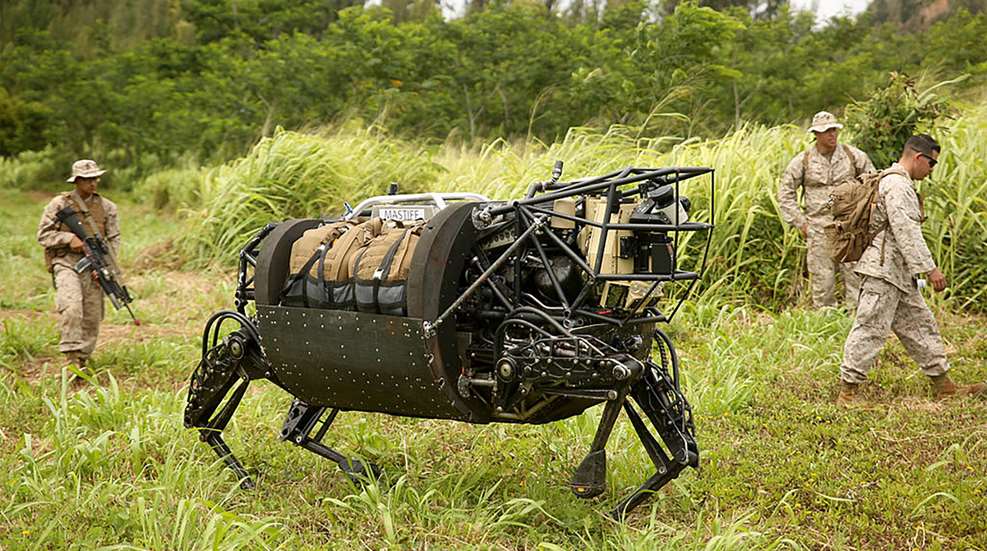
As for the Marine Corps-tested LS3 (Legged Squad Support System)—and its 400-pound load-carrying capacity—becoming available at your favorite sporting goods store, or wardens mumbling “I’ll be back,” I wouldn’t hold my breath on that those, either.