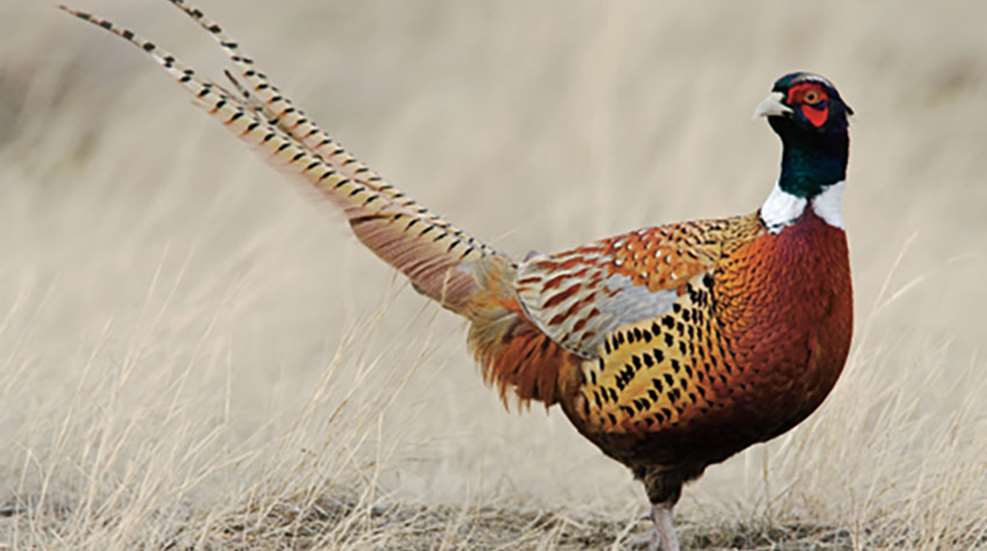
Lacking the time to work private landowners, I opt to beat my competition on public hunting areas. It takes a combination of planning, research, understanding human nature, understanding pheasant behavior, thinking tactically and working hard. It’s a mental and physical game. Here are my 10 secrets to success.
1. Know the land.
Get the maps, drive out to the public lands and assess them for pheasant values. Dense cover near private farmland can concentrate birds when the farm crops are taken down, when frost, snow and fire eliminate private-land cover. Thinner, shorter cover can be good early and late in the day because pheasants like to roost in such habitat. Deep, thick cover is best at midday and where surrounding hunting pressure is most intense. List habitat types on your map so you don’t forget.
2. Watch changes in area vegetation.
As the season progresses pay attention to the harvest. A large “No Hunting” cornfield can shelter many birds, but when the combine runs through it, they all must find new homes. If this is the bulrush slough on public ground and you’re there, bingo.
3. Hunt mid-week.
Weekend and holiday competition can be fierce. Monday birds are still isolated and spooked from weekend traffic. By Wednesday they’re beginning to relax and drift into new habitats. Thursday and Friday can be your best days.
4. Follow other hunters, then sit, watch and wait.
An empty WMA could have been hunted moments before you arrived. Look for fresh tracks along the road or in the parking area. They may suggest you try elsewhere. On the other hand, even on the busiest Saturday, you can pick up birds by hunting behind others. In big WMAs many hunters follow the easy routes and loop around the hard spots, the thickest tangles or perhaps a wet spot or island. I’ll often invest an hour with a binocular watching another hunting party push through an area. I’ll note how many birds they put up, how many were roosters, how many they hit and missed and where those roosters landed. Often a cock bird will swing to the side of the group and bend back to land behind them or land in a bordering field and run back behind them. I’ve often jumped from my truck and walked less than a hundred yards to flush and bag some of those birds. Many times they are so tired from their recent run/flight that they hold like ticks.
5. Hunt overlooked areas.
When you see a party bypass part of a public area, hit it quickly. I hunt some waterfowl production areas in the Dakotas with cattail islands surrounded by ankle- to thigh-deep water. When I see other parties circle these islands, I strap on waders and slog out with my dog to collect all the roosters that have sought refuge on the island. Some of these islands aren’t a half acre and some are under a few inches of water. In one public area I once worked a small patch of short, thin grass that two previous parties had ignored—and shot three birds in 15 minutes.
6. Cut off the escape routes.
When you know an area well, you know where birds run or fly to escape typical pressure. If other hunters move in from the south and you know escaping birds will pass near a canal on the east side, get over there. Don’t do it within a couple hundred yards of the other party or in order to beat them to their spot, but if you know their route or actions will result in roosters getting away, there’s nothing wrong with positioning yourself along the escape path. I’ve taken birds from traditional escape cover on public lands more than a half mile from the other hunters who flushed them initially. They had their chance; I got mine.
7. Push it. Work hard.
Pheasants are tough birds. You have to be tougher. They’ll duck, dodge and run a mile, fly a half mile, run a half mile more. You have to keep after them and push them. Sometimes merely putting in the hours and miles is enough to earn your birds–if you also hunt smart.
8. Be a tactician.
Football games, military battles and pheasant hunts are won or lost on tactics. You’ve got to play smart. All the effort and energy in the world won’t bag a bird if you’re hunting here and the birds are hiding there. Study, learn and interpret pheasant behavior. Don’t hunt deep cover at 9 a.m. when the birds are likely to be in fields feeding. Don’t hunt grain fields at 1 p.m. when they’re likely to be hiding in deep cover. The nastier the weather, the more pressured the birds and the later the season, the more likely you’ll find ringnecks in dense cover. But if that cover is regularly stomped by dogs and men, the birds will shift to off-the-wall places like tiny clumps of cover in the middle of bare fields or the weeds along a backyard garden fence or even short grass just off a parking area. The birds need overhead protection from hawks, but if ground predators are the bigger, immediate threat, all they need is isolation. If that means a tumbleweed in a 40-acre field of 3-inch-high grass …
9. Think like a pheasant.
This is part of being a tactician. Understand that ground birds prefer to escape with their feet, using wings as a last resort. And they prefer to run through vegetative cover. But they’ll circumvent or abandon deep, thick cover in order to run faster toward undisturbed ground. Don’t assume that an acre of tangled cattails is going to hold every rooster you push toward it. Veteran birds will run through it, duck down a fence line on the far side and race a half mile to a bean field if they think that will give you the slip. So put a quiet blocker on that fence line before you push into the acre of cover. All alone? Nudge toward the acre, then back off and circle around to the other side. Make the birds think they are surrounded and must hunker in cover.
10. Shoot well.
Duh. But you’d be amazed the number of pheasant hunters who take their first practice shot of the year when that first ringneck squawks skyward. Look, you work hard for every rooster you flush. Be prepared to hit it whether at 20 yards or 50 by making sure your gun fits (shoots where you point it) and you know how to operate it. A good shot only needs to flush three roosters inside 50 yards to bag a limit. A poor shot might need a dozen or two.