1. Remington Arms Company, LLC is the “Remington” that you know. Founded in 1816, Remington is the only major manufacturer of both firearms and ammunition in the United States. Remington Outdoor Company, Inc. (often called “Remington Outdoor Group”) is now the umbrella company formerly known as Freedom Group that owns brands such as Remington Arms, Barnes Bullets, Dakota Arms, Marlin and Mountain Khakis. And, no, George Soros doesn’t own it.
2. Remington began when Eliphalet Remington II, the son of an upstate New York blacksmith, set out to built his own flintlock. Locals began ordering their own rifles from Remington and the company was born. The company began operating at a site in Ilion, NY in 1828 where it continues its operations today. Ilion is roughly halfway between Albany and Syracuse.
3. Remington is in the process of consolidating the vast majority of its manufacturing operations in a single facility in Huntsville, Alabama. Huntsville is a hub for aerospace research and manufacturing and provides the company both room to grow and willing and able employees.
4. Remington produces ammunition at its plant in Lonoke, Arkansas, just east of Little Rock, and operates a high-tech facility in Kentucky where the Model 783 rifle is produced.
5. Though Remington had produced 1911s previously, under the Remington-UMC banner during the First World War, the company did not produce any handguns (other than the bolt action XP-100) from 1920 to 2011. Remington’s R1 1911 was the company’s first traditional handgun since the 1920s. Remington Rand 1911A1s, produced to meet the significant wartime demand during World War II, were produced by a typewriter company that had no relationship with the gunmaking giant.
6. Not only does Remington produce the multi-caliber Modular Sniper Rifle to fulfill the Precision Sniper Rifle contract for U.S. special operations forces, it produces the M-24 sniper rifle that’s long been in service with the U.S. Army. Tuned Remington 700 actions serve as the foundation of the the Marine Corps’ M-40A5 sniper rifle, as well as all previous versions of the M40 dating back to the Vietnam War. What many folks don’t realize is that Remington’s relationship with U.S. snipers goes back even further. During the Second World War, tooling to produce the M1903 Springfield was moved from Rock Island to Ilion, New York so that Remington could produce the old warhorse. Besides producing standard M1903 service rifles, Remington produced M1903A4 rifles for sniper use.
7. Produced as the Remington Autoloading Rifle starting in 1906 and re-branded as the Model 8 in 1911, Remington produced the first semi-automatic rifle in the United States chambered in a deer-appropriate cartridge. The rifle, based on John Browning’s 1900 patent (No. 659,786), saw over 80,000 copies produced.
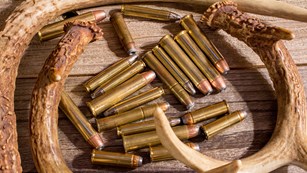
8. Remington has developed or legitimized more cartridges than any other U.S. manufacturer—34 at last count. These cartridges range in size from the .17 Rem. Fireball to the .416 Rem. Mag. Some of the notable successes are the .223 Rem., 22-250 Rem., 25-06 Rem., 7mm Rem. Mag., and .44 Rem. Mag.
9. Remington runs four shifts at its Lonoke, Arkansas plant to try to meet the current unprecedented demand for ammo. Remington does sell ammunition to the U.S. government, but those sales comprise less than 5 percent of the company’s production and almost none of that is rimfire ammunition. Lonoke produces billions of .22 LR rounds per year in an effort to keep the store’s shelves stocked.
10. Remington has pushed the innovative envelope at many points during its nearly 200-year history and that innovation has included attempts to incorporate electronics technology into sporting firearms. In 1999, Remington introduced its Etronix electric ignition system which, although commercially unsuccessful, was likely a product that will one day be viewed as far ahead of its time. In 2013, Remington took another bold step with the introduction of the 2020 digital optic system—a collaboration with Tracking Point. Time will tell if the 2020 will go the way of Etronix but no one can call the company risk-adverse.