“There,” said the man.
His English vocabulary was lacking, though it was certainly fuller than my Spanish.
“There. There.”
Luckily, certain non-verbal communications are universal, like pointing. I followed his fingertips with my own wide, eager eyes gazing in the same direction. I knew what it meant: a target had been spotted. Gesturing with his hands, the orchard manager communicated that not only was it close, but it was of the larger variety, too. Still, I stared blindly from the vantage point of the high dirt road into the canopy, straining to lock on to the destructive lizard at which he was pointing. I saw nothing but green jungle, branches and limbs.
The jungle, as we came to call it, was really not much more than an overgrown river bottom that ran for miles and bordered the fruit orchard we were there to protect. While behind us rows of mango, banana and papaya stretched to the green horizon, in front of us was a gorge. From the dust-covered farm road on which we were standing, a cliff dropped 40 feet to the thick, vine-entangled floor that extended about 40 yards to the river’s edge. Looking out from the road gave hunters a vantage point to peer into the canopy where the iguanas basked on tree branches, almost unnoticeable, in every imaginable shade of green, brown and even orange.
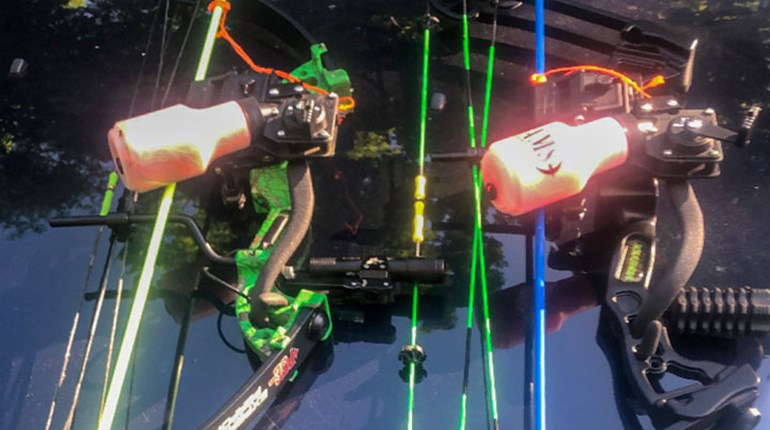
“Where?” I asked again, tightly gripping the stock of the .30-caliber Hatsan BT Big Bore Carnivore air rifle, anticipating the kill shot that was sure to come soon.
“Tail. Tail.”
And then I saw it. Like an optical illusion, the long, slender tail of the 5-foot iguana appeared like an out-of-place tree branch. It was different from the other branches, and following it from the tip led me to a 15-pound lizard I shouldn’t have been struggling to see. It wasn’t hidden, like so many others had been, moving like squirrels to the far side of limbs, but taking in the sun in plain view, stretched out along a tree branch not 10 yards in front of me.
My smile grew wide as I leveled the Hatsan, aimed at a dull orange spot behind the lizard’s head, maybe an ear, and fired.
Thwap!
I’m not sure which I enjoyed more, the glorious thwap of a .30-caliber pellet hitting leathery iguana skin, or the jungle-shuddering thud of the large, prehistoric-looking lizard smacking the forest floor.
“One more for me!” I shouted to the group. “And he may take the record!”
Though the other hunters glanced in my direction, little fanfare was given as their focus remained on the canopy. The report of air rifles and the blissful noise of leathery slaps echoed on both sides of me. One invasive critter killed meant nothing in the larger scheme of things. We’d have to kill hundreds, if not thousands, to even begin to call it progress. Lucky for us, but certainly not for the orchard owner, the 100-yard stretch of river bank we were hunting probably contained a thousand of the glutinous devils.
This was going to be a good day for iguana killing. But would it be enough?
Puerto Rico has an iguana problem. A massive one. The reptiles cause damage to the scale of millions of dollars a year. From collapsing buildings, roads, airstrips, pools and just about every manmade structure with their cavernous egg dens, to destroying agriculture and consuming resources other, smaller native lizards need to survive, the island’s iguana population is a very real danger to the economy and ecosystem. To the fruit farmer, iguanas can mean the loss of entire crops. They eat fruit and the flowering blossoms that produce it. Disaster can come from even a single iguana in a tree, as fruit scarred by a lizard’s abrasive tail is unable to be sold at market. They are everywhere on the island, and with an ideal habitat and climate, and lack of a natural predator to keep them under control, iguanas are poised to call Puerto Rico home indefinitely.
That’s where we come in, the Iguaneros.
Iguana control would be a lifelong pursuit if I called the island home. Puerto Rico is a target-rich environment and as table fare, iguana tastes like a combination of chicken and frog legs—it’s delicious. While there are a few groups that offer their time with pellet guns free to local farmers and ranchers, one look at the number of iguanas a single afternoon hunt can produce leaves you with the impression it may be a futile endeavor.
The human population on Puerto Rico is roughly 3.6 million. Since their release into the wild in the 1970s (most likely due to the pet trade) iguanas have circled the island and are now moving inward with a population estimated to be 4 million strong. And with the ability to lay up to 75 eggs a year and a hatch rate of 93 percent, well, my math says “epidemic” may soon be the label worn by the invasive reptiles.
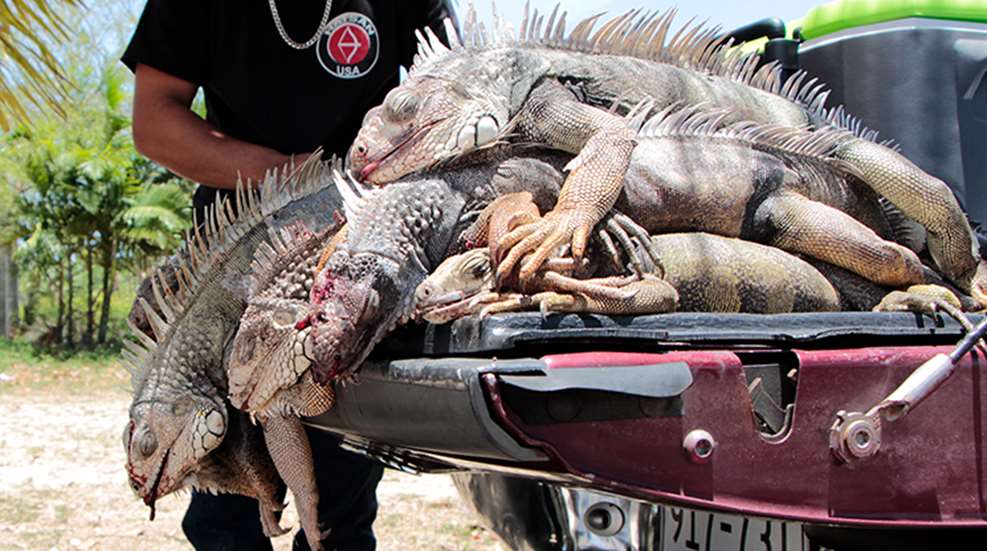
Our group of Iguaneros was able to pile up iguanas to the tune of more than 100 a day, for three days, hunting the same, single, 100-yard stretch of river bank—wheelbarrows full, literally.
Hunting iguanas, though effective on small parcels, can only do so much. Perhaps the greatest possibility of success lies in the meat trade. Despite the current prohibition of selling iguana meat on the island, Puerto Rico’s iguanas are exported stateside and to other Latin and South American countries where it is consumed as a delicacy.
If you see iguana on a menu, chances are it’s from Puerto Rico. Do your part.