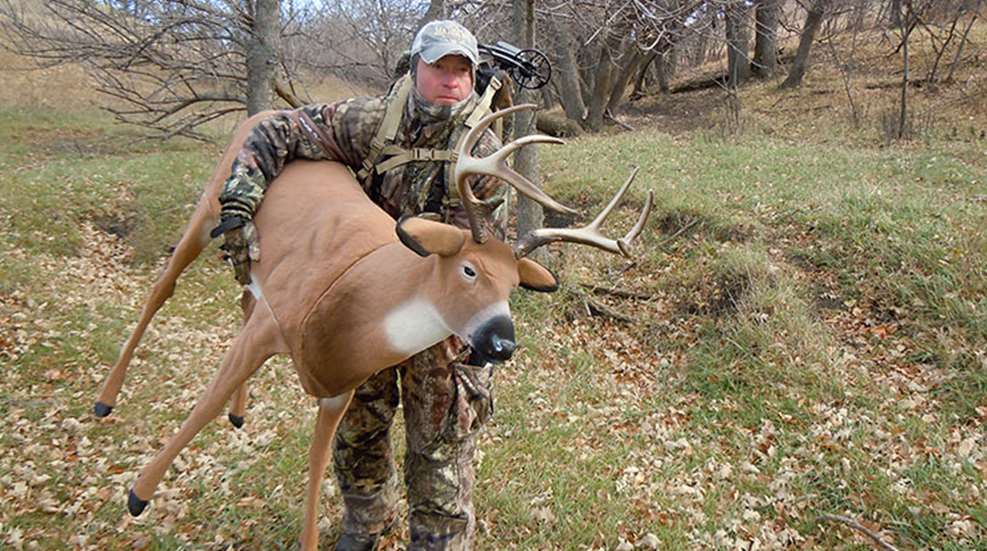
Setting a decoy spread for wary waterfowl requires strategic calculations to pull off a successful ruse. The same is true of decoying whitetail bucks. You can plunk a buck decoy anywhere, but to have it work with precision requires forward thinking. Begin with simple biology.
Throughout the fall, and especially during the rut, a decoy can lure in bucks of all age classes. Young bucks want to see what’s up, and mature bucks want to reinforce the pecking order. Both will jockey for position when they spot a decoy to gain a downwind advantage. Keeping your decoy, and the area immediately downwind of it, free of human scent is a must.
Younger bucks may simply pass by in any manner, but not older bucks. They have a genetic duty to approach another buck head-to-head and pass in parallel fashion. This may serve to show body size, accentuated by a buck’s tendency to stand its hair on end for a larger appearance. Eyes rolled to reveal white and ears pasted to the sides of the head also portray a profound (kick-butt) attitude.
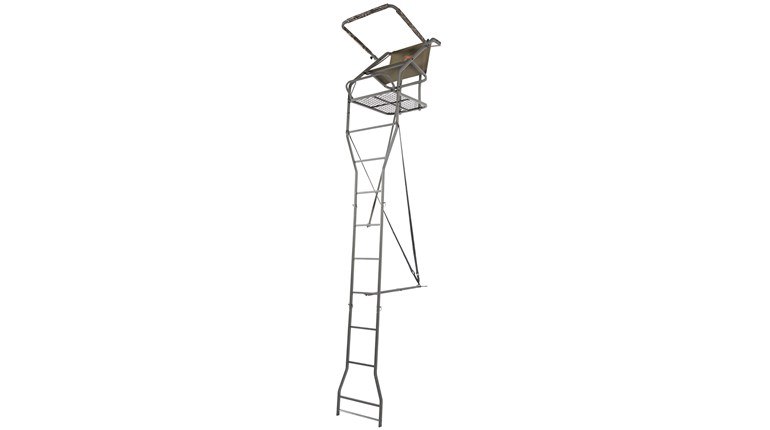
Now for the math calculation assignment. You need to be downwind, so you have to place the decoy upwind of your stand. You also need to leave enough room so any arriving buck can pass comfortably between you and your decoy for a downwind check of the opponent without smelling you. Leaving too much room creates long archery shots though. Placing a decoy 30 yards or less from your stand is ideal to tempt a buck close, as long as it has enough room to size up the opponent without getting downwind of your stand. Don’t worry about being spotted unless you fidget nonstop. Decoyed bucks zero in on their adversary with laser precision.
Also consider the biological aspects of decoy position and posture. The decoy should be quartering toward you or broadside. As a buck closes the distance it will match the decoy’s stance for a parallel passing. This gives you a textbook, quartering-away or broadside shot. Turn cupped-forward ears backward to mimic a real buck’s laid-back ear display. Removing one antler hints at a buck ready for another neighborhood beat-down.
Complete your charade with an olfactory boost. Add deer urine to your setup (where legal). Felt wicks soaked in buck urine and hung on the decoy, or on an adjacent limb, authenticate the intruder to a buck’s downwind advance. Spritzing doe estrus urine on nose-level grass sends cues that a hot doe may be nearby.
Speaking of hot does: If you wish to use a doe decoy, especially in the waning days of the rut, position is similar to using a buck decoy save for one important rule. Always place the doe quartering away and upwind from your stand location. Any interested buck will circle behind the doe to scent-check and possibly woo her. A dose of estrus-based urine will incentivize a buck to close the gap, giving you a quartering-away shot.
Before setting up your ruse, consider safety. A decoy can fool other hunters, too, so it may not be wise to employ one on heavily hunted land during firearm season.