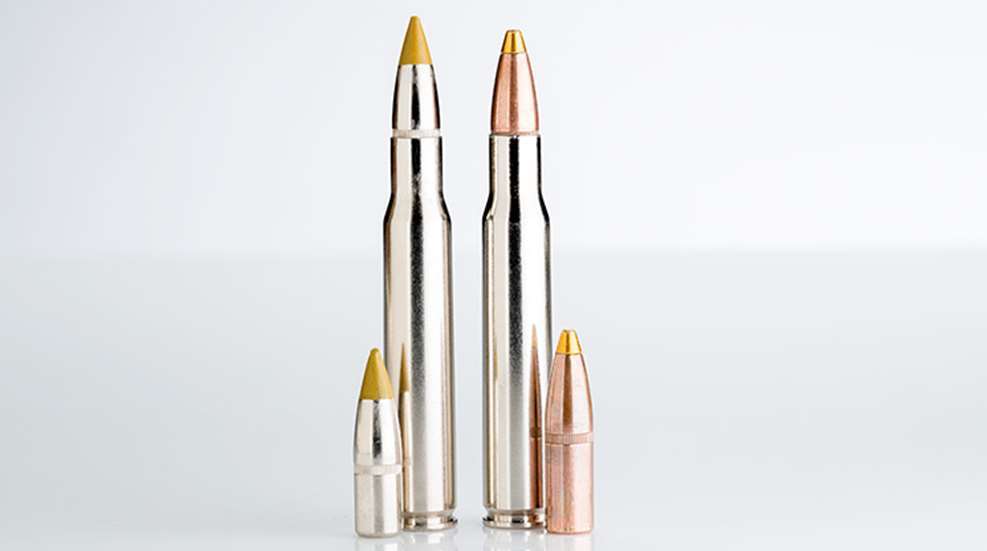
Imagine the significance the Browning Buckmark carries now that it is the headstamp for a new line of centerfire rifle loads available in two different bullet types designed for hunting all North American big game. The first, and arguably most important, bullet is Browning’s BXR with its Rapid Expansion Matrix Tip perfect for thin-skinned varieties such as whitetail, blacktail, mule deer and antelope. For thicker-skinned animals, the company offers the BXC with its Controlled Expansion Terminal Tip.
Browning partnered with a corporate relative, Winchester Ammunition, to co-develop, manufacture and supply the ammunition. But this was no simple re-branding of existing Winchester loads. The Browning line carries newly developed, specially designed projectiles in distinctive packaging—all the while benefitting from established quality control and distribution efficiencies of the Winchester Ammunition plant in Oxford, Miss.
Last November, I had an opportunity to try the Browning BXR .270 Win. load on a whitetail hunt near Nisland, S.D. It features a somewhat light-for-caliber, non-bonded bullet consisting of a lead core with a thin, nickel-plated brass jacket topped with an aerodynamic tip made of a proprietary matrix of 85 percent copper and 15 percent polymer. Designed to fragment upon impact, the tip leaves a large, hollow point at the front of the projectile, allowing it to expand and transfer energy to the target.
That is precisely what happened when I took a buck with the 134-grain BXR bullet at about 130 yards. A nearly imperceptible entry hole in a fold of the hide behind the right shoulder and a 1.5-inch exit hole behind the left were all the evidence of the kill I could find in the field. At the skinning shed, further examination revealed the bullet pulverized the top of the 200-pound animal’s heart and a major portion of both lungs. The next evening when I sent a bullet through the shoulder of a 150-pound doe at about 70 yards, the results were remarkably similar. In each case, the animal’s physical reaction was brief enough that no prolonged tracking sessions were required.
While it’s impossible to make a sweeping judgment as to the efficacy of a bullet from only a couple of observations, I can attest that the BXR projectile performed exactly as designed. Anecdotal information about the 10 or so other deer taken at the time of my hunt was consistent with my experiences. Nearly all animals required only one shot, with most bullets passing through and with no animals traveling more than 40 yards after the shot.
Rafe Nielsen, communications manager for Browning ammunition, analyzed the BXR’s construction: “It’s not a weak bullet; it just opens up faster,” he said, adding that when the BXR strikes soft tissue, its tip fragments explosively but the bullet’s remaining core continues penetrating. The tapered construction of the jacket covering the core, he noted, further controls rate of expansion. According to Ben Frank, product manager for Browning ammunition, penetration of BXR bullets in 20 percent ballistic gelatin is typically 14-16 inches.
Browning’s other bullet, the BXC—with a thicker, thermally bonded jacket, solid anodized-aluminum tip and boattail base—is tougher and offers more penetration than the BXR. Frank quantified the BXC’s performance by noting penetration in ballistic gelatin is about 18-24 inches.
Editorial Director John Zent hunted with the BXC .30-06 load and observed its terminal performance on two red deer and a fallow deer taken in New Zealand. “The stags (a bit smaller than bull elk) both did the ‘double-leg-kick’ typical of heart-shot deer and crashed over after abbreviated death sprints,” Zent reported. “The 185-grain slug recovered from my animal had transformed into a ‘mushroom’ as picture-perfect as any controlled-expansion bonded projectile I’ve used. Ironically, the bullet recovered from my fallow buck (built like a big whitetail) was far more misshapen, but understandably so since it traversed stem to stern while anchoring him in place.”
With its BXR and BXC, Browning appears to have most scenarios for North American or African plains game hunting nicely covered. A growing list of offerings is likely to ensure the Browning name is a major player in the hunting ammunition market for years to come.
Technical Specifications:
• Caliber: .243 Win. (BXR), .270 Win. (tested), .30-30 Win. (BXR), .308 Win., .30-06 Sprg. (tested), 7mm Rem. Mag. (BXC), .300 Win. Mag., .300 WSM
• Bullet Type: BXR Rapid Expansion Matrix Tip, BXC Controlled Expansion Terminal Tip
• Bullet Weight (grs.): 134 (.270 Win. BXR), 185 (.30-06 Sprg. BXC)
• Ballistic Coefficient: .464 (.270 Win. BXR), .484 (.30-06 Sprg. BXC)
• Muzzle Velocity (fps): 3060 (.270 Win. BXR), 2700 (.30-06 Sprg. BXC)
• Muzzle Energy (ft.-lbs.): 2786 (.270 Win. BXR), 2994 (.30-06 Sprg. BXC)
• MSRP: $28-$30 (BXR), $35-$37 (BXC)