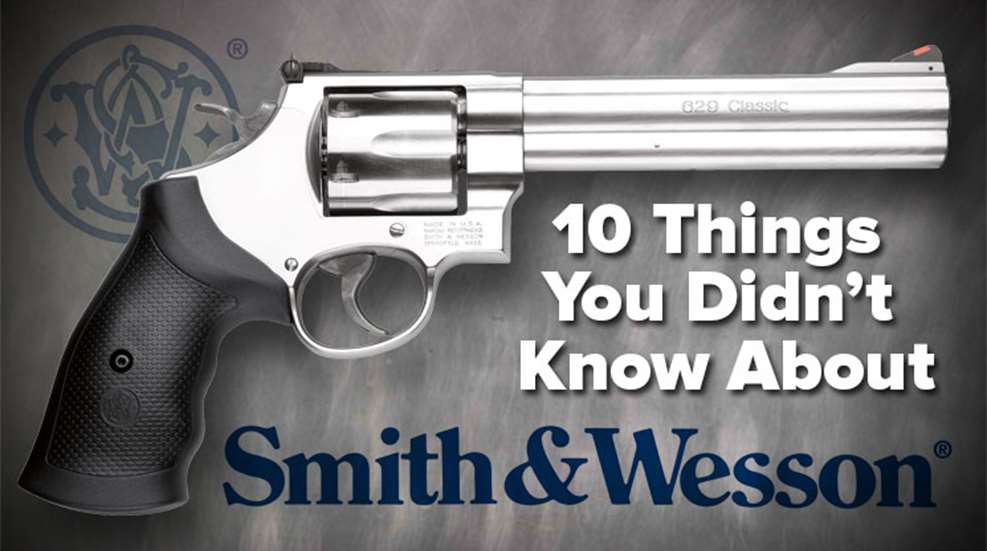
Smith & Wesson's origins can be traced to 1850, when Horace Smith and D B. Wesson first became acquainted while working as subcontractors supervising the manufacturing of different firearms at the Robbins and Lawrence Company in Windsor, Vermont. It is speculated that it is here where the two men first had the opportunity to discuss their dream of producing a firearm that was a “repeater” and would use a full self-contained cartridge. Now, after more than 160 years in existence, the company created by their eventual partnership is one of the most well-respected of its kind. As you might imagine, a lot can happen—and be forgotten—during such an expansive history. With that in mind, here are 10 things you probably didn't know about Smith & Wesson.
The facts below were put together with help from Smith & Wesson and the company’s historian, Roy Jinks. For additional information, interested readers might consider picking up “History of Smith & Wesson," which he authored, or “Images of Smith & Wesson” by Jinks and Sandra C. Krein.
1. Smith & Wesson failed in their first venture.
By 1852, the two men had a prototype lever action-repeating pistol and had formed a partnership to produce the new style firearm in Norwich, Connecticut. Although the design would later be recognized as an invaluable step forward, the firm failed, and by 1854, Horace Smith & D B. Wesson were forced to sell the company to Oliver Winchester, a shirt manufacturer from New Haven, Connecticut. The original design by Smith & Wesson reached its full potential in 1866 when it emerged as the basic design for the famous Winchester Repeating Rifle.
2. D.B. Wesson worked for Winchester.
After their original firm had failed, Wesson agreed to stay on and work as a plant superintendent to help Oliver Winchester get his new plant operating. While in his employment, Wesson designed a small revolver that fired a rimfire cartridge that he and Smith would later patent. After discussing the design with Horace, the two decided to reform Smith & Wesson in Springfield, Massachusetts.
3. The Tip-Up Revolver
The first revolver models made by Smith & Wesson were called tip-up models. For the revolver to function, the barrel is tipped up and folded backward over the top strap. The cylinder is then removed for loading. Once all the cartridges have been fired, the barrel is again tipped-up, the cylinder is removed, and the cartridges are pushed out using the rammer rod underneath the barrel.
4. Smith & Wesson Cartridge Development
More commonly known for their production of firearms, Smith & Wesson has also played a leading role in the development of many of today’s most popular cartridges. Among those credited to the company include: .22 Short, .32 S&W, .32 S&W Long, .32-44, .38 S&W, .38-44 S&W, .38 S&W Special, .357 S&W Mag., .40 S&W, .41 Mag., .44 American, .44 Russian, .44 S&W Special, .45 S&W Schofield, .460 S&W Mag. and .500 S&W Mag.
5. Humble Beginnings
The first home of Smith & Wesson was a small shop at 5 Market Street in Springfield. At that time in 1857, Smith & Wesson was the smallest of four arms manufacturers in the city. The demand for the company’s new revolver and its cartridges would soon outgrow the capabilities of the 25-man shop, forcing Smith & Wesson to relocate to a new factory on Stockbridge Street in 1859. The move was well timed, as the demand for arms would skyrocket two years later, when the American Civil War began in earnest. Wartime production helped to establish Smith & Wesson as one of the leading gun manufacturers in the United States.
6. The modern day plant is built like a bunker.
The current Smith & Wesson plant resides at 2100 Roosevelt Avenue in Springfield, Mass. Construction for the plant began in the late 1940’s and was built entirely out of poured concrete with reinforced steel supports. The factory was designed with enough space so that operations could be moved to the underground level in the event of an attack without halting production. The enormous amount of press generated by the new plant and the bunker mentality of the 40s lead to numerous rumors about a duplicate underground factory at Smith & Wesson.
7. There's an in-house historian.
In 1970 Smith & Wesson added Roy Jinks to the company roster as the official Smith & Wesson Historian. One of Roy’s duties as Smith & Wesson Historian is to send out official factory letters to individuals who inquire about a particular firearm. This service is available to any Smith & Wesson owner for a fee of $50.
8. The company has long been at the forefront of magnum cartridge development for handguns.
Long known for innovation, Smith & Wesson has also been at the forefront of cartridge development for decades. In 1935 Daniel Wesson’s grandson, Colonel Douglas B. Wesson, worked in conjunction with Winchester Ammunition, Elmer Keith and Phil Sharpe to develop the .357 Mag. cartridge and the Smith & Wesson .357 Mag. revolver. At the time the .357 was the most powerful handgun ever produced. Then, in early 1950’s, Keith pushed Smith & Wesson to produce a revolver that was capable of handling increased pressures. The end result was the Smith & Wesson .44 Mag., which, again, was known for years to come as the most powerful handgun in the world. It was, of course, later topped by the company's .500 S&W Mag.
9. Big names painted some of the company's earliest advertisements.
In the early 20th Century, Smith & Wesson commissioned several artists to create advertising artwork. Perhaps the most famous of these was Fredric Remington, a painter, illustrator, sculptor and writer who specialized in depictions of the Old American West. In 1902, Remington was commissioned to paint four black-and-white oil paintings of Western scenes that were used in advertisements. For 10 cents silver, customers could purchase a 14x15-inch poster of each advertisement. These ads ran in Collier’s Weekly, Cosmopolitan, Harper’s Monthly and Scribner’s, among others.
10. The company produces more than firearms.
Today, Smith & Wesson offers a variety of specialty services to external customers. The company’s expertise in forging, heat treatment, custom tool manufacturing and grinding, as well as plating and finishing, are contracted out by some of most well-know brands in the United States. These clients include companies in the automobile, aerospace and appliance industries.