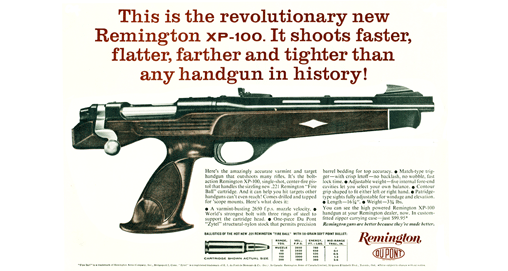
As Dick Williams noted in his article titled "The Singles Scene" in the June 2014 print edition, the single-shot, bolt-action Remington XP-100 handgun caused quite a reaction when it was introduced in 1962.
"Just about everyone agreed the XP-100 was probably the ugliest handgun to ever appear on the planet—even those who acknowledged that it could shoot groups smaller than any other handgun ever seen," Williams wrote. "I reluctantly admit that I was one of those dedicated Renaissance revolver men who looked at the XP-100 and stuck my finger down my throat to clear my pallet. While I was doing that, some really smart, clear-thinking handgunners took the Fireball afield and enjoyed incredible long-range small-game hunting."
Williams got over his initial distaste for the handgun's unconventional form as soon as he realized its far-reaching power. In fact, as he recounts below, it took him just one trip afield to recognize there is much more to the XP-100 than meets the eye.
"I was not a happy camper as I skulked along the edge of the cactus forest, carrying the misshapen lump of steel and multi-colored plastic slung over my shoulder. After an unsuccessful week of searching for javelina in southern Arizona, I was now hunting the northern part of the Sonoran Desert for rabbits and worried about friends seeing me with the incredibly ugly Remington XP-100 pistol. The silhouette of a sitting rabbit a bit more than 100 yards away caught my eye, and my day suddenly brightened.
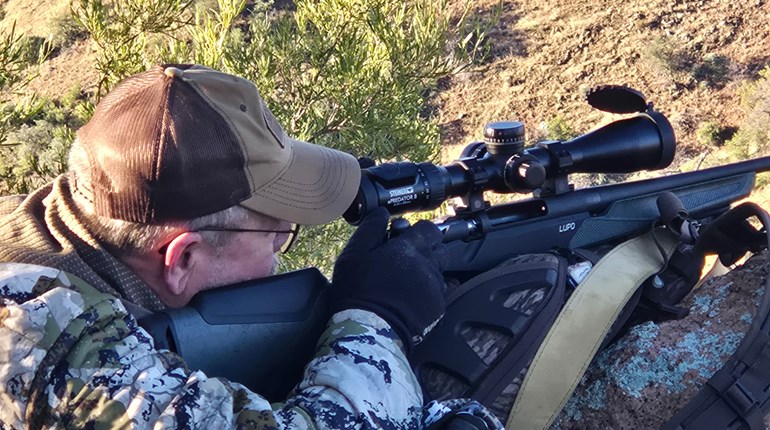
"After checking the ground around me for pieces of cholla cactus, I slid into the Creedmore position with my feet toward Peter Cottontail and braced the Fireball against the side of my leg. The rabbit didn’t get much bigger through the compact 2X Leupold scope, but he was clearly visible, as were the crosshairs on his shoulder. While the Remington bolt-action pistol would never qualify for entry in a beauty pageant, the trigger pull was as beautiful as any good bolt-action rifle I’d fired. My position was rock-solid, and when the trigger broke, there was no doubt in my mind about the outcome. The 45-grain jacketed-soft-point left the muzzle at about 2600 fps and struck about an inch high at the base of the rabbit’s skull.
"There was no tracking required. I walked to the downed rabbit, put the first half of what would turn out to be an excellent dinner in the game pouch of my vest, and took another close look at the Remington XP-100. It hadn’t gotten any prettier, but I was beginning to see the outline of a cleverly designed, well built, high-performance hunting handgun shining through the strange exterior. Now if I could just find a holster for it!"
Enough hunters and shooters looked beyond the XP-100's appearance that Remington produced the handgun for more than 30 years before discontinuing it in 1994. Along the way, several variations in numerous chamberings served small-game, varmint and big-game hunters in addition to competitive silhouette shooters. Here's a look at nine of them.
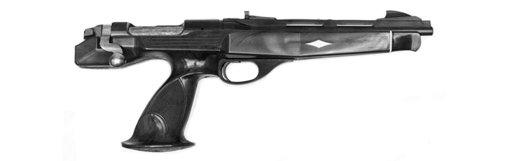
The first in the family, the XP-100 Long Range Pistol had a 10.5-inch barrel with a ventilated rib and a "sharkfin" front sight. Although the rear sight was adjustable, the handgun was also drilled and tapped for scope mounts. The ambidextrous, glossy, Zytel nylon stock gave the XP-100 a distinctive look, but serious handgunners paid even more attention to its .221 Fireball chambering, which made it effective on small game to 200 yards or more. The .221 cartridge quickly became inextricably tied to the XP-100, and the pistol was often called the "Fireball."
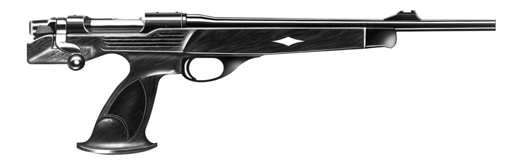
Recognizing the .221 Fireball cartridge was underpowered for hunting big game and for reliably knocking down steel targets at the longer ranges of silhouette matches, Remington introduced the XP-100 Silhouette Target Pistol, chambered for 7mm BR, in 1980. The Zytel stock remained, but the gun got a 14.5-inch barrel for increased velocity. In 1987, Remington beefed up the bore even more, chambering the pistol for .35 Rem.
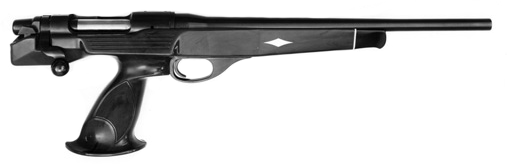
It was easy for varmint hunters to find .223 Rem. ammo in the late '80s. Easier, in fact, than it was to stock up on .221 Fireball, so Remington brought out the XP-100 Varmint Special, chambered for .223 Rem., in 1986. The 14.5-inch barrel had no sights, as most hunters planned on scoping the handgun. Remington later called this version the XP-100 Synthetic Pistol, as the nylon stock continued to be a prominent feature.
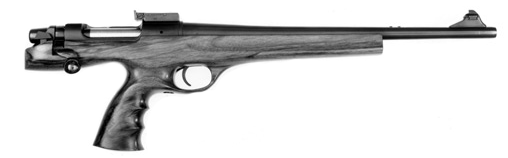
Hunters who liked the XP-100's performance but just couldn't stomach the Zytel stock rejoiced in 1986 when the Remington Custom Shop announced the XP-100 Custom Long Range Pistol. Handsomely carved walnut cradled the barreled action, and the pistol, complete with adjustable sights, was chambered for 7mm-08 Rem. and .35 Rem.
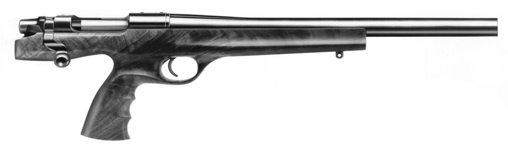
In 1988, the Custom Shop added the XP-100 Custom Long Range Pistol Heavy Barrel version, chambered for .223 Rem. The robust, 15.5-inch barrel came without sights or even holes in which to mount them. Chamberings for both it and the standard-barrel version later included .22-250 Rem., .250 Savage, 6mm BR, 7mm BR and .308 Win.
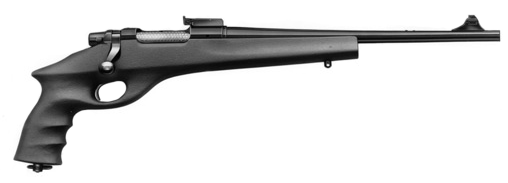
The XP-100 was known as a single-shot pistol, but that changed in 1991 with the introduction of the XP-100R Custom KS Repeater. The Kevlar-reinforced stock held a blind box magazine, which accommodated .223 Rem., .22-250 Rem., .250 Savage, 7mm-08 Rem., .308 Win., .35 Rem. or .350 Rem. Mag. cartridges. From the Custom Shop, the pistol came with adjustable sights and sling swivel studs. The XP-100R later became a regular production item, sans sights and swivel studs, chambered for .223 Rem., .22-250 Rem., .260 Rem. and .35 Rem.
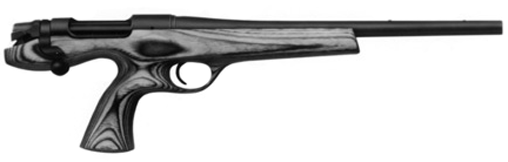
In 1993, the Custom Shop returned to the handgun's single-shot roots with the XP-100 Hunter. It featured an ambidextrous laminated stock and a 14.5-inch barrel, and was chambered for .223 Rem., 7mm BR, 7mm-08 Rem. and .35 Rem.
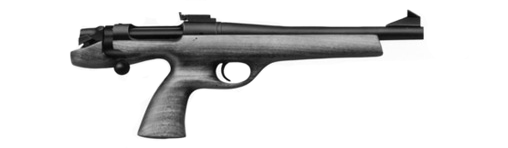
The XP-100 Silhouette Pistol also came from the Custom Shop in 1993. In a way, this version may have been the one hunters and shooters wanted all along. It kept the original 10.5-inch barrel length, but walnut replaced the Zytel stock. The gun was equipped with target-style sights, and it was offered in 7mm BR—a cartridge with plenty of power to successfully deal with steel targets and deer-sized game.
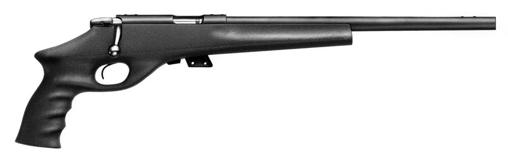
A spinoff of the centerfire XP-100R, the XP-22R Rimfire Pistol was chambered for .22 LR. The five-shot repeater had a Kevlar-reinforced stock like its big brother, but it did not come with sights. The XP-22R appeared in the 1991 Remington catalog, but according to Remington historian and author Roy Marcot, only a few were made and none were released to consumers.
Even today, more than 50 years after its introduction, the XP-100 continues to take handgun hunting to new heights. For example, NRA Benefactor member Larry C. Rogers used his custom XP-100 chambered for .325 WSM to bag not only a black bear in West Virginia, but also a 12-foot crocodile in South Africa! His story appears in the June 2014 print edition's "Members Best" feature. I'd say the XP-100 passes our field test.
 <
<