Since 2004, Kubota RTVs have been the best-selling diesel utility vehicles in North America, according to the "North American Utility Vehicle Report" produced by Power Products Marketing. Now, thanks to a complete redesign of the lineup, Kubota RTVs offer improved performance, smoother rides, more legroom and improved ergonomics. If you're a landowner or contractor with a fleet of diesel-powered vehicles and you're looking to add a small utility vehicle to that fleet to fill a niche, you owe it to yourself to see them. Shoot, any hunter should like what he sees.
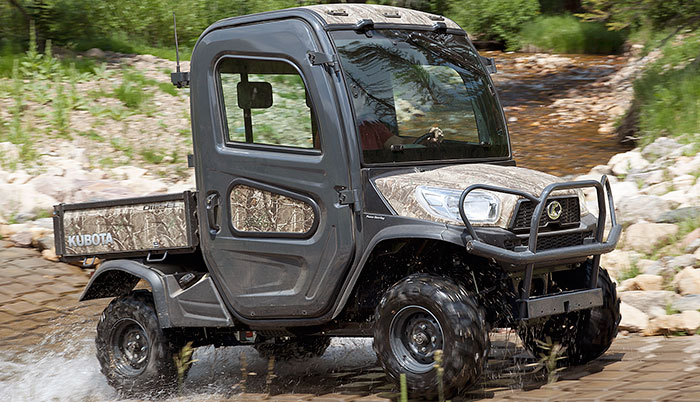
Now available at dealerships nationwide, the lineup includes the RTV-X900, RTV-X1120D and RTV-X1100C. Each unit is available in Kubota Orange or clad in Realtree AP camo. I attended a new-model introduction of them all in Kansas, in April, and I liked what I saw.
Features common to all three vehicles include a three-cylinder, four-stroke, liquid-cooled diesel engine with an overhead cam; a variable hydraulic transmission; four-wheel drive with a limited-slip differential; a locking, foot-operated rear differential; front/rear independent suspension; hydrostatic power steering; wet-disc brakes on all wheels; and a 7.9 gallon fuel tank. Dual A-arms are used on the front suspension, coil-over shocks on the rear; 8 inches of travel exists on both ends. Ground clearance is 10.4 inches, which is 2 inches greater than previous models.
Lots of steel is used in these vehicles. The rollover protection system (ROPS) features 2-inch tubing (most ROPS feature 1.5-inch tubing). Steel skid plates are found beneath each unit. The steel cargo beds measure roughly 5x3.5 feet and hold 1,102 pounds. Two-inch hitch receivers front and rear are standard. Towing capacity is 1,300 pounds.
Sixty-forty split bench seats are cushy, and their finish means easy cleanup—just hose them down. They tilt forward to reveal storage compartments good for holding tools, tie-downs and other small equipment. Thirty-seven watt halogen headlamps and digital instrumentation is standard, too.
Farmers, ranchers and contractors who own Kubota tractors know the company's hallmarks include diesel and hydraulic power. Both systems are used in its RTVs. In fact, Kubota is the only maker of utility vehicles that produces its own diesels. Hydraulic power is used not only in the power steering system but in the transmission. The company's VHT-X two-speed transmission provides a wide torque band, and its large oil coolers boost durability. The dump beds on the X1120D and X1100C employ hydraulics, too. With a flick of a lever, you'll dump the contents of the bed easier and more quickly than any electric system I've seen.
The RTV-X900 (MSRP: $13,345) is powered by an 898cc, D902 diesel engine that produces 21.6hp. Two levels are available: the General Purpose and Worksite. Length and weight are a bit more on the latter, but payload capacity is slightly greater on the former. The bed on the General Purpose is dumped manually (hydraulics are optionally available).
The X1120D ($15,981) is the deluxe unit. Blue-tinted halogen headlamps and polished alloy wheels show off plenty of style, and a tilt wheel provides comfort for drivers big and small. Three-point seat belts and half-doors are standard. Its 1,123cc, D1105 diesel produces 24.8hp for a top speed of 29 mph. This is the unit you want if you require extra acceleration and climbing power.
The RTV-X1100C ($20,833), powered by the same 24.8hp diesel mentioned above, is the all-weather unit. It features a quiet, factory-installed, fully enclosed unibody cab with large, roll-down windows on either side, and heating and air conditioning. I can't think of anything better for Northern hunters who want to ward off the cold or Southern hunters who want to keep out bugs and humidity. The cab is nearly airtight and almost rattle-free, keeping noise to a minimum. It's also pre-wired with an antenna and two speakers so buyers may simply add an optional radio.
Kubota began in Osaka, Japan, in 1890. It launched Kubota Tractor Corporation (KTC) in the United States in 1972. Today, the company and its 45 subsidiaries and affiliates across the globe produce agricultural and construction equipment, engines, one-run steel pipes, vending machines, sewage treatment plants and scales. Kubota RTVs are manufactured in Gainesville, Ga., by KTC.
When revamping the RTV lineup, the company focused on engineering excellence with customer needs in mind. After test-rides behind the wheel of each unit, I'd have to agree Kubota accomplished its goals. Durability, of course, can't be measured in a short time span, and I don't own a Kubota machine. But I know folks who do; none of them, whether they own a tractor or RTV, complain about short vehicle life spans. But a test-ride can provide insight into capability—moreover, what the ATV industry calls "terrainability," the ability to negotiate terrain elements hunters encounter on a regular basis. On that note, I'd give the RTVs solid marks. Keep in mind these units aren't designed to be raced; they're meant to provide workhorse capability.
"We have raised the bar on styling, ergonomics, comfort and storage without giving up the durability, ruggedness and reliability that Kubota utility vehicles are known for," said product manager Dan Muramoto. "We've taken a huge leap with feature enhancements for this line, and the powertrain componentry, fit and finish, and quality of materials are arguably best-in-class."