My first experience with muzzleloader hunting occurred in the 1980s when my father purchased two Hawken caplock rifles. The muzzleloading deer season was relatively new and started before the regular firearm season, giving hunters an early start before the deer got spooky.
My father was a competitive pistol shooter in the Army and taught me to shoot a pistol before any other type of firearm. We had entered a new type of shooting that neither one of us was familiar with. I remember going to the range and shooting with percussion caps, loose power and lead bullets. At 50 yards our groups were marginal and beyond 50 we couldn’t get our shots to group at all. We never did harvest any deer using this combo and I grew disenchanted with smokepole hunting.
That changed in 2002 when the Marriott Ranch in Virginia invited me to hunt whitetail deer on their property. For the first time ever, they were opening up the Ranch for guided hunts, a great opportunity but with one catch—the invitation was for muzzleloader season. I consulted with my colleague John Zent from NRA Publications, and he updated me on developments that had transformed muzzleloading, including Pyrodex pellets, sabot bullets and the use of rifle scopes, all of which greatly enhanced the accuracy and effective reach of modern blackpowder rifles. Following John’s suggestions, I was able to kill an 8-point buck at nearly 100 yards.
Since then I’ve been hooked on muzzleloader hunting, purchasing new rifles, mounting scopes on them and trying out different sabot bullets. Accuracy was good out to 100 yards. But in a lot of instances I would see game beyond 100 yards and would not take a shot because I was unsure of the bullet drop.
Thus began my quest to find muzzleloading equipment capable of shooting at longer ranges. I settled on a .50-cal. T/C Omega rifle with a stainless steel barrel. I like the idea of a stainless steel barrel with an action that dropped from the bottom and one that is not hinged. My reasoning was that it would be more rugged and thus more accurate.
For sights I opted for a Leupold UltimateSlam scope with the BDC reticle. The scope adjusts to match the trajectories of different propellant charges, as well as a setting for shotgun slugs. You sight-in at 100 yards and there are successive drop-point crosshairs for 150, 200, 250 and 300 yards.
I settled on a load consisting of three .50-cal. Pyrodex pellets, a 209 primer and the Barnes 250-gr. Spit-Fire TMZ bullet that has a tapering, semi-spitzer ogive optimal to long-range performance. I zeroed my Omega at 100 yards, and at 200 yards my shots impacted only a few inches below point of aim. I took this combo to the Marriott Ranch and harvested a doe at 211 yards and a black bear at 158 yards using the appropriate aiming points. I was so impressed with the Leupold scope that I reviewed it.
The following year NRA Secretary Jim Land and I were sighting-in during late summer in preparation for the upcoming season, but I was unable to get consistent grouping. Upon examining the sabots, I could see they were being blown apart because of excessive pressure. Presuming this was caused by the high summertime temperature (upper 80s), I switched to two pellets and once again my Omega delivered tight groups. Using the Leupold scope’s two-pellet setting, shots were dead on at 200 yards. Since then I have hunted exclusively with two 50-gr. pellets, a loading that is still plenty accurate at longer distances but which produces less recoil.
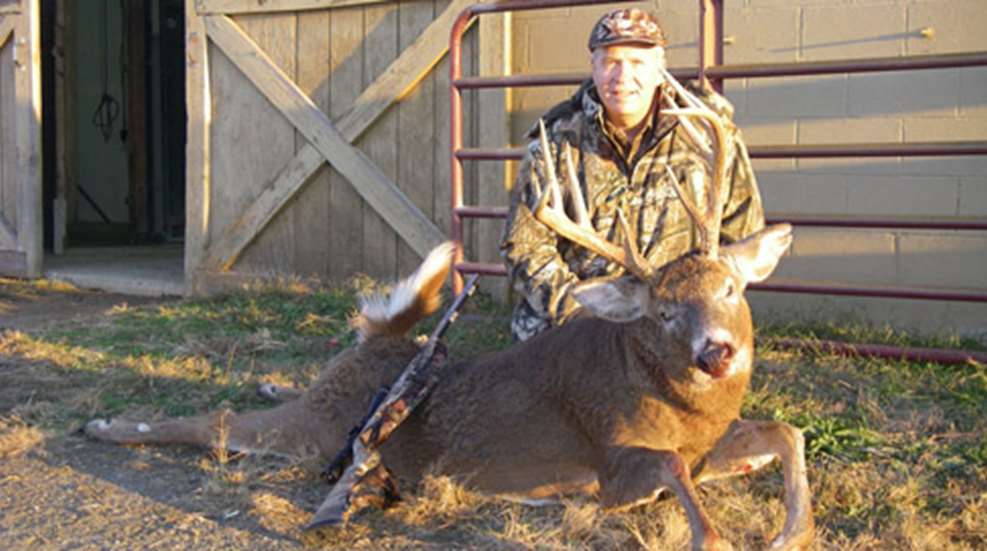
I just returned from a deer hunt on the Marriott Ranch and was not disappointed with my rifle’s long-range performance as I was able to harvest the one of the biggest bucks ever taken there at 213 yards using the Leupold’s 200-yard dot. The deer’s actual weight was 238 lbs. before field dressing and it had 10 points. On the last morning I harvested a turkey at 100 yards, although not a great distance, it nonetheless required an accurate shot at that small target.
With all the improvements in rifles, scopes, bullets and powder, today’s muzzleloading rifles rival the accuracy of many center-fires out to 200 yards and possibly even farther. Hunters who gear up accordingly and put in the range time to master their equipment, are not only able to extend their seasons, but can count on long-range performance when an opportunity comes along.
MARRIOTT RANCH
The 4,200-acre Marriott Ranch in Hume, Virginia, celebrated its 10th anniversary of guided hunting in 2012. The Ranch offers a three-day hunt at a very modest price that includes hunting, luxury accommodations, meals prepared by a Marriott chef and open bar in the evenings.
Having hunted at the Ranch for many years, I’m glad I returned to witness what was likely the best season ever for the seven hunters in my group. In three days, we were able to harvest six whitetail bucks (all with at least a 15-inch spread), four does, two turkeys, one bobcat and one coyote, all with muzzleloaders. As a Virginia resident for the past 50 years, I know of no other location in the Old Dominion that can offer such a variety of game that can be hunted in a single location. A large percentage of repeat clients return each year to enjoy great sport in what has to be one of America’s most distinctive and beautiful hunting properties. Information on the Marriott Ranch hunting and other activities can be found online or by calling 877-324-7344.
See more of the Marriott Ranch with this video from AmericanHunter.org.