By far, my preferred form of hunting is backcountry hunting. I admit that “backcountry” is a somewhat difficult term to define, but it’s definitely fair to say that the backcountry is not a place where you can hoist a whole big-game animal into the back of your truck or onto the rack of a four-wheeler and drive it home. Instead, backcountry hunting usually involves packing out your kill on your own—either all the way to the trailhead or at least to where you can reach it with a boat or pack animals.
Getting an animal broken down into small enough pieces to fit in a pack can be a large and daunting job. For that reason, manufacturers have created all sorts of overblown cutlery and knife sets that are meant to make it easier. For sure, these tools might come in handy once the animal is down and you start to butcher. But before that happens, that gear amounts to more stuff that takes up space and adds weight to your pack. Over the last 15 years, I have broken down somewhere in the vicinity of 50 animals and hauled them out on my back. These animals have ranged from black bears to moose to bighorns to whitetails. Through those experiences I’ve developed a fairly stripped-down field cutlery kit that has enough redundancy to allow for unexpected situations and occasional gear failures or loss on long trips. I think that the one-knife school of thought is foolish. Also, the kit serves the cross-purposes of handling camp chores and cooking duties.
Here are the four knives and tools that can usually be found in my backpack:
1) At all times, I carry a high-quality multi-tool that includes a sharp skinning blade, a serrated blade and a bone saw. This stays on my belt no matter what, so that I have it even if I have to leave my pack behind on a stalk. This is part of the redundancy that’s built into my kit. Because, while I seldom actually use my multi-tool on butchering projects, in a pinch I know that I could process an entire animal with one. Granted, it’s sometimes difficult to remove a large animal’s skull cap with a multi-tool bone saw without bending the blade, but I’ve done it in the past and it’s perfectly possible.
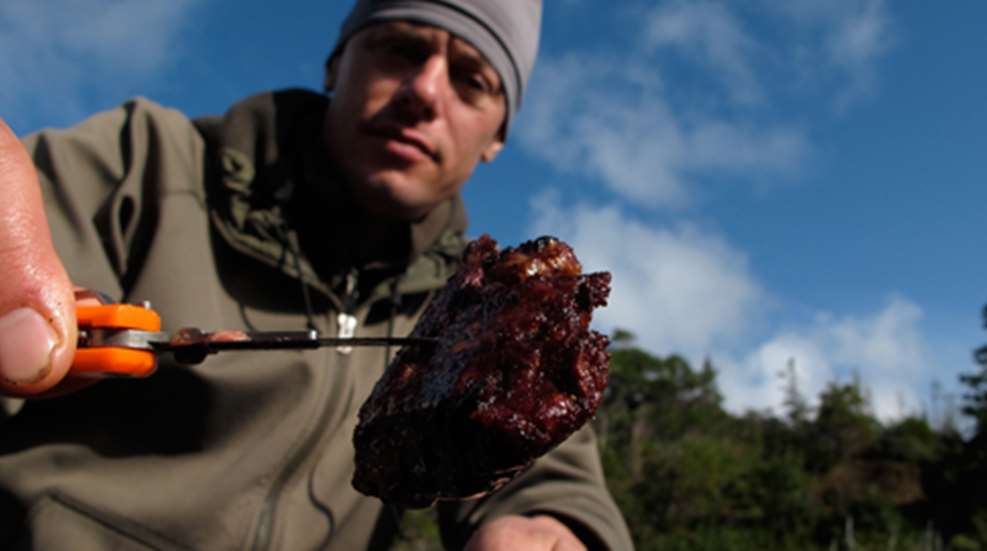
2) Over the last couple of years, my primary skinning tool has been a replacement-blade razor knife that uses stainless-steel autopsy blades. This is perfect for making clean and straight opening cuts, as well as caping heads and skinning bear paws in order to reduce the weight of the hide. These knives weigh next to nothing; my Havalon Piranta weighs only about 50 grams and is smaller than my middle finger when folded up. In fact, there’s an accessory pocket on the sheaf of my Leatherman that the Piranta fits right into. A dozen of the replacement blades take up less space in my bag than any portable sharpener on the market, not that you need a bunch of blades. I’ve broken down entire deer into quarters using just one. The single biggest drawback to replacement razor knives is that they are intensely sharp. You have to relearn how much pressure to use when skinning; if you jump into a task without a little experimentation, you’re likely to nick the hide. Also be careful when making gutting incisions with razor knives, as a wrong move can puncture the stomach before you even realize you messed up.
3) The thin, fairly short blade of a replacement razor knife isn’t perfect for everything. They sometimes find their limits when it comes to removing legs from large, ungainly carcasses, especially the rear legs where you need to pop the ball joints. And while they are definitely suitable, they are not the perfect knife for boning leg meat or removing loins or fleshing hides that have already been removed from the carcass. For handling these jobs, and any heavy-duty camp chores or woodcraft that needs to be taken care of, I generally rely on a small drop-point sheaf knife. The blade needn’t be much bigger than your index finger, so long as it is fairly ridged and holds an edge. I’ve had excellent luck with a number of such knives, ranging from the Companion by the knife maker Brian Goode, to the Alpha Wolf by Knives of Alaska. If you’re on a tight budget, which is something I’ve experienced many times over the years, the Victorinox commercial kitchen line includes several perfectly suitable camp/skinning knives for around $20. I’ve had great luck with the 5-inch curved boning knife as a general all-purpose butchering and skinning tool. The primary negative on these less-expensive knives is that the steel requires frequent stropping during a big job or it will get hopelessly dull.
4) Finally, I carry a bone saw when hunting large animals such as elk, caribou or moose. This is especially true on shorter trips where weight isn’t such a crucial issue—or on canoeing or rafting expeditions where I can carry a little extra gear without having to lug it on my back the entire trip. I use the saw for splitting briskets and pelvis bones, cutting legs off at the knee, removing skull caps and cutting rib cages away from the spine before trimming them into packable strips. I’ve had excellent luck with bone saws made by Knives of Alaska, which cut beautifully. Their one drawback, which is also an advantage, is that they are full-tang. So while they handle nicely and are ruggedly built, they do not collapse. This means you must carry the heavy leather sheath—as the saws are sharp enough to easily destroy your pack. Another good saw, and much less expensive than those made by Knives of Alaska, is the Kershaw Bahco. You can find them for less than $30, and they can last for several seasons if you take care of them.