I remember too well the first time I used an AR-15 on a hunting trip. I was in Texas on a coyote hunt, and I spent a week of hell enduring smart-mouth remarks about my “Rambo” gun that stopped being funny by lunchtime of the first day. But that was a long time ago, and a lot has changed. I am betting my as-yet-unborn grandsons will grow up hunting with AR-15s because of what is happening today. Right now is the genesis of that future result.
Historically, most rifle designs come from the military side. That’s probably because that’s where the money is found for research and development. Even the lever-action first saw use during the waning months of the Civil War. The single-shot, bolt-action and semi-auto all started life as military guns, too. I suppose we might include the pump-action if we fudge a bit and allow that early pump-action shotguns were used by the military. The point is, they all went on to become popular civilian hunting guns. After every war, the guns used by our fighting forces found favor with soldiers when they came home and went back to life and deer hunting.
That is, until Vietnam. That was the conflict that introduced the AR-15. Well, theirs was the M-16 select fire with full auto capability, while the AR-15 is the semi-auto civilian version. But, until recently, the rifle never caught on with hunters.When our warriors came home from Southeast Asia they were the first generation to reject the rifle they used in war. I believe that’s because the Vietnam War was the first to become so controversial and political. Once Vietnam became a political swamp, our boys fought a war many citizens didn’t believe in, which tore this country to pieces. Those lucky enough to come home wanted it all behind them. I have a buddy who was drafted and served his tour of duty in Vietnam. Today he is a hard-core gun guy, a hunter, shooter, collector, gunsmith and reloader. But he wants nothing to do with “black guns.” When I show him one, he will not even touch it. Forty years later, the emotions are still that strong.
But the wars today are different. We have an all-volunteer fighting force, and warriors are coming home and buying the civilian versions of their fighting guns and they are taking them hunting.
Another big factor in why the AR didn’t catch on for hunting was the drive to ban “assault weapons,” which helped turn society’s thinking against these rifles. The media and politicians said they were evil guns because of how they looked, and far too many believed them. The stigma stuck and was part of why I took so much grief from other hunters during that Clinton-era coyote hunt in Texas. That stigma remains today, as I recently heard about a shooting industry group organizing a push to refer to the AR-15 as something more politically correct. We have never had a reason to apologize for any rifle, but the media and politicians have been so successful that even our side sometimes buys into the “assault rifle” lie.
That thinking spilled over into the hunting world, and over the years several prominent hunters have come out in opposition to the rifles, based on the media-developed stigma. During the Clinton years, before the Internet took off, these guys, including one well-known editor of a major hunting and fishing magazine, were virtually unnoticed. But a more recent blog by a big-name hunting celebrity ignited a firestorm on the Internet. He paid a high price for that article, but it brought awareness of the rifles to the forefront and ignited a revolution that was primed and ready. The result brought the AR-15 rifle into acceptance in the hunting fields today.
This is a complicated issue with plenty of sub-plots and underlying issues that were all on a path of convergence. For example, for a long time the AR-15 suffered from the Henry Ford approach to product development. You could have any color you wanted, as long as it was black. You also could have any cartridge you wanted, as long as it was .223 Remington. There were always a few hard-core hunters who recognized the value of these guns, mostly for predator and varmint hunting. But with the media demonizing them and society a bit frightened by their looks, plus the lack of diversity in products, the AR-15 just didn’t excite mainstream hunters.But then it started to change, and the trickle-down effect kicked in as a catalyst for more change. A new generation came home from war and bought the rifles. At the same time, changing political power made a lot of other people buy black guns who might not have otherwise done so. When President Obama kicked off his “guns and ammo sales stimulus plan” on Nov. 4, 2008, sales of AR-15s shot into the stratosphere.Now many are realizing what they’ve been missing. That’s caught the attention of manufacturers of ARs, and they have started ramping up the drive to add guns that look less military and cartridges better suited for hunting.
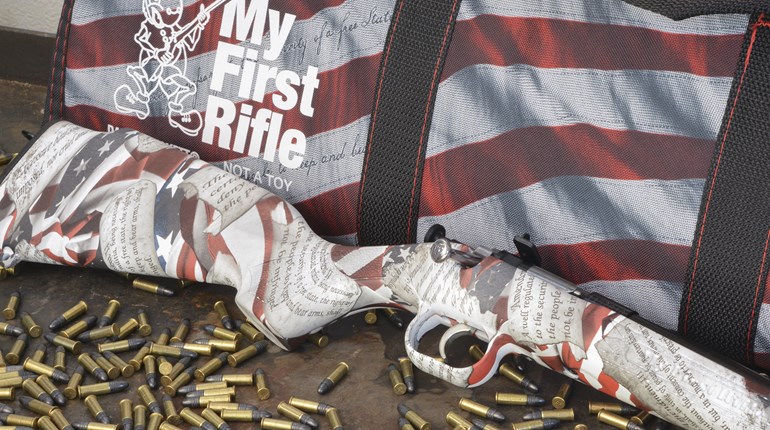
Now “black rifles” come in camo and other colors.The rifle designs evolved, too, with longer barrels, lighter weight, better triggers and other changes directed at hunters. What’s more, hunting versions usually lack some of the more common AR features like a collapsible stock, a bayonet stud, a flash hider on the muzzle or the A2-style front sight on the gas block. But what really kicked this trend into overdrive was when Remington announced its R-15 rifle in 2008. Now, with the power, gravitas and visibility of America’s largest gun company behind it, the AR-15 has arrived as a hunting rifle.