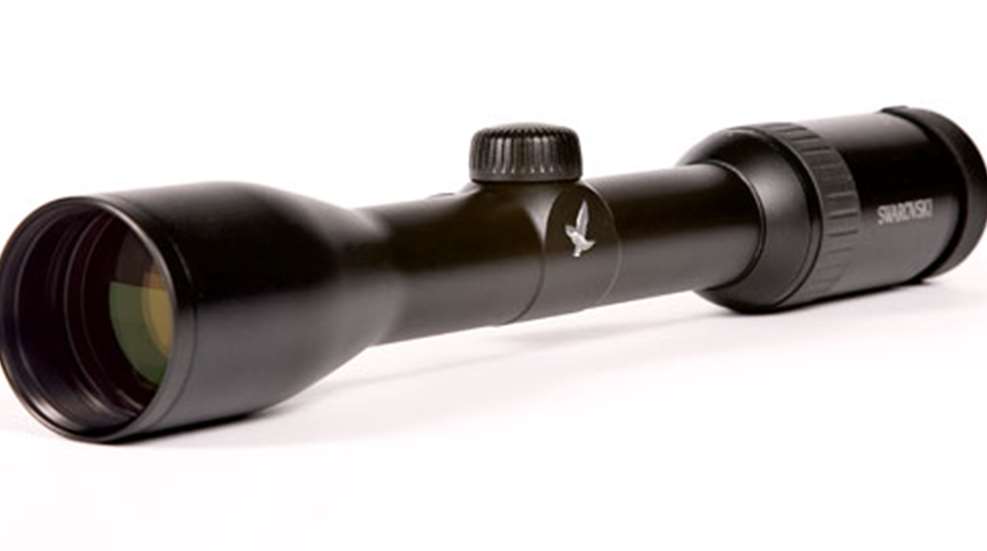
Leave it to Swarovski to devise the new math for riflescopes. The company that famously rewrote expectations for brightness and clarity in hunting optics is now breaking the variable-magnification barrier with its new Z6 line.
Heretofore, there has been a limit on how much zoom could be built into scopes of practical size and eye relief. Standard 1-inch-tube scopes could triple their magnification, as in the case of 3X-9X, 4X-12X and 6.5X-20X, while 30mm models could increase it fourfold, such as 2.5X-10X or 4X-16X. Seeming oddballs, like the 2X-7X, are in fact expressions of power ratings rounded off to the nearest whole numbers, which, in this example, is closer to 2.25X-6.75X.
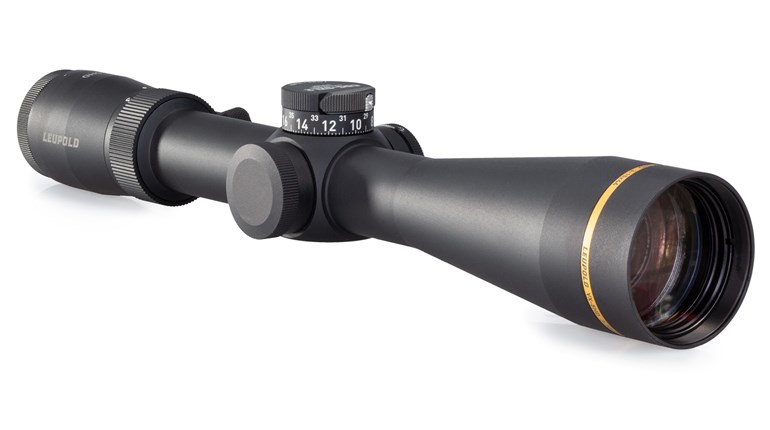
With the Z6, Swarovski circumvents the traditional limiting factor, which is the way focal lengths of different light waves pass through the sliding glass lenses of a scope's erector tube. Sticking with 30mm tube diameters, the Z6s can boost power by a multiplier of six, including 1X-6X-24mm, 1.7X-10X-42mm and 2X-12X-50mm models.
The most obvious application would be for hunters who rely on one favorite rifle for different kinds of game in varying habitat conditions, say a deep-woods whitetail hunter who also wants to pursue open-country game like coyotes or pronghorns with the same gun. This principle may prove even more valuable to dangerous-game hunters in Alaska or Africa, who one day use their .338 or .375 magnums for precision shooting on distant critters like sheep or small antelope, but on the next must follow up on a bear or buffalo in heavy cover. A wider range makes it more likely to dial in the perfect magnification, especially for accomplished marksmen with the skills to utilize high-end settings. Also, the extra detail provided just might allow hunters to pick up obstructions in the brush they would have missed otherwise.
The advantages don't stop there. The Z6s offer generous eye relief, anywhere from 20 to 50 percent greater than comparable models, delivering a minimum of 3.75 inches at the highest power settings. Furthermore, for big-bore shooters who can use even more separation to prevent a recoil conk on the forehead, Swarovski has added a 1X-6X EE (Extended Eye Relief) model boasting 4.75 inches of clearance. And all that eye relief doesn't come at the cost of a narrow field of view, either. Models set at 1X cover more than 100 feet FOV at 100 yards, and even at 12X the field extends 10.5 feet at 100.
Z6 features include six different reticles (four of which also come with battery-powered illumination, designated Z6i) including the TDS with multiple horizontal crosswires for trajectory compensation. The series can be purchased with the easy-mounting Swarovski Rail (see sidebar).
I tested the Z6 1.7X-10X-42mm on a 6.5-pound custom rifle chambered for .300 Win. Mag. and a T/C Encore .50-caliber muzzleloader. Firing stout loads (Hornady Heavy Mags in the custom gun and 150-grain charges in the T/C), there was no shift of zero, which, frankly, I have occasionally noted in other Swarovski scopes. Accuracy of both rifles remained consistent throughout my firing sessions, and the positive click adjustments moved point of impact as marked. Light transmission and sharpness were just what you'd expect from an acknowledged market leader-absolutely brilliant.
Of course there are certain prices to pay for the technical wizardry. Some shooters, especially those accustomed to standard 1-inch scopes, will find these optics bulky and a bit heavy-the non-illuminated 2.5X-12X, for example, weighs more than 18 ounces. Then there's the other price, the literal one, and on that score Swarovski already led the way in changing what a surprising number of hunters will pay for blue-chip optics. Z6s start at $1,600 and run to more than $2,500 (suggested retail) with all the bells and whistles.
Sticker shock may indeed limit the number of folks who eventually carry the Z6 into the woods, but those who do will have a breakthrough product whose versatility and smart features may well influence subsequent riflescope development.