Back in the day here in America, a hunter’s knife was often a butcher knife pilfered from the kitchen, a trade knife or the biggest folding jackknife the hunter could find. Just before the start of the 20th century Webster Marbles introduced the modern hunting knife.
Today we have so many knives to choose from it’s a bit overwhelming when trying to buy one. Here is a little info to help with your decision.
First off is what type do you want, fixed blade or folder?
Folders are shorter in the sheath and are easier to carry when worn on the belt, particularly when seated. Folders are not as strong as a fixed blade and are much harder to keep clean. If I will use the knife for more than just field-dressing, I prefer a fixed blade. They are stronger and a lot easier to clean the blood and bits from after use. It’s also easier to get into play from the scabbard when the other hand is busy. Often the handle is more comfortable to hold than a folder.
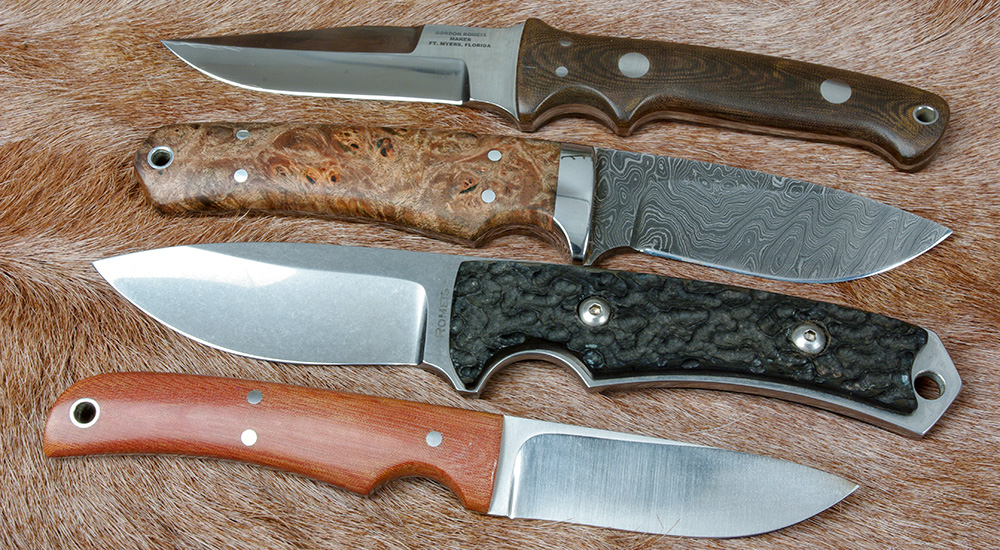
Stainless steel has just about taken over the market, but there are a few things about carbon steel that I like. It sharpens easily compared to stainless steel, for one. It requires more maintenance and care, but after a few years it can take on a nice patina that looks aged, experienced and pleasing. Still, stainless has taken over for a reason. It’s pretty trouble free.
The biggest decision you will face is the blade style. There are a lot of knife blade designs, but the hunter should be most concerned with these three.
A clip point is a blade that appears to have the top of the last third or so of the blade “clipped” off. It’s very popular with hunters and is a good choice all around. Some say it’s not as strong as other designs, but you should use your knife for cutting, not prying or chopping, so it’s a moot point.
The drop point has the spine of the knife “drop” down slightly in the last section of the blade as the edge rises to meet at the point, with a long, curved belly on the edge. The drop point is thought to be the best design for hunting use and I cannot disagree. For all-around hunting and woods it is my first choice.
The “trailing” point turns up near the tip to raise the point of the blade above the spine of the knife. This creates a sweeping edge that is very good for skinning. It’s probably not the best design for all around use, as that tip can get a bit “stabby” when field-dressing game.
See what I did there? Now you need to buy at least two knives. The blade length on useful hunting knives is around 3 to 5 inches. I just measured a dozen of my most favored knives and 3.5 inches seems to be the most common blade length.
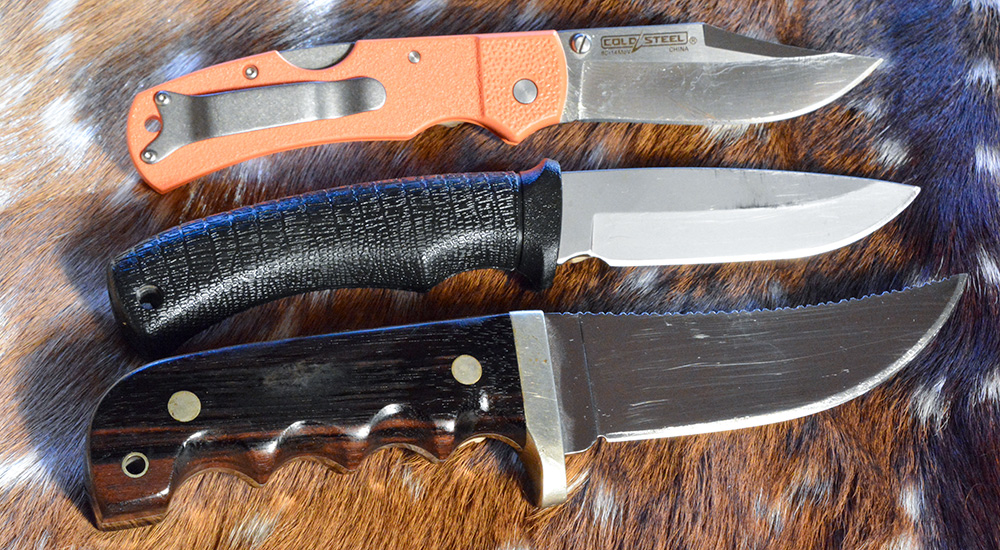
Serrations? While they are popular today, I detest them. They are primarily said to be for cutting rope. That’s great for a tangled sailor avoiding a dunking, but hunters rarely have a rope emergency. Serrations are difficult to sharpen and after multiple sharpenings have a tendency to decay into an ugly mess.
While I am not a fan of serrations on a hunting knife, I absolutely detest a blade with a gut hook. First of all, if you know how to field-dress big game it’s unneeded and unnecessary. It’s always getting snagged on something. A gut hook is hard to sharpen and just a nuisance. If you must have a gut hook, buy one of the stand-alone models or a folder with a stand-alone gut hook.
There are a lot of options for the grip. Rubber is hard to beat. It provides the best gripping surface for a wet, bloody hand and requires little maintenance. I have used rubber-handled knives in 100-degree heat of Africa and at minus 45 degrees north of the Arctic Circle. Other than a Lab puppy eating one I hadn’t washed yet, I have had no trouble.
Other synthetic grips come in a wide range of colors and designs and are just about bulletproof. They are always a good choice and often they are enhanced with some sort of embossing or checkering to improve the grip.
Wood looks good and has a decent grip, but it takes a bit of work to maintain. I rub the wood down with tung oil after use to keep it from drying out. The metal is cleaned and then rubbed with a silicone cloth to protect it, as silicone will not contaminate meat or other food like oil can.
Bone or stag (antler) is fine for a grip, but can be expensive and sometimes uncomfortable in the hand. I prefer it on a custom knife that I hold and gaze at more than use in the field. The fake stuff is popular on affordable knives and works just fine. Not as popular as they once were, stacked leather washers are still used for knife grips. They require a bit of leather conditioner now and then.
You will carry the knife in its sheath a lot more than you will use it, so pick a strong, secure design. Leather is the old standby and is still a good choice if you take care of it. Kydex is also good and trouble free, but it’s stiff and can be noisy. Nylon has all but replaced leather and is probably the best choice for an active hunter.
So, what would I buy if I were a hunter looking for a first-time hunting knife? I would pick a fixed blade, drop point, stainless steel, 3.5-inch blade with a rubber grip.
Of course, I am a true believer of the adage that a hunter can’t own too many knives, so I am already shopping for the next one right away.