As spring descends, it's game on for sportsmen and women with turkey seasons booming all over the country. With an estimated 3 million sportsmen considering themselves turkey hunters, spring turkey hunting is not only the biggest game in town at this time of year, it also turns out to be one of the biggest types of hunting period, right behind whitetail hunting.
Hunters who have already been bitten by the bug know it’s addictive.
“There is no better feeling than waking up on a warm spring morning before the sun rises and driving out to your favorite turkey spot…because you put those monster thunder chickens to sleep that night [before], and you know where you want to be the next morning,” said California turkey hunter Keith Swope. “As you start [calling], you know he hears you and he's answering every call. Your heart starts to beat harder, your breathing becomes faster, and…you feel more alive in this moment than any other time of year.”
Swope isn’t alone in his enthusiasm.
“When you get [a tom] in so close that you can feel his gobble rip through your chest ... there's just no other high like that in the world. It gets in your blood, and then stays there,” said writer Cory Pedersen.
Ask other turkey hunters what they think, and their statements will be filled the same passion.
In fact, when asked to choose which one they would pick between deer hunting or turkey, many outdoor industry hunters who do both will quietly admit they would choose turkey hunting.
Why Spring Turkey Hunting?
So, what makes spring turkey hunting so great compared to other types of hunting? For starters, it’s quite simply an excellent time of year to be outdoors. Winter weather is releasing its icy grip, and with the red buds and dogwoods blooming and leaves greening out, the countryside is coming into full splendor. That warmer weather also means it’s much more comfortable to be outside. Let’s face it, as fun as hunting deer, ducks or other game in the fall and winter can be, hunters oftentimes face brutally miserable weather to enjoy the best conditions. Not so with spring birds. There’s no need to wear layers of bulky clothing as most mornings that still have a chill give in to the warmth as the sun rises. And as the temperature heats up, so does the hunting action. Few things drive gobbling birds like a break in the cold.
For hunters, spring turkey hunting is also pretty much the only game in town at this time of year. Sure, you can always pursue hogs, coyotes and, in fewer places out West, spring bears, but their range is still limited. Turkeys, however, are nationwide, with spring seasons now open in every state but Alaska, where it is too cold for turkeys to survive. But it wasn’t always this way.
Just 50 years ago, most turkey seasons—at least in the states where struggling populations still clung on—were held in the fall. It was even considered unsporting by many to hunt gobblers in the spring, when it was believed it was too easy to hunt gobblers as they were blinded by the urge to breed. However, as efforts to restore wild turkey populations began to ramp up in the late 1950s and on into the 1970s, wildlife biologists such as North Carolina’s Wayne Bailey led the charge to switch the seasons.
“It didn’t take biologists long to realize that if they wanted to restore turkey populations that hunters had to quit killing hens, which was happening in the fall,” said National Wild Turkey Federation Assistant Vice President of Agency Programs Robert Abernethy.
Both toms and hens remain legal to take where fall seasons occur. Gradually, more and more states opened spring seasons as turkey numbers continued to skyrocket, and today, we have turkey hunting virtually everywhere.
Lastly, the challenge of working a bird to the call in spring has been likened to a chess game—man versus beast in a match of woodsmanship and instinctive wits. The turkey itself is often given way too much credit for being smart. Its brain is the size of a walnut. Not a lot of smarts there. But there is one heck of an instinct for survival. Turkeys, from the time they are born—even before they are born and are still in the egg—until the day they die, are prey for something else in the woods where they live. Something always wants to eat them, so a paranoid ability to survive is what keeps the species thriving.
Put simply in the words of outdoor television personality Michael Waddell, “If you can call in and kill a turkey, you can kill anything.”
If you’re still one of the holdouts on this most challenging spring tradition, it’s time to give in and try your hand at spring turkey hunting.
Getting Started
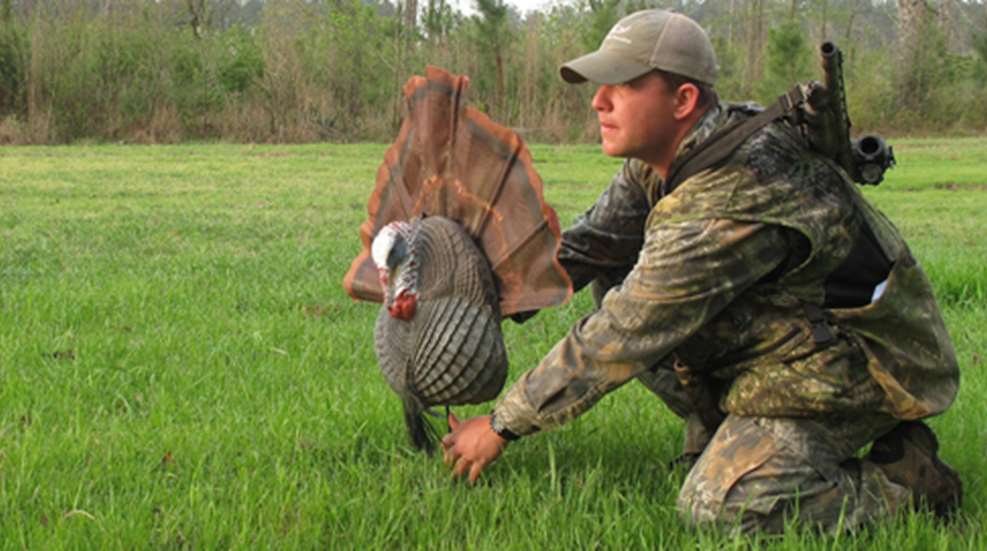
Getting started is easy. While there is tons of specialized gear designed exclusively for hunting turkeys, most hunters already own the basics of what they need for a day in the spring woods. Good camouflage, a place to go and a shotgun are the basic ingredients. Odds are, turkeys roam the same property you deer hunt in the fall. Make a run to the store to get a few turkey calls along with some No. 4, 5 or 6 turkey loads and you are on your way.
As for learning to call, a push-pin call, which works from simply using your finger to depress a rod that runs a small rectangle of wood along a pointed or angled surface to create the yelps and purrs of a hen, is a great call to begin with.
Pot calls, also often called slate calls because of the primary friction surface originally used (they now come with a variety of composites, glass, crystals and metal), are also easy to learn, as are box calls, which deliver great yelps and cutts with lots of volume for long range calling or windy day hunting.
You’ll want to grab a mouth call, too—they’re among the cheapest to buy—however they are harder to learn to use.
While it is always good to watch DVDs or programs on turkey hunting to begin mimicking the calls you hear and learning about the tactics you’ll need to master—as well as doing your fair share of reading and researching—by far, the best way to learn how to turkey hunt is to find an avid turkey hunter and join him or her on actual hunts. Going on a guided hunt or two, even locally, can be both affordable and a wise investment on fast-tracking your turkey hunting education.
Regardless of how you approach turkey hunting, just get out there and start enjoying the spring woods. The time is now. Make the most of it.