Editor's Note: Read Part I Here
Perhaps you thought I was being a bit too dramatic when I warned you about broken scopes in Part I. Well, a week after I wrote it, I found myself in Central Montana chasing deer with a new rifle from Bergara. During a lull in the hunt, I staged the rifle on some rocks to get static photos for publication use. Here in Alabama, winds that can knock down a rifle are tracked by the National Hurricane Center. In Montana, they call days with those kinds of winds "Tuesday." A strong gust of wind blew the rifle from its perch and sent it tumbling down the rocks that had made such a fantastic photo backdrop. By the time the rifle came to a stop, the scope’s erector system had found a new place to rest. Is the scope to blame? Maybe, but I think that most brands would have suffered a similar fate. The blame lies with the idiot who propped the rifle on a rock on a Montana Tuesday. Hey, these things happen. Because we were prepared, we mounted our backup scope, hit the range to confirm our zero, and I killed a nice buck that afternoon. Happy ending for everyone but the deer.
Hopefully this anecdote is a reminder that scopes and mounts can make or break a hunt. Let’s focus the attention of this installment on detachable mounts and iron sights for close shots in thick vegetation—rifles intended for dangerous game hunting are the most common example of this kind of arrangement. That said, everything that I’m about to say can be applied to hunting any game in thick cover where close shots are common be it bears, hogs, deer or even elk.
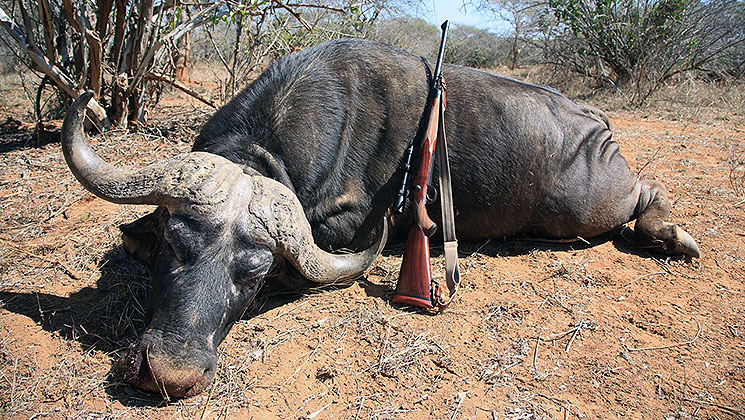
The "rule" for dangerous game goes like this: Hunter shoots a cape buffalo at 50 yards and it runs away. It’s in the thick stuff now and the time has come for a tense tracking job. The hunter removes his scope and prepares to take his next shot with iron sights. Why? Because that’s what he read in a book written decades ago. Let’s just say that I don’t necessarily agree with this logic. Bad things happen in the real world and when bad things happen on a dangerous game hunt—someone can get stomped.
For starters, a scope is a superior sight in almost every circumstance; it’s not really even up for debate. There’s a reason that fast-paced competitive shooting events have different categories for firearms equipped with optics—they are a tremendous advantage in both speed and accuracy. If you want to go into the woods with the best advantage that you can, use a high-quality optic. I have no problem with someone who wishes to tackle dangerous game with an iron-sighted rifle such as a vintage double, so long as that hunter understands that doing so will limit the shots that he will be able to take. Unlike the old photos that you saw, most buffalo hunts nowadays take place in thick vegetation. In much of Zimbabwe or Mozambique, a hunter will likely see "pieces" of buffalo through the brush rather than a clear image of a bull. The one exception to this in the dangerous came context is probably elephant, but that is a very specific niche that 99 percent of hunters will never experience.
The first time I had a shot opportunity at a buffalo was in Zimbabwe’s Save Valley Conservancy. Despite being only 35 or so yards away, I could only see bits of his black hide and the reflection of his smooth bosses in the shadowed jess. By arranging the images of bits into the form of a buffalo in my scope, I was able to put the pieces together sufficiently to take an ethical shot. I had to trace his front leg up from the ground and, using his brisket as a height gauge, aim for a shoulder that I couldn’t see. A single Barnes Triple-Shock quickly ended his time on this Earth. Had I been hunting with iron sights, I would not have pulled the trigger.
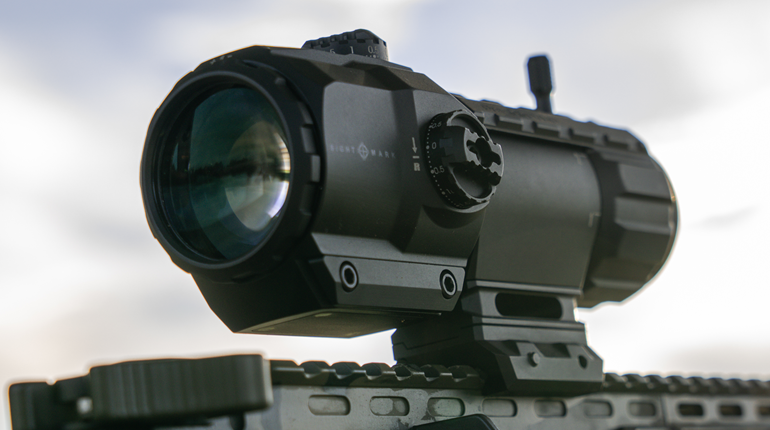
Despite the clear advantage of an optic, some hunters still believe that iron sights are superior to a scope in thick bush. Oh yes, I know what you’re going to say: a scope is slower at close range. Well no, actually; not if you chose an appropriate scope for dangerous game hunting. Low power variables, scopes such as the 1-4x24mm Trijicon Accupoint, 1-4x24mm Nightforce Compact, or the Swarovski Z6 1-6x24mm allow hunters the ability to make shots at hundreds of yards at maximum power while besting the speed of iron sights at 1x. Next time you watch a 3-Gun match, pay attention to the scopes they are using to make lightning-fast hits at close range, any one of those optics would work equally well for hunting in thick cover.
The problem is really one of perception. Africa-bound hunters fear that the most likely outcome of a wounded animal is a charge, and want to be prepared to stop that animal at spitting distance. As exciting as this sounds, a far more likely scenario is a brief opportunity to put down the wounded animal after hours of exhausting tracking. These are likely to be some very difficult shots under very tight time constraints in thick, dark cover. These are precisely the conditions under which a scope shines and why an appropriately-scoped rifle makes lots of sense for following up wounded game.
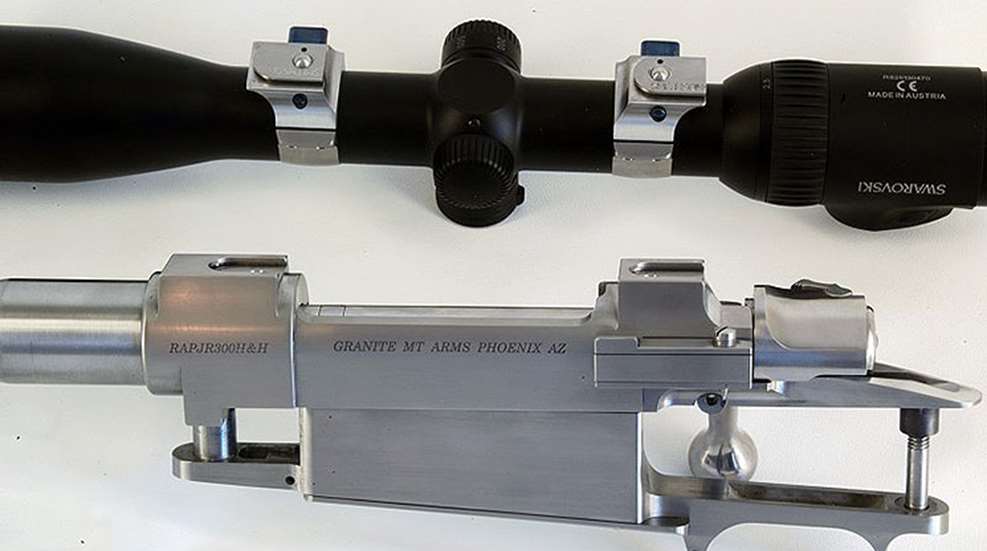
We are going to switch gears and talk about scope mounts. Rifles for buffalo, elephant, lion and the big bears produce a great deal of recoil. The inertia of that recoil can be tough on scopes and solid mounts are a key element of a successful equation. Quick detachable (QD) mounts are handy for removing a scope quickly but many are made from materials that make them prone to excessive wear if they are removed and replaced too many times. Couple this with a hard-kicking rifle, and you have a recipe for trouble. Yes, I know that it’s traditional to put scopes in QD mounts on a dangerous game rifle but that doesn’t mean it’s a good idea. If you gave me the choice between ensuring that my scope would stay put under recoil and the ability to remove it without grabbing a torx wrench from my pack, I’d opt for the security of a fixed mount every time.
Not all QD mounts are created equal: Some notable custom gunmakers have produced QD-style rings using heat-treated steel and tolerances that are repeatable over the life of the firearm and hold scopes securely. The late Tom Burgess’ QD rings were the standard by which other rings were judged for decades and Joe Smithson produces some very slick rings that are secure, durable, and fast to remove. German-style claw mounts can provide repeatable accuracy along with strength but require hand-fitting and are expensive to produce. I had a set of claw mount rings fit to the existing bases of a 1903 Mannlicher-Schoenauer carbine a few years ago and the parts and labor exceeded what I’d paid for the rifle.
Just because something is traditional doesn’t make it a great idea. If you want to hunt with iron sights for the challenge or because you own a vintage rifle, by all means do it but understand that you are putting yourself at a disadvantage. 3-Gun shooters, military units and police SWAT teams have embraced the advantages for optics for close-in shooting but hunters have held-onto obsolete concepts when it comes to scopes, sights, and mounts. If your experience hunting dangerous game in thick cover causes you to disagree with my position: by all means, do it your way. However, if you disagree because you read it in a book somewhere, maybe you should get out to the range or hunting fields and give the question some honest exploration.