A dogger’s goal while pushing deer is to drive the prey into a pocket formed by others in his gang, those hunters who are posted about a hundred yards apart along strategic locations up to a half-mile away from the dogger’s starting point. When everyone is in position, the dogger weaves his way through the woods into the wind and pocket formed by the other hunters. The approaching sound of the dogger snapping twigs and crunching leaves alerts unsuspecting deer. They often panic and flee from perceived danger, toward real danger, waiting loaded and ready in the pocket.
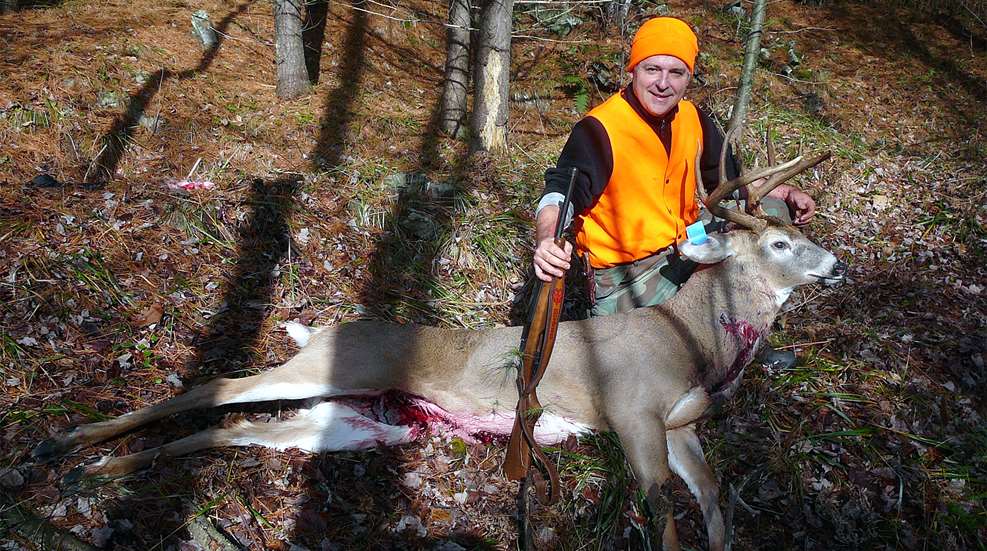
This time-tested hunting strategy, like any other trap, is often successful. But the dogger rarely kills a deer during a planned drive, except when the Dogger’s Window is open. The “window” is a period lasting 15 minutes or less, when he has a better chance of killing a deer than all the other hunters combined. I have killed numerous deer from the Dogger’s Window, including this 200-pound, 8-point buck last November.
The Dogger’s Window is created by the hunters while forming the pocket. Often they choose to roar along through the quiet woods on four-wheelers to get to their watches. As each hunter is dropped off, a shell is slid into a hidden chamber and a clip is snapped into place with a piercing, metallic clickety-clack that reverberates through the light of dawn. The line of hunters forming the pocket has become a wall of noise in the woods. To deer the sound is no different than a pack of coyotes howling at a full moon.
Any deer near the pocket know where those hunters are, what they are doing and why they are there, especially big bucks, which are already up and gone. But that’s good news for the dogger, because those deer are heading in his direction. The hunters in the pocket have temporarily and unknowingly flipped the strategy around. They are now pushing deer to one hunter: the dogger.
If you are a dogger, you are already one of the best hunters in your camp, because you know the great woods. You probably learned those woods the hard way, which is also the best way and the only way—by getting lost and turned around so often that gradually you came to know what is over that next ridge and the one after that, where one swamp ends and another begins, which way the ridges run, where the woods open and where they close in heavy cover, and how it’s all stitched together with the game trails of whitetail deer to create a sacred and timeless wilderness mosaic.
All you have to do is decide where the Dogger’s Window should be in the big woods. To minimize your imprint, it should be a place located within a few minutes of where you would normally start the run. I stand behind a clump of birch trees on a ridge looking down towards a lake, watching a deer path running parallel to the water, and broadside to my watch.
The big buck I killed there last year was trotting down that very path.
I could see from his body language that he felt he was far away from the danger of the pocket because he was no longer running hard. But he knew he still had to hurry, and could not afford to just walk. His mind was preoccupied with the threat behind him. He was not thinking about the danger ahead. The easiest buck to kill is the one that doesn’t know you’re there.
Don’t wait to stumble upon a window of opportunity in the November woods. Chances like that don’t just appear on their own. You make them happen. When the Doggers Window is open, be there and be ready. Opportunity is on the way.
2026 ‘Member’s Hunt’ Prize Package
In 2026, every author of our 12 “Member’s Hunt” departments published here will receive an NRA membership prize package including a handful of hats (including a hard-to-get American Hunter hat), a made-in-America Buck Slim Ranger folding pocketknife, a rechargeable headlamp, a gun cleaning kit and a packable duffel.
Do you have an exciting, unusual or humorous hunting experience to share?
Send your story (800 words or less) to [email protected] or to American Hunter, Dept. MH, 11250 Waples Mill Road, Fairfax, VA 22030-9400. Please include your NRA ID number. Good quality photos are welcome. Make sure you have permission to use the material. Authors will not be paid, and manuscripts and photos will not be returned. All material becomes the property of NRA.