Rifles are hard enough to sort out with the many different brands and calibers to choose from, but if you think deciding on a new rifle is tough, try riflescopes. Optics are significantly trickier to cull through than rifles because, while you can compare rifles and calibers in a fairly impartial manner based on easily understandable criteria, you’re left to decipher confusing jargon, arcane technology and alien terminology when you start browsing riflescope catalogs. Even if you learn to understand the complexities of optics, you can’t measure things like light transmission or refractive index outside of a laboratory anyway.
However, there are some measurable and quantifiable features to a riflescope that you can use in your buying decision. It’s precisely those practical aspects that led Leica to re-enter the riflescope business with two new models tailored specifically to the American hunter.
Certainly, all the techno-jargon of optical instruments applies in spades to anything Leica makes because the 161-year-old German manufacturer is renowned for the quality and performance of its many types of optics. It was Leica, after all, that invented the 35mm camera back in the 1920s, and it has pioneered some of the best optical devices since then, including binoculars, spotting scopes, camera lenses, rangefinders and now, again, riflescopes.
Leica’s new riflescope line consists of two models, a 2.5X-10X-42mm and a 3.5X-14X-42mm. This new line represents Leica’s third offering of riflescopes. The first series was introduced in the 1950s at the behest of Dr. Ernst Leitz, an avid hunter who was then head of the family that started Leitz Camera (Lei-ca, get it?). The second series made a brief appearance in the United States as a joint venture between Leupold of Oregon and Leica in the 1990s, but the line was discontinued.
Now, in 2010, Leica is back with riflescopes made in its German factory but with features designed specifically to address the needs of American hunters. These are things we can measure in such areas as the amount of straight tube space available to accommodate different rifle/ring configurations, generous eye relief and a second-focal-plane reticle, which Americans prefer.
If you take these features and reverse them—inadequate tube length, overly short eye relief and a first-focal-plane reticle—you have a concise list of the three biggest complaints against other European brands of riflescopes. Leica started with these negatives and transformed them in a totally red, white and blue manner.
While Leica’s tubes are 30mm in diameter, which is not necessarily the American norm, the larger tube is necessary to house Leica’s impeccable camera-grade glass; after all, a Leica buyer is primarily interested in the superior optical qualities for which the brand is justly renowned. America’s best-selling riflescope brand, Leupold, also offers 30mm tubes, so that’s not so un-American after all.
Leica is proud of the engineering of its tubes, which feature lengthened straight-sections to accommodate various ring spacings. Leica claims their straight-sections are up to 48 percent larger than competing brands. I measured several models from Leica, Zeiss, Swarovski, Schmidt & Bender and Leupold—from the objective lens to the turret (front section) and from the turret to the eyepiece (rear section). Adding up the rear and front sections, Leica offers 5.184 inches of mounting surface, which is indeed greater than that of any of the other models I measured.
Eye relief is my biggest issue with European riflescopes. Invariably, the eye relief is set too short for the heavier calibers favored by American riflemen. I prefer at least 5 inches of eye relief on any caliber beginning with a 4, but eye relief of 4 inches is sufficient for calibers in the class of the .375 H&H Mag., .338 Win. Mag. or the various .300 magnums. Leica’s two riflescopes both come with exactly that—4 inches of eye relief—which is just fine. I don’t plan on putting a 2.5X-10X anything on a .458 Lott.
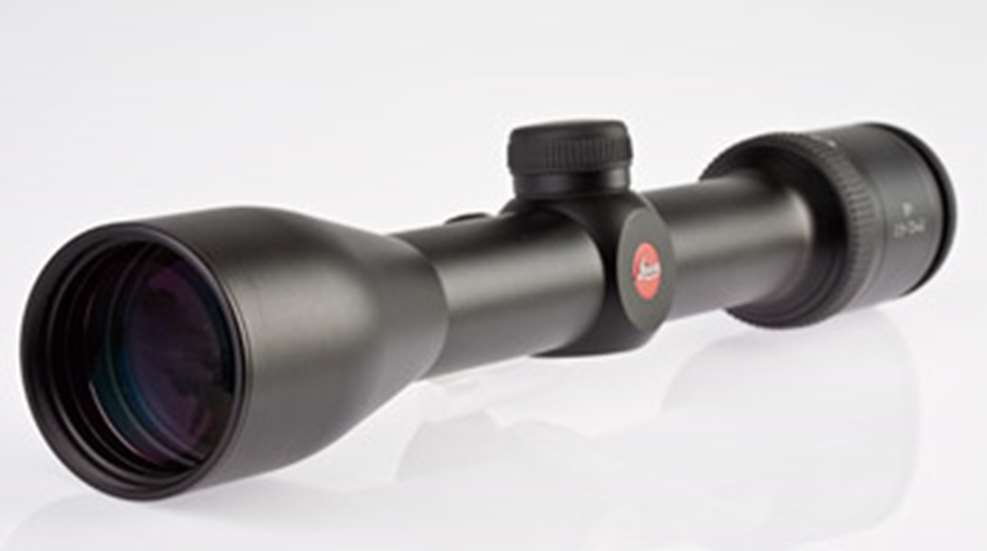
I tested a Leica 2.5X-10X-42mm sent to American Hunter for review. The finish is an attractive matte black, which matches the more subdued finishes on today’s hunting rifles. A see-through scope cover is included.
The adjustment turrets are calibrated in quarter-MOA increments with positive clicks that are easily felt. The directions (up, down, left, right) are in English and German. The turret caps are rubberized and sealed with O-rings for weatherproof protection.
The eyepiece is adjustable for diopter compensation from -4 to +3 and is covered with a rubber pad in case the 4 inches of eye relief is not quite enough if you crawl up your stock when a full-curl sheep is standing in your Leica-Plex crosshair.
Parallax on the 2.5X-10X model is factory-set at 100 meters, but there is a parallax-adjustment knob on the turret opposite the windage adjustment on the 3.5X-14X model. There are five reticle styles available: Leica-Plex (duplex-style), a bullet hold-over ballistic reticle; two German post options; and a reticle with two small dots for specialized benchrest competition.
I tested the Leica 2.5X-10X on a .375 H&H Magnum. The rifle is a custom-built Winchester Model 70 and is fairly heavy at 9.5 pounds without the riflescope, and 11 pounds with the optic and 30mm steel Talley rings. I fired 20 rounds of 300-grain handloads, which is not exactly a 10,000-round torture test. But it sufficed to show that the Leica reticle can withstand recoil. The only time I’ve seen a broken reticle, it happened in the first five rounds.
I fired two rounds, dialed up four clicks and fired two more, dialed right four clicks and fired two more, dialed down four clicks and fired two more, and finally dialed left four clicks and, yes, the last two rounds hit on top of the first pair. This is called “shooting the box,” and it tests how accurately the erector tube moves when adjusted—which was perfectly fine.
To test for optical clarity, I placed a newspaper at 25 yards and, with the Leica set to maximum 10X, read it. I could not get the focus perfect at that close range, but was able to read 14-point headlines clearly. I tried a Trijicon and a Leupold on the same test, and could not tell a marked difference between those and the Leica. Print smaller than 14 points was indecipherable with all of them.
Overall, I’m impressed with Leica’s new series of riflescopes. I like the fact that they’re made in Germany, which indicates a stronger commitment than its previous joint venture, and of course I love the “Americanized” features of long eye relief and lots of straight tube.
A company spokesman preferred not to comment on new models that will be coming in 2011 other than to say there will be more choices of power range and different objective lens sizes. To which I say, bring ’em.
Specs:
Magnification: 2.5X to 10X
Objective Lens Diameter: 42mm
Eye Relief: 3.94"
Exit Pupil: 4.2-14.9mm
Field Of View @100m: 3.9 to 14.5m
Coatings: fully multi-coated; Aqua Dura on exterior surfaces
Dimensions: length, 13"; weight, 16.5 ozs.
Construction: 30mm aluminum main tube
MSRP: $1,999