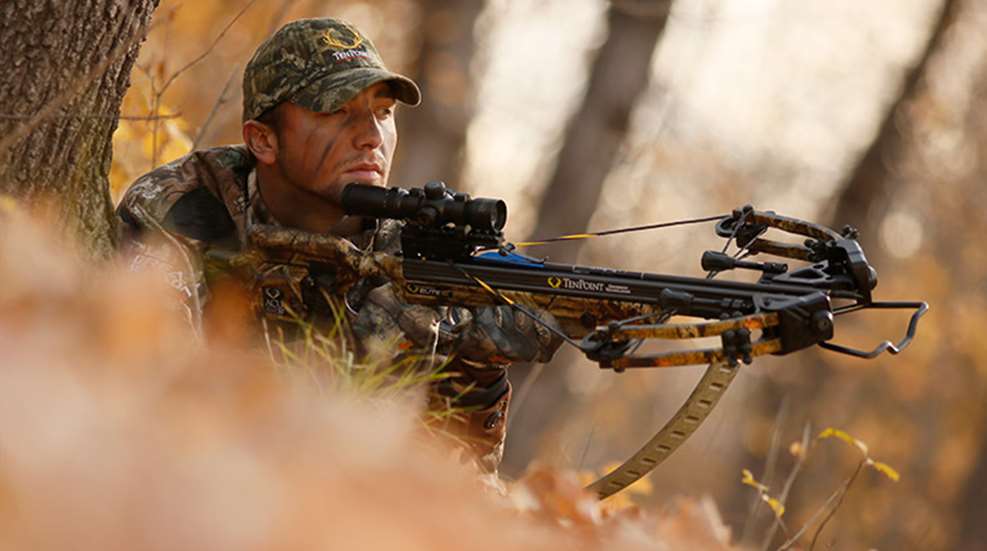
With more states opening archery seasons to crossbows, thousands of hunters are taking them afield for the first time. But without dad and grandpa there to give advice gleaned over generations—today’s crossbows are unlike any other hunting tool and are far more advanced than those of just a decade ago—techniques and tricks must be developed via experience. So instead of learning the hard way, simply get it here now.
Mount a Possibles Bag
Tape or otherwise attach a small pouch to your crossbow’s buttstock, wherein you can keep a rope-style cocking aid, string lube, Allen wrench set and field point. Think of it as a possibles bag, so all you have to do is grab your crossbow and go hunting.
While most men can cock a crossbow using only their fingers a few times, it’s a whole different story when it’s freezing cold in the morning or while in the confines of a treestand. For people of lesser stature, a forgotten rope cocker can mean a cancelled hunt. Finger cocking also is less precise than using a dedicated cocking device and is potentially dangerous—so I don’t recommend it. Keep a rope cocker ever handy by storing it in the pouch.
The same goes for the other items, especially the field point. At the end of a hunt, remove the arrow from the crossbow, replace its broadhead with the field point and shoot it into a small, portable target to uncock the crossbow. Then inspect the arrow to be sure it’s not cracked or bent, reinstall the broadhead and return it to your quiver. (While it’s desirable to simply keep an arrow tipped with a field point in your quiver, most crossbow quivers allow for only three arrows, and I don’t like to waste a spot on an arrow used only for uncocking.)
Load and Unload Safely
While the chance of a crossbow accidentally discharging is about like that of a gun—rarer than sushi—just like a loaded gun you’d never place anything in front of it that you value. But unlike a gun, a crossbow has three danger zones: One is any place inside the triangle formed by the cocked string and a line drawn between both axles. Another is directly in front of the arrow; the third is the broadhead itself.
To load safely, grasp the arrow directly behind the broadhead with only your thumb and forefinger while of course keeping your hand and other body parts out of the arrow’s flight path and the crossbow pointed in a safe direction. Place the arrow on the barrel while keeping your hand in front of the cams and axles. Then feed the arrow down the barrel without ever letting your hand go past the point where the string comes to rest when uncocked. This way, if the crossbow happens to fire (which is highly unlikely) the arrow will pass through your grasp harmlessly, while the string will stop before it reaches your hand.
Follow a similar procedure to unload, keeping your hand behind the broadhead but in front of the string’s stop point while you guide the arrow off the barrel. Be sure to keep the broadhead clear of the strings and cables, and your body, when placing the arrow in the quiver.
Zero Your Broadheads
Because broadhead flight and therefore point of impact often varies from field points, hunters should sacrifice a broadhead or two for zeroing their crossbow. Don’t trust expandable heads to fly exactly like field points, either. If your expandables didn’t come with a practice point, dedicate one to the zeroing process. No matter the design of your broadhead, check its point of impact on the target at multiple distances to be sure it flies true out to your maximum range.
Make a Dope Chart
Most crossbows come with multiple-crosshair scopes for precise shooting at various ranges. But some crossbows are faster than others, and so in some situations it’s best to use the top crosshair for both 20 and 30 yards, the second crosshair at 40 and so on. Problem is, all this can get confusing when a big buck stands broadside at 45 yards. So, like long-range riflemen, place a small square of duct tape on your crossbow’s scope or tang, and draw your reticle on it with a permanent marker. Then list the range of each crosshair based on your findings at the practice range. With a dope chart plainly in sight, you can simply range the animal, confirm the correct crosshair and fire.
Invest in a Quality Scope
For years experts have preached the importance of quality optics for hunters, and the industry has responded by making great, fully multi-coated optics affordable for everyone. But as of this writing, the crossbow industry lags when it comes to glass. Because a couple companies began offering package-deal scopes with their crossbows for almost no extra charge, others followed suit to remain competitive; now the market is filled with the cheapest Chinese-made scopes in existence. Most of them work fine on the target range under perfect conditions. Trouble is, when the rain begins to pour, the sun gets low and glare fills the view, or you bang the scope a few times, you’ll find out just how cheap these optics are.
If you’re investing in a new crossbow for serious hunting, spend a couple hundred dollars more on a quality, fully multi-coated, waterproof optic that has precise adjustments, good glass and solid components that won’t shift zero after a bumpy four-wheeler ride. While any riflescope you already own will work, dedicated crossbow scopes that have multiple crosshairs are ideal. Bushnell, Nikon and others make quality units for around $200, while the Zeiss Terra XB-75 costs about $100 more but is terrific. Perhaps the finest crossbow optic on the market is Trijicon’s ACOG XB, but it is very expensive. Whatever your budget, strongly consider upgrading your crossbow’s optic.
Add a Sling
Often the biggest complaint hunters register with crossbows is that they are heavy and cumbersome to carry in the woods. But most have sling studs. Use them. Buy an inexpensive sling or pillage one from your deer rifle. You’ll be glad you did when you head to the woods this fall.