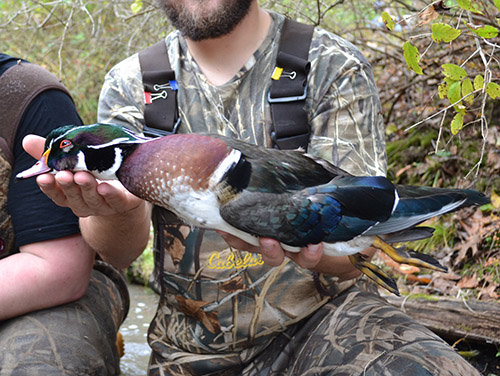
We all have our favorite ducks, but a few select birds hold a certain universal appeal. They are beautiful in plumage and flight; a challenge for any wingshot; a delight on the table. If surveys on the subject were ever taken, rest assured the wood duck would rank near the very top.
Never have I spotted one—shotgun in hand or not—without feeling fortunate to be in that place, at that moment. I could ramble on about the regal shape of the woodie’s crown, his hauntingly beautiful red eyes or his chestnut breast. But, to summarize, the wood duck is a bird that makes me happy to be alive.
It’s a pity that many hunters encounter him but once or twice in October, if they’re lucky, before moving on to other, less scattered species. There is a better way to enjoy the wood duck: by building wood duck boxes. Through perfecting its assembly and positioning it near an appropriate habitat, you can observe, appreciate and give back to arguably North America’s most beautiful bird throughout much of the year. Here’s how to build the perfect wood duck box, and why it’s so beneficial to nesting woodies.
Why Wood Duck Boxes Help
Many biologists believe that prior to the arrival of Europeans, the wood duck was the most common duck in eastern North America. By the 20th century, however, wood ducks nearly went extinct due to a two-pronged attack: heavy deforestation and market hunting. The Migratory Bird Treaty Act of 1918 ended market gunning, but deforestation remains an issue.
“Ultimately the biggest threat to the wood duck population is the loss of forested wetlands, which are especially important in terms of breeding habitat,” said Dr. Tom Moorman, director of conservation planning for Ducks Unlimited. “Wood ducks nest in natural tree cavities in forested wetlands, and require trees of cavity-forming age and size—at least 30 years and usually older.”
 Thankfully, these days the trend in many regions is toward habitat reforestation. The USDA-NRCS Wetland Reserve Program, for instance, has reforested 600,000 to 700,000 acres of flood-prone wilderness. But it takes three decades for newly reforested areas to boast tree cavities. And what about states like Missouri and Ohio, which have lost up to 95-percent of their historic wetlands areas?
That’s where wood duck boxes come in. They provide instant, artificial cavities for wood ducks in deforested areas and new-growth timber. Moorman can’t say for sure how large an impact the boxes have on the wood duck’s overall population, but those who build them are sure to notice a difference in their areas.
“Boxes can definitely boost local populations,” he said.
Building Plans
There are many schools of thought regarding the best lumber for building wood duck boxes, but it’s most important to use rough, unfinished wood, which provides a grip for ducklings to climb up and exit the box when the big day arrives. Smooth wood or metal is not recommended; however, if this is all you have at your disposal, be sure to line the inside with cloth or another material for the birds to use as a ladder. Ducks Unlimited recommends styling wood duck boxes after the original design by wood duck experts Arthur Hawkins and Frank Bellrose, the design plans for which can be found on the DU website.
The opening to the box should be about four inches across to keep heat in and weather out. You can additionally help the hen keep her eggs warm by placing about four inches of wood shavings in the bottom of the box.
One of the biggest mistakes people make is failing to install a suitable predator guard.“Hens nesting in boxes are very vulnerable to mammalian predators that can climb—especially raccoons,” Moorman says. “So it is important to install some barrier to prevent access.”
A predator guard can consist of something as simple as an upside-down cone made of sheet metal and attached tightly to the box’s post. Just ensure there aren’t any nearby tree branches that the predator could grab and use to hop over your barrier.
Proper Placement
The ideal wetland area for your wood duck box is thriving with invertebrates and insects, and the surface is a 50/50 blend of open water and plant vegetation. It should be located fairly deep in the woods, but not so remotely that you can’t visit it on occasion. For the first few weeks, you’ll need to ensure it isn’t claimed by starlings, stinging insects and other unwanted invaders.
You should also consider placement. Boxes placed in the middle of wetlands may be too visible, leading to excessive competition by hens for the box. It can also lead to “dump nesting”, in which two or more hens lay their eggs in the box. An average woodie’s clutch is 10 to 14 eggs, but dump nesting can result in huge clutches—up to 50 eggs.
“I personally once found a box with 49 eggs,” Moorman says. “Most dump nest clutches have lower egg hatch rates, because the hen that eventually uses the box cannot effectively incubate all of the eggs.”
So, consider placing your box within the surrounding timber to provide it some shelter. Don’t worry, the ducks will still find it.
Recently it’s been found that dump nesting is also exacerbated by the placement of multiple wood duck boxes in view of one another. It’s as if the nesting hens spot each other and decide to burden other ducks with their eggs. Therefore if you build multiple boxes, ensure they are not in direct lines of sight of one another.
On the opposite end of the spectrum, what if no hen uses your box? Don’t worry if it’s ignored for the first year. If by the second or third spring your box isn’t being used, well, move it somewhere else that hens may find more suitable.
When the ducks do arrive, enjoy them, but do so from afar with binoculars. Frequent visits to the box can cause the hen to abandon it in search of better privacy.
Maintenance
Proper maintenance is essential to ensuring the success of your box each nesting season. Failure to do so could even endanger the hen and her eggs. So, every year during the first few days of spring, inspect the box and repair any damage; remove the previous year’s nest; add fresh wood shavings; and ensure the predator guard is in proper working order.
Though at one time wood ducks were in jeopardy as a species, today they number between 1 and 2 million breeding pairs in the Mississippi and Atlantic Flyways. What better way to celebrate this comeback, boost local wood duck populations and better enjoy the birds throughout the year than by building a wood duck box?