The prairie dog town extended to the horizon, yet the closer, easier shots had all but ceased to exist. In spite of the intensity of the South Dakota sun, there was activity out around 300 yards; I got the rifle steady and gave the appropriate amount of elevation for 315 yards. When the trigger broke, I was elated to see the dog roll over. That .17 Winchester Super Magnum was wonderfully accurate, and proved to be a fully capable varmint cartridge, even at longer distances. Not that there were any flies on the .17 HMR we had at our disposal; the group of us were invited by Federal ammunition and Savage rifles to test some new ammunition, and we were certainly putting it all through its paces.
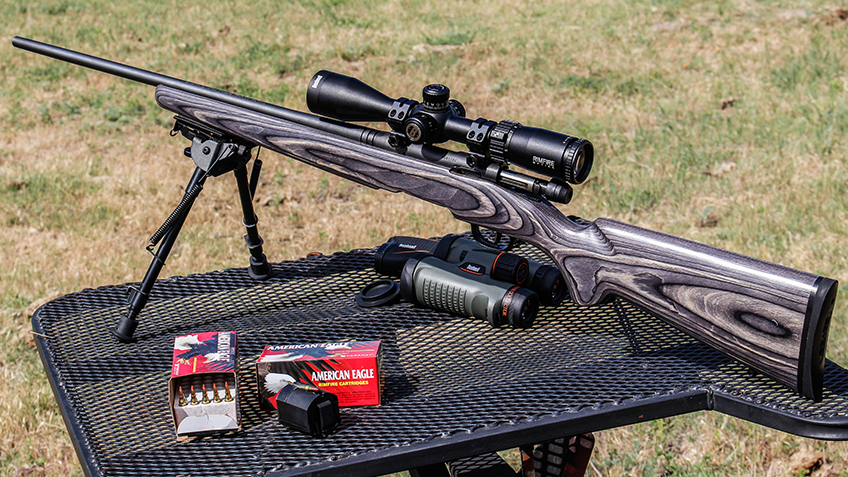
It was my first time shooting the .17 WSM, though I had spent a decent amount of time with the .17 HMR, I hadn’t had the opportunity at these distances before. I came away from the hunt with an appreciation for both cartridges.
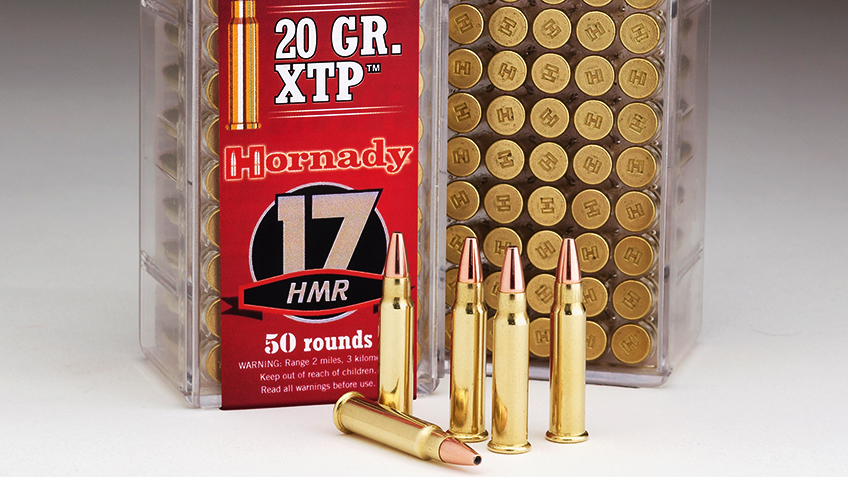
The .17 Hornady Magnum Rimfire, introduced by Hornady in 2002, is nothing more than the .22 WMR necked down to hold 0.172-inch bullets. Pushing a 17-grain spitzer bullet to 2550 fps, the blazing new rimfire gave both velocity and trajectory that had been previously unattainable in a rimfire cartridge, though the discontinued 5mm Remington Rimfire Magnum wasn't all that far behind. Hornady offered two loads: the 17-grain load stated above, and a 20-grain load moving at 2350 fps. Though both bullets are highly susceptible to wind deflection, shooters enjoyed the higher velocity, and the .17 HMR proved to be a success from its introduction. Zeroed at 100 yards, the 17-grain load drops just 2.7 inches at 150 yards, making life difficult for squirrels, rabbits and woodchucks.
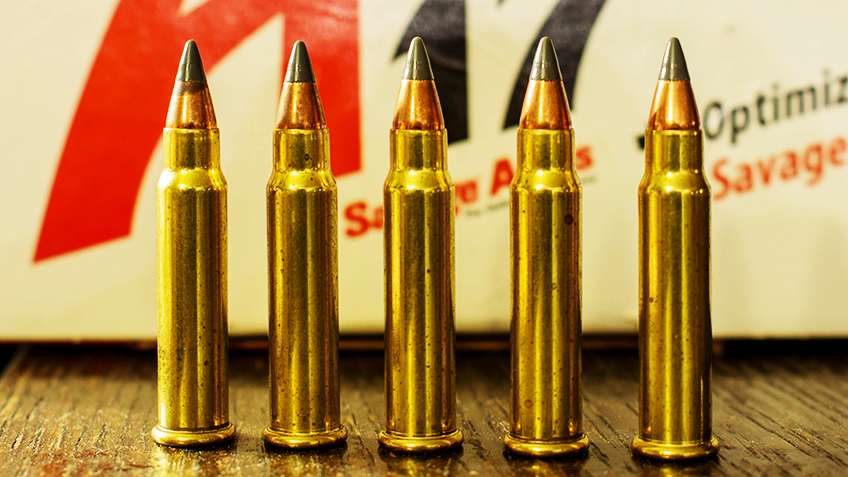
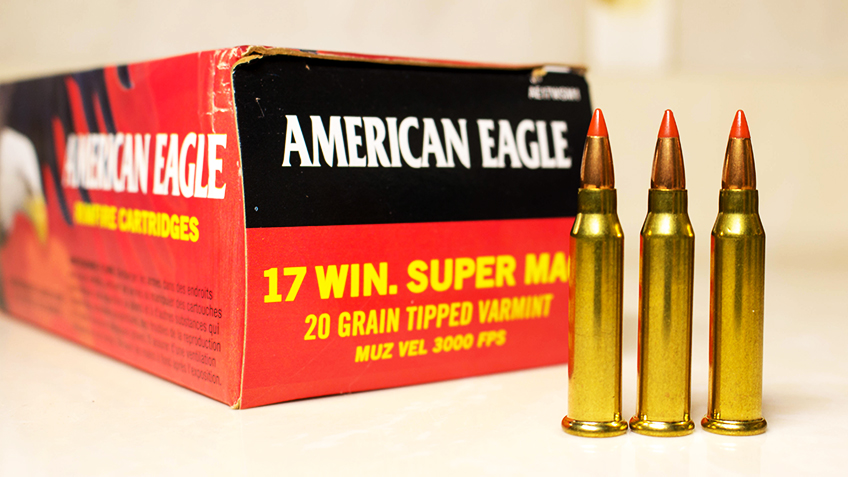
A decade after the introduction of the .17 HMR, Winchester threw its hat in the .17-caliber rimfire ring with the release of the .17 Winchester Super Magnum. The new speedy cartridge is based on—of all things—a .27-caliber nail gun blank. Driving a 20-grain 0.172-inch bullet to 3000 fps, the .17 WSM sits at the top of the heap as far as rimfire cartridges are concerned, and comes in just 500 fps or so behind the .17 Hornet. With a 100-yard zero, the 20-grain .17 WSM bullet drops but 1.2 inches at 150 yards and 4.1 inches at 200 yards, giving a very usable trajectory from a rimfire rifle. Quite obviously, Winchester is the biggest producer of the .17 WSM, offering three loads: the 20-grain load at 3000 fps, a 25-grain load using the Hornady V-Max bullet at 2600 fps and a lead-free 15-grain load at 3300 fps. Hornady offers its 20-grain V-Max bullet in their rimfire line and Federal offers a 20-grain polymer tipped bullet for the .17 WSM in their American Eagle line, and it was that load that shot so well on the Rosebud Reservation in South Dakota.
For the hunter looking for a speedy rimfire, which of these cartridges will better serve? I think it will depend on a couple of parameters. Neither of them will be as economical to shoot as a .22 Long Rifle, but I doubt you’ll be shooting either of them in the same volume you would a .22 LR. The .17 WSM tends to be a bit more expensive than the .17 HMR—the HMR costs between $0.20 and $0.30 per round, while the .17 WSM comes in at $0.30 to $0.35 per round—so if cost is an issue, the HMR may have a bit more appeal. The .17 HMR also has more ammunition choices; with options from Hornady, Remington, Winchester, CCI, Federal and Browning.
Looking at field performance, I find the WSM cartridge a better choice for the longer shots. Both the WSM and HMR can be made a fool of windy conditions, but as time of flight is a definite factor in the wind deflection values, the WSM makes the best of a situation. I also like the fact that the WSM offers a wider range of bullet weights; that 25-grain load makes a better choice for foxes and coyotes.
If your shots are inside of 150 yards, the .17 HMR is an effective cartridge, but I like the additional velocity of the .17 WSM. Perhaps it was the downrange performance on that South Dakota hunt that impressed me, or maybe that particular Savage rifle just suited me better that afternoon, but the .17 WSM made a lasting impression on me. In my opinion it is a 200-yard rifle, and that range can be extended a bit under good conditions. The .17 HMR is best inside of 150 yards, and is an awful fun cartridge to shoot. All said, I like the performance of the .17 WSM over the HMR, in spite of the additional cost; it’s a speedy cartridge that is well-suited to a prairie dog town, the woodchuck field or the coyote woods.
Looking for previous installments of our "Head to Head" series? Click here.