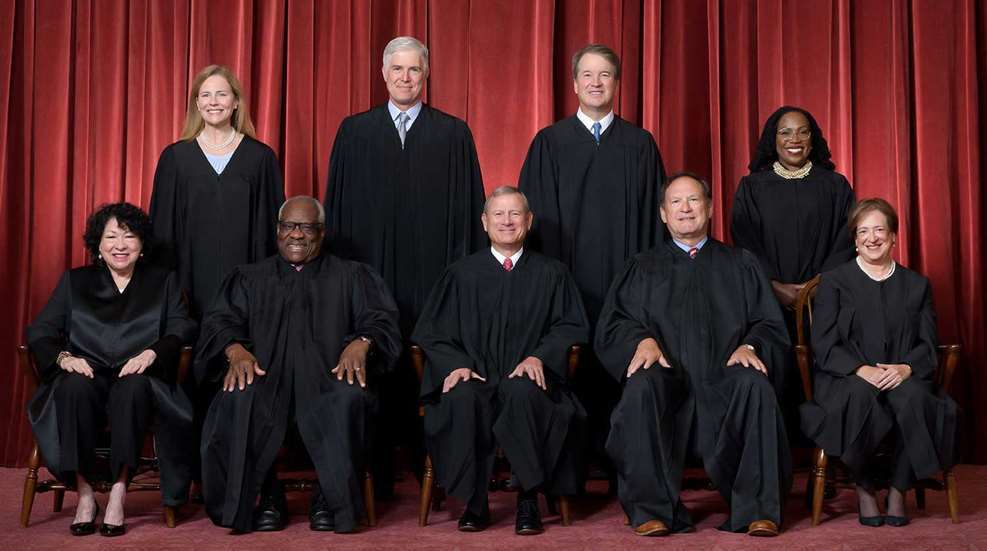
In a 6-3 rebuke of Hawaii’s attempt to circumvent the U.S. Supreme Court’s NRA-backed Bruen (2022) decision, the Court ruled in Wolford v. Lopez that “Hawaii’s law prohibiting licensed concealed-carry permit holders from carrying handguns on private property open to the public without the property owner’s express authorization violates the Second and Fourteenth Amendments.”
The majority opinion was written by Justice Samuel Alito and it was concise: “The restrictions imposed by Hawaii’s challenged law fall within the plain text of the Second Amendment, so the law is presumptively unconstitutional.”
The state had tried to effectively terminate the law-abiding citizen’s right to carry guns for self-defense outside their homes by making private property—gas stations, department stores, barber shops, churches—presumptively into “gun-free” zones unless the owner explicitly gave gun owners permission to carry for self-defense.
Anti-gun lawmakers in the state of Hawaii tried to do this in part by citing 18th-century laws designed to stop poaching.
To give this context, realize that in New York State Rifle & Pistol Assn., Inc. v. Bruen the U.S. Supreme Court required that Second Amendment protections first fall “within the plain text of the Amendment’s language by asking whether the law applies to ‘the people.’” And next, a law that seeks to restrict “the people” must have historical precedents that show such a restriction fits into the understanding of the Second Amendment when it was ratified or when the Fourteenth Amendment impacted it.
To satisfy this second necessary requirement, the state of Hawaii cited, among others, anti-poaching laws.
The majority opinion parried the attempt to use laws designed to thwart poachers in order to presumptively ban carry on private property open to the public by finding: “The State’s colonial and early state law analogues consist almost entirely of laws that prohibited unauthorized hunting of deer or small game on someone else’s private property. These laws—including a 1721 Pennsylvania law, 1722 New Jersey statute, 1728 Maryland statute, 1763 New York law, and 1771 New Jersey law—targeted unauthorized hunting and applied to land where game could be found, not retail establishments that residents frequent as part of their daily routines. Those laws had little if any impact on the Second Amendment’s central objective of protecting the fundamental right to self-defense, and their obvious aim was to prevent the distinctive harms and risks associated with unauthorized hunting. The gap between the State’s anti-poaching analogues and its new rule is too wide.”
Nevertheless, in dissenting opinions, three justices all said they would allow anti-poaching laws that predate even the Declaration of Independence to stand as rationales for effectively making all private property open to the public into presumptive no-gun zones.
Justice Elana Kagan’s dissent said, “I would uphold the challenged Hawaii law because, as Justice Jackson shows in Part III of her opinion, it is a modern-day analogue of colonial and founding era laws that similarly prohibited carrying firearms onto private property without the owner’s affirmative consent ... . Both sets of laws respond to the dangers and harms that someone with a gun can cause on another person’s property. That the old laws had a special (though by no means exclusive) concern with poaching does not matter.”
Meanwhile, Justice Jackson and Sotomayor argued that the “English rule was that the public had to obtain the owner’s express permission to hunt or fish on ‘unenclosed’ private property … . But some States altered this rule via positive law. See, e.g., Pa. Const., §43 (1776) (“[I]nhabitants of this state shall have liberty to fowl and hunt ... on all ... lands ... not inclosed”) … .”
These dissents, once again, show the importance of elections. If these three anti-Second Amendment justices had a majority supporting their convoluted interpretation of precedent, they would have used these anti-poaching laws as a way to effectively ban almost all concealed carry for self-defense.