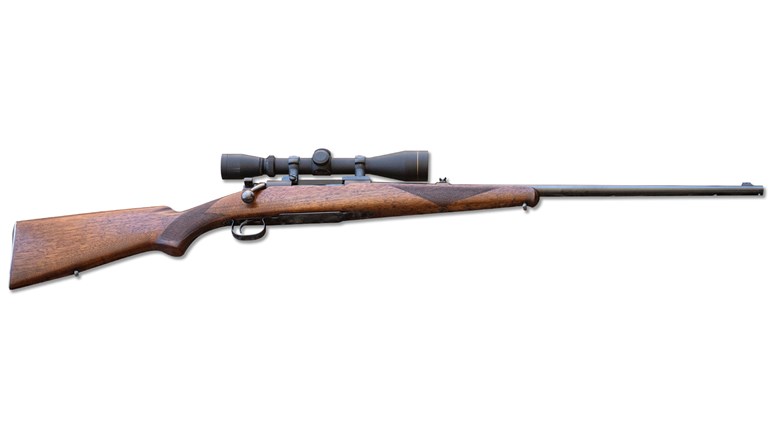
Each year we see plenty of new sporting rifles on the market, but very few recent additions wear traditional lines. The new Webley & Scott Empire rifle combines modern features with old-fashioned design elements, including a checkered Italian walnut stock and highly polished metal work. The Empire is the type of rifle that was the standard for big game during the latter half of the 20th century, but that we don’t see as often today. I think many hunters will welcome back such style.
The Webley & Scott name has been around the gunmaking trade since 1790, though today the brand’s rifles are made far from Birmingham, England, where the company began. The Empire is built in Japan by Howa, a company that has produced everything from Armalite AR-18 clones to rifles under the Mossberg, Weatherby, and Smith & Wesson banners, as well as a variety of bolt-actions wearing its own name. Legacy Sports International offers the Empire, along with a Webley & Scott rimfire rifle, here in the U.S.
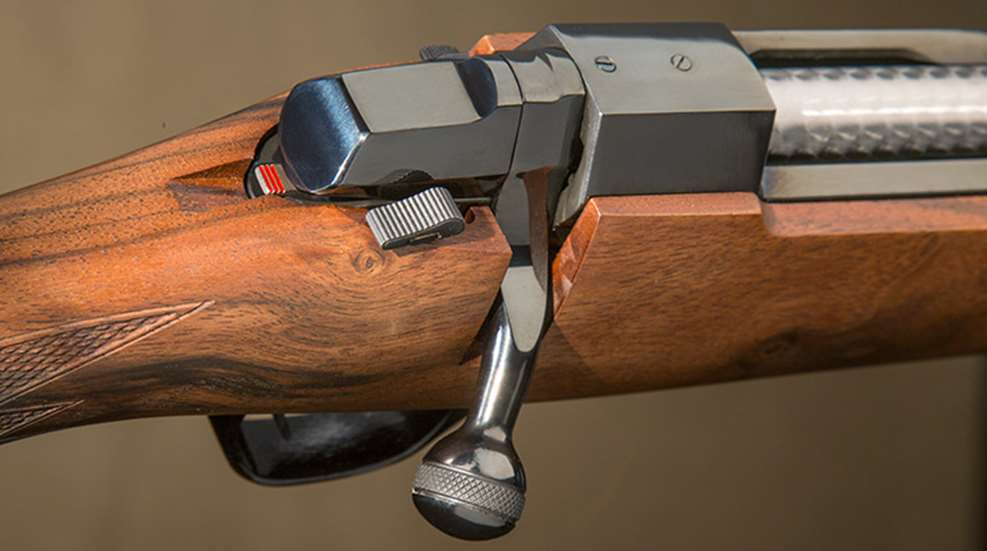
The Empire’s action is a push-feed design, similar to the Remington Model 700 and nearly identical to the Weatherby Vanguard. The jeweled bolt has two opposing locking lugs, a plunger-type ejector and an M16-style pivoting extractor. Three large holes in the bolt body are designed to vent gas downward and away from the shooter in the event of a case or primer failure. The magazine is a flush-fit steel detachable box, which can be top-loaded through the action port to quickly replenish rounds. My test rifle fed, fired and extracted reliably throughout testing.
The two-stage trigger allows for some take-up before consistently breaking right at a civilized 3 pounds. The three-position safety is located to the right of the bolt shroud, and a bolt release occupies a similar spot on the left side. In its middle position the safety allows the shooter to safely cycle the bolt, and it locks both the bolt and the sear at its rearmost setting. Pushing the safety fully toward the muzzle renders the rifle ready to fire. The generous surface area provided by the safety’s ergonomic teardrop-like shape makes it easy to operate. A red cocking indicator protrudes below the bolt shroud.
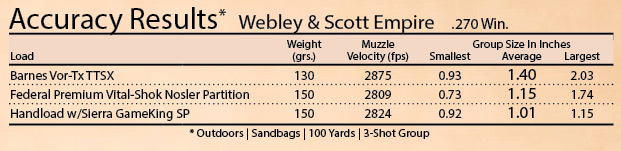
Empire rifles use cold-hammer-forged, 22-inch barrels with a sporter-weight No. 2 contour, regardless of the chambering. My test rifle was chambered in .270 Win., and the contour felt about perfect. I fired ammunition from Federal Premium and Barnes, as well as some handloads using Hodgdon H4831 powder that have proven accurate in other rifles. My testing indicated the barrel is of excellent quality, as the rifle almost begged to shoot tiny groups. The metal work on the rifle was polished to a high gloss and wore caustic bluing that appeared to be well-executed.
Despite the English name, the walnut stock of this Webley & Scott carries some traditional design elements of the American classic style, including a point checkering pattern. A few of the features, though, such as the pistol grip’s shape, and the rosewood grip cap and fore-end tip, are more reminiscent of rifles from the 1960s. The cheekpiece is comfortable and not overdone, and a 1-inch rubber recoil pad helps make the rifle pleasant to shoot. The stock wears a stain finish and is attractive, though the wood on my sample carried little, if any, figure. Dressing up the pistol grip and fore-end, the machine-cut checkering is deep, even and neat.
The Empire is available alone or as a package, which includes a Nikko Stirling Panamax 3X-9X-40mm scope, mounted in two-piece rings on a Picatinny-style base. For testing I received a rifle with the scope mounted, but I was much more impressed by the Empire than the Panamax optic. The scope’s eye relief was extremely short, and I found it difficult to comfortably acquire a clear sight picture. After 15 rounds from the bench, three-shot groups went from around an inch to more than 3 inches at 100 yards; the scope became mechanically suspect and I replaced it with one of known reliability.
With a new scope, I was pleasantly surprised by the rifle’s accuracy. The Empire was a solid 1- to 1.5-MOA rifle with the majority of the ammunition I used, though the groups indicated the rifle would be capable of even greater accuracy after some careful glass bedding. When a rifle consistently shoots two rounds into the same hole, followed by another shot or two dispersed an inch or more vertically, one can almost be sure that bedding is the culprit. This is incredibly common in factory rifles and is also a relatively simple fix, especially since the Empire’s stock already has pillars installed.
There’s nothing gimmicky about the Webley & Scott Empire; it is simply a traditional sporter and a solid performer chambered in well-established cartridges that get the job done with minimal drama. It is neither a lightweight mountain rig nor a heavyweight built for long-range shooting; it is the kind of general-use rifle that is perfect for the vast majority of hunting.
Technical Specifications:
• Type: bolt-action centerfire rifle
• Caliber: .243 Win., 7mm-08 Rem., .308 Win., .270 Win. (tested), .30-06 Sprg.
• Barrel: 22"; cold-hammer-forged chrome-moly steel; 6 grooves, 1:10" RH twist
• Trigger: two-stage; pull weight 3 lbs.
• Magazine: steel detachable box; 5-rnd. capacity
• Sights: none; receiver drilled and tapped for scope base (package includes Nikko Stirling Panamax scope, one-piece base, rings)
• Safety: three-position toggle
• Stock: straight comb w/cheekpiece; Italian walnut w/rosewood grip cap and fore-end tip, stain finish, pillar bedding; LOP 13.87"
• Metal Finish: gloss blued
• Overall Length: 42.25"
• Weight: 7.8 lbs.
• MSRP: $956 (rifle only), $1,087 (package)