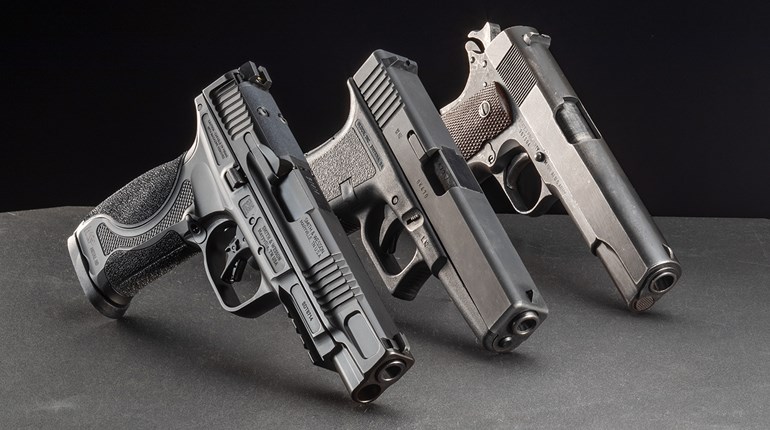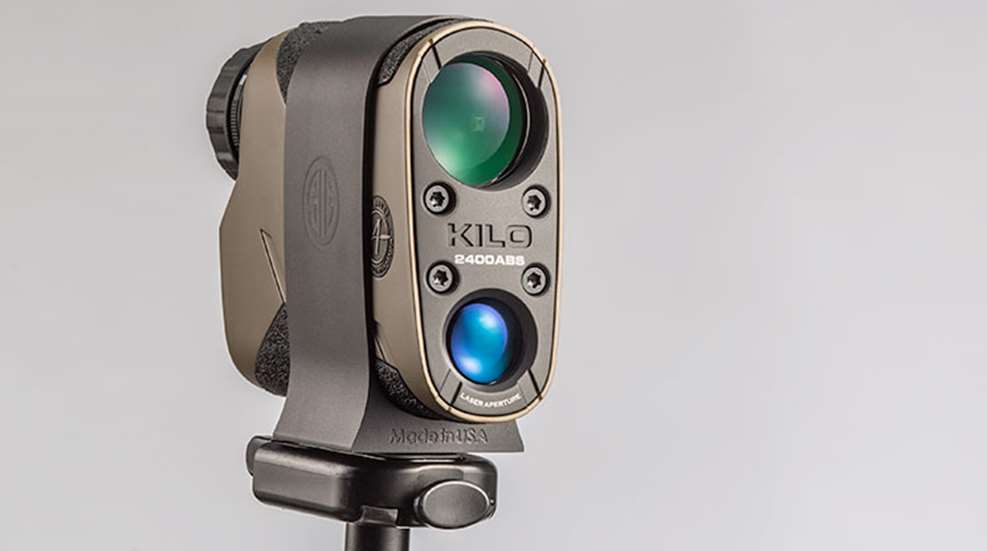
I’ll bet a silver buck that you know SIG Sauer makes high-end handguns. You may also know that in 2004 the Exeter, N.H.-headquartered company delved into the AR-15 business. But today SIG is a full-blown sporting goods manufacturer whose product lines now include apparel, airguns, laser sights, knives, holsters, suppressors, ammo, scopes, red-dot sights, binoculars, rangefinders and more. From what I’ve seen, all of it is top-quality gear designed by shooters and hunters. Each product category is named for a letter in the International Radiotelephony Spelling Alphabet. SIG’s rangefinder line is called Kilo. Its flagship unit—and likely the most advanced handheld laser rangefinder/ballistic solution ever offered to civilians—is the Kilo2400ABS.
By itself the Kilo2400ABS is a laser rangefinder that has 7X magnification and a 25mm objective lens, along with rubber armoring and only two gloriously simple buttons. Its outer lenses feature hydrophobic SpectraCoat anti-reflection coatings that reduce glare. The unit is waterproof and comes with SIG’s Infinite Guarantee (plus a five-year warranty on electronic components). From the outside it looks like one of many good rangefinders on the market. But it’s actually a whole lot more. It’s good to a class-leading 3,500 yards on highly reflective objects, 1,800 on flora and around 1,400 on fur.
Thanks to a powerful microprocessor featuring technology called LightWave digital signal processing with a four-times-per-second HyperScan refresh rate, it’s quicker than any handheld unit I’ve tested—and I’ve tested a bunch. Readouts provided by a red LED are given in about a tenth of a second after the range button is depressed. (The red LED makes the display easy to see in all lighting conditions, and its brightness adjusts automatically to best suit ambient levels if you so choose.) The 2400’s minimum range is 5 yards, so it’s fine for bowhunting. But let’s be clear: There are cheaper units for bowhunting if all you wish to do is find the distance to a deer feeding near your treestand. The Kilo2400ABS is for precision at long range, and it offers real benefits that no other rangefinders can claim at this time.
What separates it from others is what’s found within its magnesium chassis. Connected to its microprocessor are a barometer, magnetometer, digital compass, inclinometer, altimeter and thermometer. Combined with the range reading (that’s compensated for uphill or downhill angles) is an external wind meter that plugs directly into your smartphone’s audio jack. All of this data is instantaneously fed to your phone’s free Ballistic Solver app via Bluetooth.
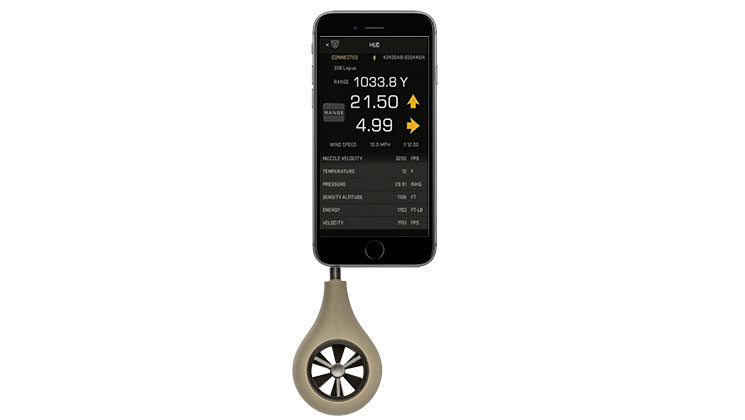
I suspected that it would all be too complicated for me—and I’d probably just wind up using the rangefinder as a rangefinder—but I found I was wrong. It was easy. First I downloaded the app to my phone (it’s available for Android and iOS platforms). Next I pressed and held the mode button, and then pressed the range button to turn on the unit’s Bluetooth feature. Seconds later it automatically paired with my phone. Looking at the app on my phone, I chose my exact 6.5 Creedmoor load from the list of cartridges/bullets and saved it. And then the magic happened.
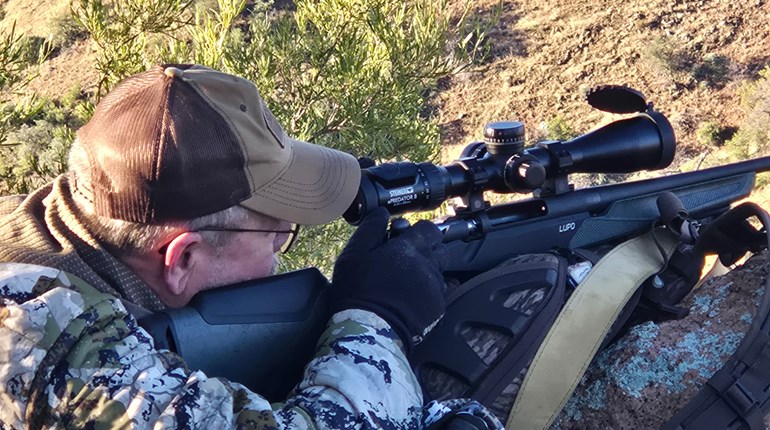
While holding my phone in one hand, I ranged a steel gong. The readout said 429 yards. When I glanced back at my phone, the temperature, inclination, heading, wind speed and direction, pressure and humidity was already populated in the data fields; it was automatically beamed to the app from the Kilo. Using this data, the app told me to hold 6.2 MOA high, so I dialed up my scope. The simple wind readout, gleaned from the meter I plugged into phone, told me to hold 1 MOA left. Moments later I pulled the trigger and heard the sound of the gong. It was incredible.
The Kilo and the app had taken all variables into account and allowed me to focus only on the shot. At longer ranges, it even accounts for Coriolis effect (hence its internal compass) and other sniper-type stuff. For shooters who demand precision, this baby is it.
And it’s got a ton of other features, both in terms of hardware and software. For example, while target shooting, you can screw the Kilo2400ABS onto a tripod (using the supplied mount) and work the rangefinder remotely via your phone. Its software program developed by Applied Ballistics is used by the world’s best shooters and lets advanced users control everything manually if they wish—even barrel temperature data. However, at any time a simple push of a button will revert to real-time data updates from the unit.
While the Kilo is expensive, after testing it I now think it’s one piece of gear that’s very much worth it. It takes the place of my $400 watch that I bought for measuring altitude. If I get lost I can use its digital compass in a pinch. It also takes the place of a separate wind meter, barometer and other expensive instruments that long-range shooters need. So I’ll wind up saving money, all while having all of these tools in one handheld unit.
As hunters and shooters, most of us are guilty of having too much gear that can actually overcomplicate things. But I’m a believer in quality products like the SIG Sauer Kilo2400ABS that combine multiple pieces of gear. As I found, it can help you obtain your goal of nailing your target on the first shot by replacing your best guesses with hard data.
Technical Specifications
• Type: laser rangefinder
• Magnification: 7X
• Objective Lens Diameter: 25mm
• Eye Relief: 15mm
• Exit Pupil: 3.6mm
• Field of View @ 100 Yds: 35.67′
• Measurements: 5-3,520 yds. in .1-yd. increments; Angle Modified Range, Line of Sight, Best Target, Last Target modes; LightWave digital signal processing technology w/HyperScan refresh rate
• Coatings: multi-coated; anti-reflective, hydrophobic SpectraCoat
• Construction: magnesium body w/rubber armor
• Power Source: CR2 lithium battery
• Dimensions: length 4.2″, width 1.3″, height 3″; weight 7.5 ozs.
• Accessories: Ballistic Solver app for Android and iOS, wind meter, tripod mount, water-resistant gear bag, padded ballistic nylon case, pen/stylus, lanyard, 3 batteries
• MSRP: $1,799; sigsauer.com