When it comes to glass, I’m a Leupold guy. I’ve come to trust the clarity and dependability of their optics, from scopes to binos to spotters, and they always perform brilliantly. Of course, rangefinders fall into the optic arena and are arguably one of the most crucial tools for firearm and archery hunters.
Over the years, the rangefinder pocket on my bino harness has held multiple Leupold models like the RX-1600i TBR/W, RX-FullDraw 3 and RX-FullDraw 4. All performed as advertised, and I killed lots of critters using them.
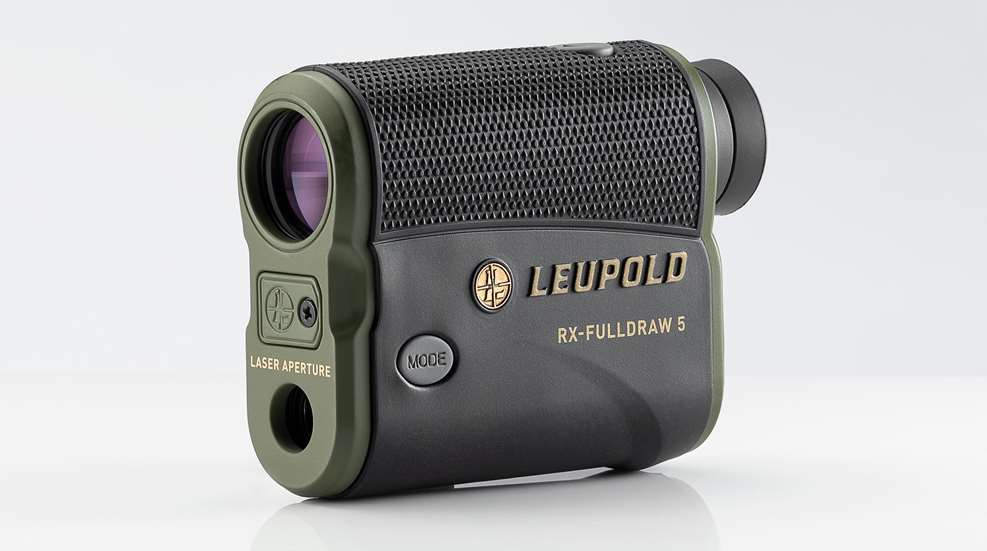
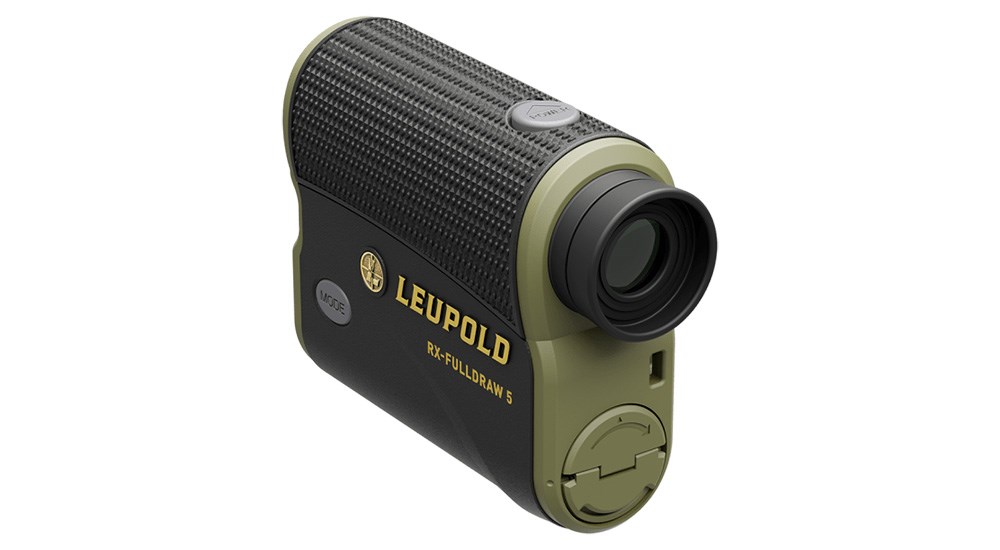
Leupold’s latest incarnation for archers, the RX-FullDraw 5, is the spitting image of the RX-4: compact, lightweight, durable, ergonomic and 6x magnification. The big difference, and one I was ready to dive headfirst into, is the new rangefinder’s Ballistic Mode.
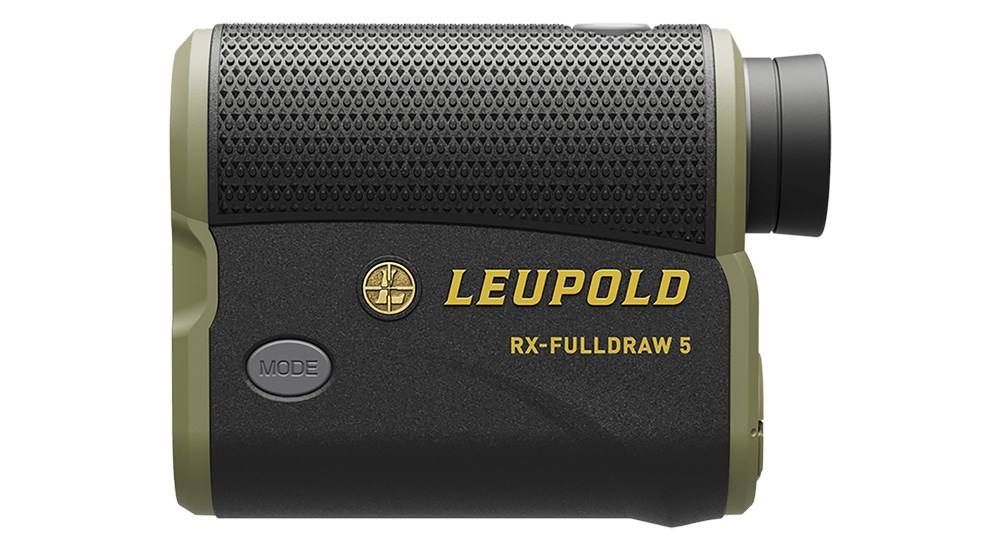
Before taking full advantage of the technology that makes this rangefinder one of the market’s most advanced and accurate bowhunting rangefinders, Leupold asks that you complete the following three tasks. First, use a chronograph to measure your arrow’s speed. Leupold’s instruction manual will tell you to record the velocity of your arrow at 36 inches of draw length. Don’t let this become a roadblock—simply shoot your standard draw length and record your arrow’s velocity. Second, use a digital arrow scale to measure your arrow’s total weight. Be sure to weigh the arrow with the broadhead you plan to use while hunting. Lastly, have your wife, kid, friend or whoever use a ruler or tape measure to record the vertical distance between your arrow shaft at full draw and the center of your peep sight. That’s it. Now it’s just a matter of punching in the numbers.
Don’t let the setup process intimidate you. You don’t have to work at MIT to be able to use the RX-FullDraw 5. Press the Power button on top of the rangefinder’s body and then hold the Mode button on the rangefinder’s left side toward the front until you see “CALC” on the screen. Now press the power button again, which will scroll you through the various CALC settings until you reach the “BALL” (ballistic) setting. Select BALL by punching the Mode button again. You’ll see “VEL” (velocity) in the screen’s upper right corner. Use the Power button to set your arrow’s speed, and then press the Mode button to continue. You’ll now see “WGHT” (weight) on the screen’s upper right corner. Again, use the Power button to enter your arrow’s weight. Hit the Mode button, and then plug in your peep height. It’s that simple. The most tech-challenged person in the world can set up this rangefinder.
Of course, Leupold thought of everything, and you can adjust display brightness, unit of measurement, crosshair display, etc. The rangefinder walks you through each process.
Leupold dubs the next important choice as Flightpath technology. You have two options. The default 20-yard mode shows an illuminated mark, or tick, as Leupold dubs it, indicating the max height of your arrow flight at a 20-yard target. I like this mode; it tells me that if I see any obstructions below the tick mark, I will have arrow interference. The second mode is Mid Mode. When using this mode, the illuminated tick mark represents the highest point of flight along the arrow’s entire path, usually halfway between you and your target. It’s a matter of personal preference, but I tell you without hesitation that the default mode simplifies things.
With my numbers plugged in, I was eager to put the rangefinder to use. My first test: set a 3D target at 60 yards, and get the tick mark as close as possible to an overhanging branch somewhere between me and the target. I tinkered for a while, moved left and right, and got the perfect setup. Looking at the 60-yard target through the rangefinder, the cottonwood limb sat barely above the Flightpath tick mark. I sent an Easton 4MM Axis Long Range from my Hoyt Carbon RX-7 and sunk the arrow into the target’s lungs. The rangefinder’s ballistic technology performed flawlessly.
For testing’s sake, I moved to where the tick mark was in the middle of the branch, fired another arrow, and watched as my projectile smacked the limb and deflected out of sight. I found the Flightpath feature worked to 93 yards, which is good enough for me.
I also took the time to test the rangefinder at extreme angles, and it’s a win. Not only will the readout show you the angle of the shot, but it will also provide the true ballistic range to that target. This is a must-have feature when hunting the mountains or when ambushing whitetails from an elevated perch. Last season, in Colorado, I would have shot over my bighorn if it had not been for Leupold’s True Ballistic Range (TBR) technology.
There are other features that make a rangefinder shine, and I promise, the RX-FullDraw 5 has all of them. The 6x glass is crystal clear, and target acquisition is rapid. As for the time it takes to get an accurate yardage readout once you settle on an object and push the button, it’s as quick as I’ve seen. The bright red LED display is visible in any lighting condition, and as mentioned, it can be adjusted quickly if needed.
As for distance, Leupold brands the RX-FullDraw 5 as one that will provide an accurate range on deer-sized animals from 6 to 900 yards and on reflective targets from 6 to 1,200 yards. Testing confirms this, and twice (though it took me using my tripod for balance) I ranged a single pronghorn buck at 907 yards. Max TBR is 175 yards, and Scan Mode allows you to hold down the power button and move to different objects to get various range readouts.
If you’re in the market for a top-tier archery rangefinder that promises ease of use and maximizes purposeful technology, Leupold’s RX-FullDraw 5 is the one you want to have tucked into your pocket.
Technical Specifications
• Type: laser rangefinder
• Magnification: 6x
• Objective Lens Diameter: 22 mm
• Eye Relief: 17 mm
• Field of View @ 1,000 Yds: 315 yds.
• Max Range (yds): 900 (deer), 1,200 (reflective)
• Features/Modes: Archer’s Advantage software; Flightpath; LOS; TBR; Last Target Mode
• Display: red OLED; adjustable for brightness
• Reticle: selectable; three options
• Construction: aluminum housing, rubber armor; waterproof
• Dimensions: 3.8" L, 1.4" W, 3" H
• Weight: 7.5 ozs.
• Battery: 1 CR2
• Accessories: soft case
• MSRP: $499.99; leupold.com