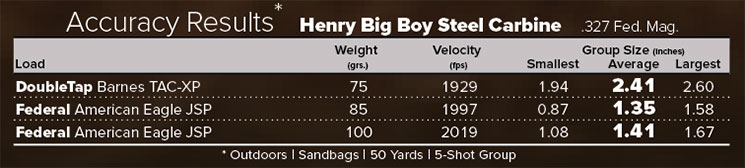
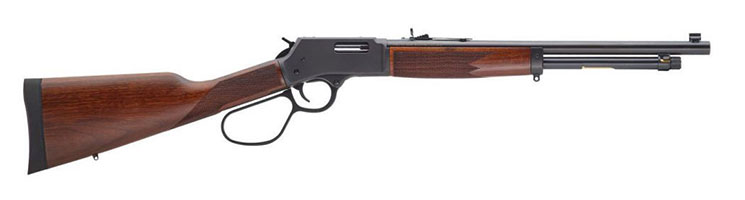
The allure of the lever-action is rooted in the American West. As the first high-volume repeating rifle, it became legendary and ultimately iconic. In contrast, the .327 Federal Magnum, heralded as the cartridge to carry the revolver into the 21st century, has languished in near desuetude since its introduction in 2007. Henry Repeating Arms, somewhat capriciously, marries the two in its Big Boy Steel Carbine.
Henry has become the leading manufacturer of lever-actions in the United States. Headquartered in Bayonne, N.J., Henry is a family-owned business. All its products are made in America and consumed by a devoted fan base. Conversely, the .327 Fed. Mag. cartridge fills a gap between the .38 Spl. and .357 Mag. that no one seems to care about. Ruger is solely responsible for keeping the .327 alive in its revolvers. Limited ammunition offerings from mainstream manufacturers, along with the failure of hunters to understand the role of the .327, have kept a good cartridge down.
So why would Henry take the proverbial leap? Customer demand. Though it never gained widespread popularity, the .327 Fed. Mag. has a cult-like following. Revolvers in .327 are great trail/general-purpose handguns, and boutique ammunition makers offer a wide array of loadings. Missing was a .327 rifle companion to Ruger’s excellent revolvers. Carrying a revolver and a lever gun that share the same ammunition has long been a cowboy tradition, and, well, everyone has a little cowboy in ’em.
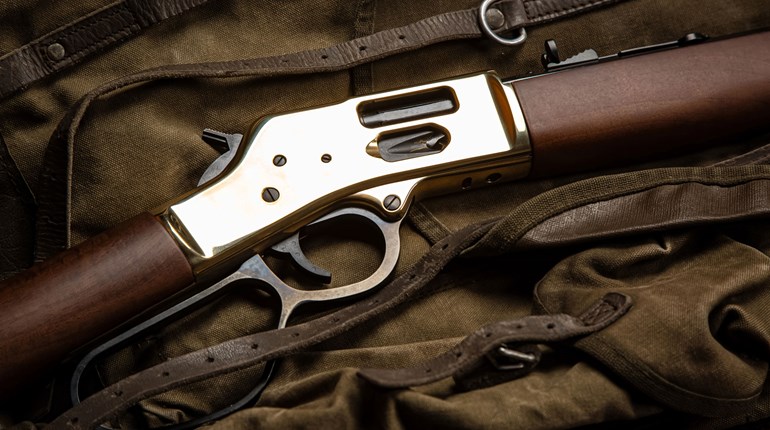
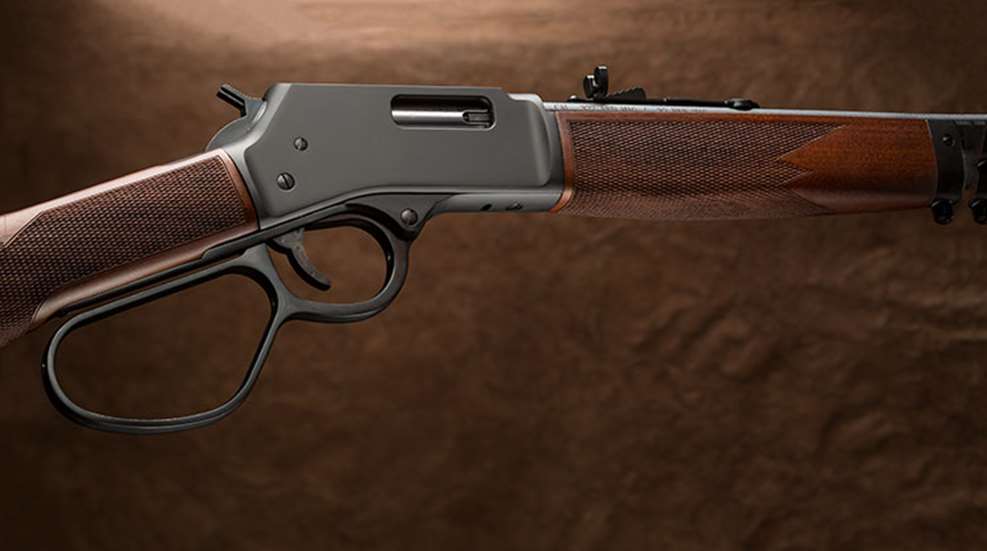
Henry’s Big Boy Steel Carbine has traditional lever-action lines but retains Henry’s signature cutout in the magazine tube, through which cartridges are loaded and unloaded. Though somewhat unconventional in appearance and function, it makes the lever gun infinitely easier and safer to unload at hunt’s end. The carbine has a 16.5-inch barrel; its magazine tube extends to within 1.5 inches of the muzzle and is secured at the front via a robust band dovetailed into the barrel. (Henry also makes a rifle version with a 20-inch barrel.)
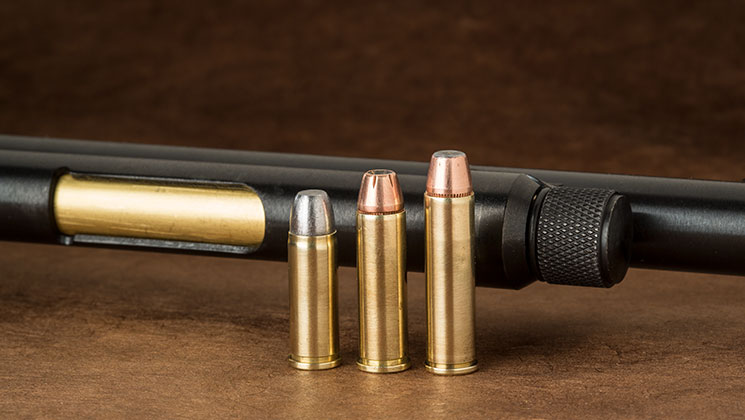
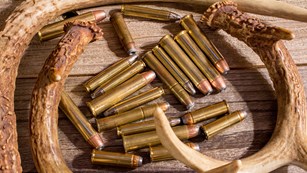
The magazine holds 10, nine or eight rounds of .32 S&W Long, .32 H&R Mag., or .327 Fed. Mag., respectively. Yep, this rifle reliably cycles, chambers and fires all three cartridges, even with overall lengths varying from 1.26-1.46 inches. Only two failures to cycle or feed occurred during my firing of 500 rounds. A single .327 Fed. Mag. cartridge became unexplainably fouled in the action, and a .32 S&W Long empty failed to eject. Both stoppages were easy to clear.
Take care when seating the inner, brass magazine tube to ensure it locks in place. Otherwise, it can spring out when the rifle is fired. A stud on the end of the inner tube must fit into a distinct notch in the support band. Additionally, if the tube is inserted on a full magazine with force, the lever can spring open; grasp or otherwise secure the lever when seating the inner magazine tube.
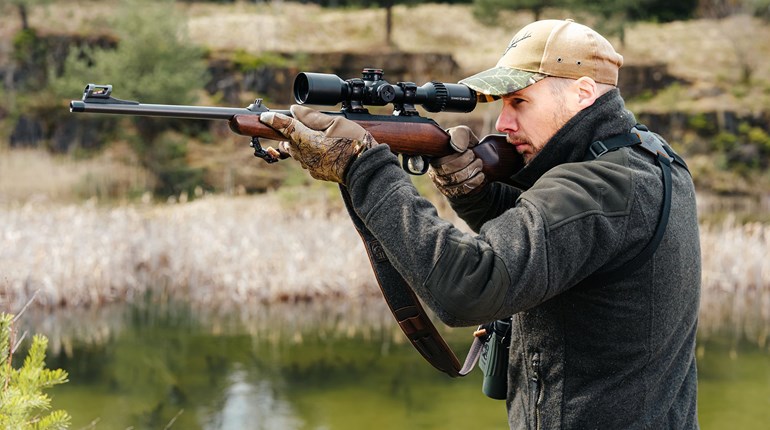
The factory sights are the traditional front post with a brass bead and rear semi-buckhorn on an elevator. As functional and rugged as these sights are, my presbyopia-afflicted eyes found them a challenge. The rifle is also drilled and tapped for a scope base. Henry offers its own for less than $30.
As its name implies, the action is made of steel. While it feels trim and light in hand, the compact rifle still tips the scales at 6.6 pounds. Metal surfaces are finished in a well-executed matte blue. The big-loop lever is not only distinctive, but also allows for comfortable one-hand carry at the stock wrist without pinching the little finger. Steel sling-swivel studs are standard: One is on the steel cap at the end of the fore-end, and the other is a few inches from the toe of the stock.
The American walnut stock has a rich, deep tone and nicely executed, wrap-around checkering at the wrist and fore-end. While the straight-wrist buttstock is trim, the fore-end is slightly swelled to fill the support hand. Somewhat surprising is the addition of a 1-inch-thick and moderately hard buttpad. It looks good and helps stick the rifle to the shoulder, but it is totally unnecessary on a rifle that generates free-recoil energy of less than 3 ft.-lbs.
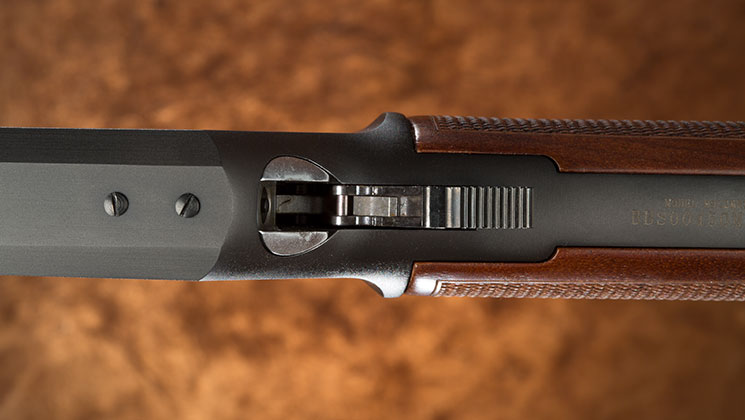
A bigger surprise in the test rifle was its trigger, which broke at an amazingly creep-free pull weight of 3.5 pounds. To fire, simply cock the hammer and pull the trigger. There is no manual safety on the Big Boy. Instead, it has a transfer-bar safety. The hammer must be fully cocked, and the trigger must be pulled and held to the rear for the rifle to fire. You can safely carry the rifle loaded with the hammer down, as the hammer does not contact the firing pin. To put the hammer down, hold it under your thumb while you press the trigger, and then release the trigger as you ease the hammer forward. If you look closely, you’ll see the transfer bar drop out of position as the hammer moves forward, preventing the rifle from firing.
With good bullets at high velocities, the .327 Fed. Mag. kills out of proportion to its size and makes this gun just fine for the deer woods. Don’t forget the Big Boy is also compatible with lesser loads ideal for a myriad of small game. I’ll be keeping this carbine, partly because my Ruger revolver in .327 needs a companion, and partly because of that little bit of cowboy down somewhere deep inside me.
Technical Specifications
• Type: lever-action repeater
• Caliber: .327 Fed. Mag. (tested), .38 Spl./.357 Mag., .41 Mag., .44 Spl./.44 Mag., .45 Colt
• Barrel: 16.5″; button rifled; 6 grooves; 1:16″ RH twist
• Trigger Pull Weight: 3.5 lbs.
• Magazine: tubular, front-loading; 7-rnd. capacity
• Sights: fully adjustable semi-buckhorn ladder rear, reversible white diamond insert and brass bead front; drilled and tapped for optics
• Safety: transfer bar
• Stock: straight-grip checkered American walnut; LOP 14″
• Metal Finish: matte blued
• Overall Length: 34″
• Weight: 6.6 lbs.
• MSRP: $893; henryusa.com