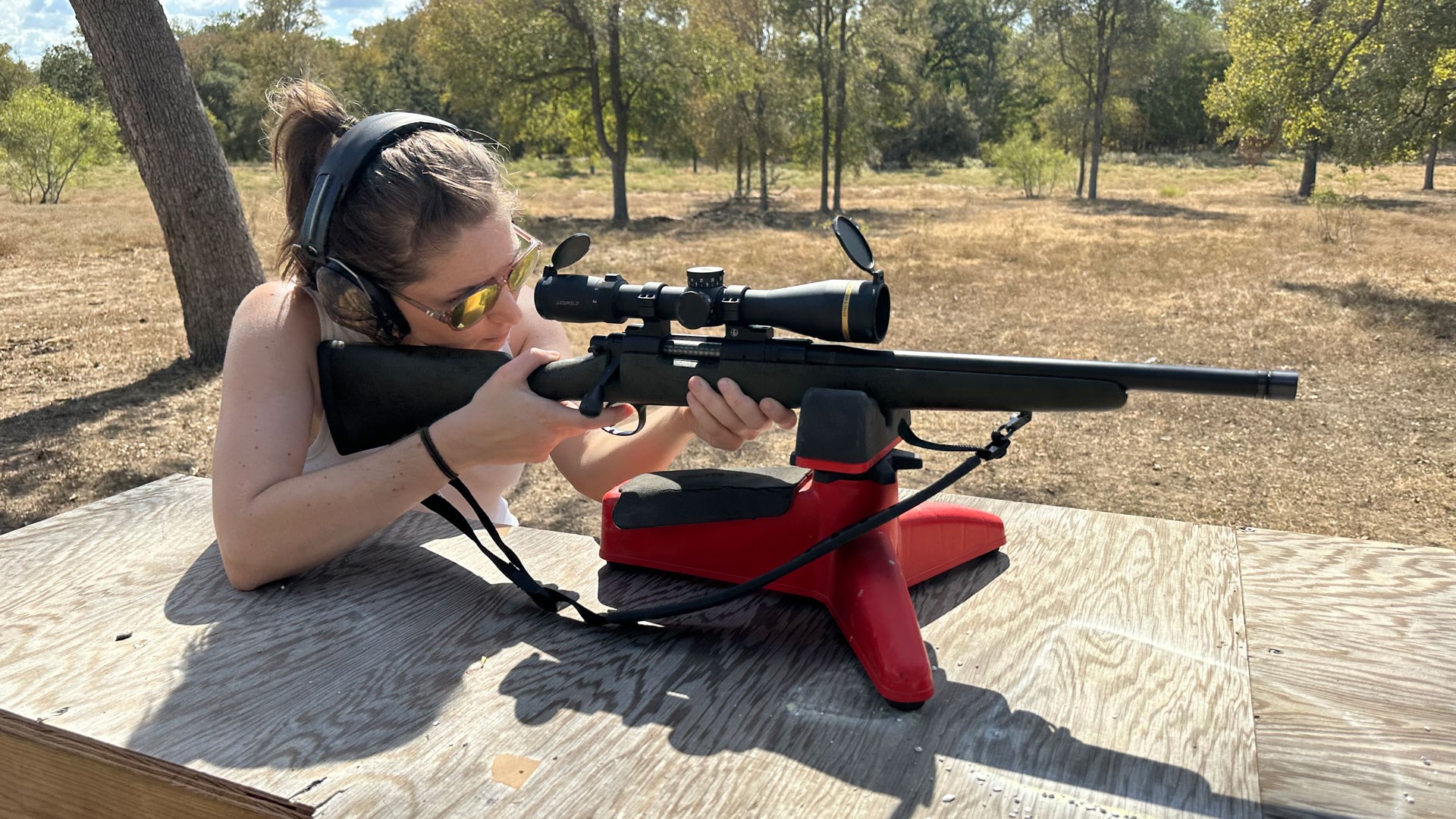
I briefly covered the 8.6 Blackout in my last Alternative Ammo piece, in which I compared it to the .338 Federal. But because this is such a new, niche cartridge, my editor thought it also deserved a deep dive, so I’m here to provide an in-depth look at the new 8.6 BLK.
Big BLK
First, some history and background information are necessary to understand the intended purpose of the round. Since its 2010 introduction, the .300 Blackout became one of the most popular rounds for the AR-15 platform (as well as some mini-action bolt guns), largely due to the characteristics of its suppressed ammo, and the benefits suppressors provide in numerous applications, such as hunting, home defense, etc. The .300 BLK was created by AAC, which was then bought by Remington, after which the same individual who started AAC went and started another company to make the .300 BLK’s big brother. The 8.6 BLK fits perfectly in short-action rifles like the AR-10 platform, as well as a host of other bolt-action rifles (for those unfamiliar with a short-action length, think .308 Win. cartridge dimensions). Functionally, the 8.6 BLK is a .300 BLK scaled up to a 6.5 Creedmoor cartridge (this is important for later).
Cartridge Specs
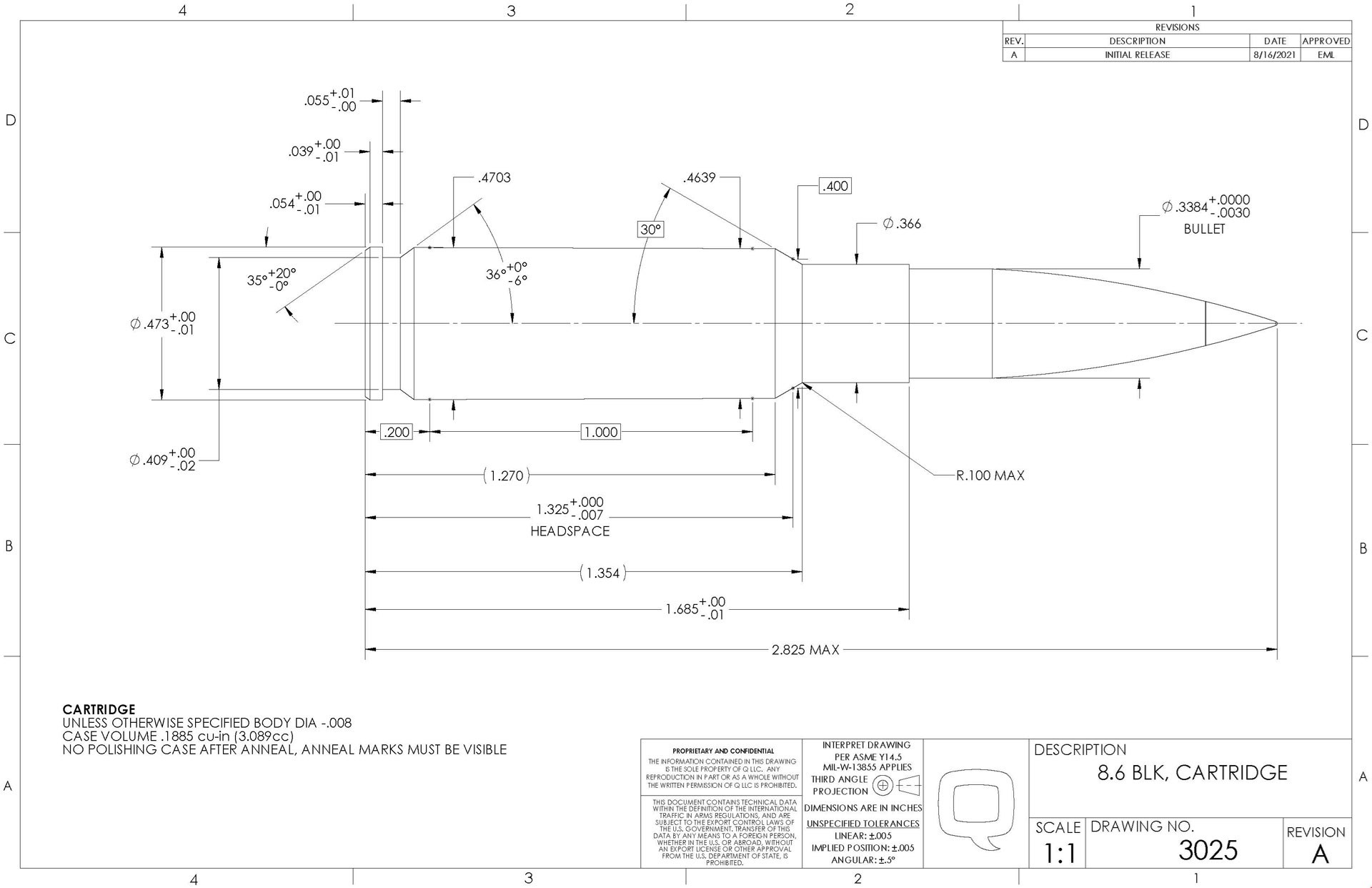
As for the round itself, for those not familiar with metric conversions, 8.6mm is the same diameter as .338 inch. In other words, it uses the same caliber bullets used in the renowned .338 Lapua, except instead of shooting those projectiles at supersonic speeds, the 8.6 BLK shoots them at subsonic velocities, making it perfect for suppressed fire. And … that’s about all I can tell you, as the cartridge isn’t “officially” SAMMI spec yet, meaning there aren’t “official” dimensions available from the overseers of safe ammunition production and chamber specs. That said, there is a cartridge diagram on the company’s website, as well as a chamber drawing for those interested in having custom barrels made (Faxon Firearms makes the majority of barrels right now, though other manufacturers are getting into the 8.6 chambering). For those interested in what the proposed measurements are, the overall length of the brass should be 1.685-inches long, and the case has a 30-degree shoulder (we’ll see where this comes from in a second). It’s sized to fit a .308 Winchester bolt face, just like another cartridge it’s based on (there’s your second hint). Maximum cartridge overall length is 2.825 inches, so the 8.6 BLK will feed through a short action, including the AR-10 platform as mentioned before.
If you couldn’t guess it by the previous hints, the cartridge itself is based on the now-common 6.5 Creedmoor brass, except it’s shortened and has the neck blown out. This makes it great for handloaders since brass is so prevalent, while the supply of ammunition is not. That said, I’ve made a piece of brass from 6.5 Creedmoor, and while it was difficult, it wasn’t impossible. Most pieces of info I found say to neck-size the brass first, then trim the excess neck material to length, but I found it easier to do the reverse and just trim a piece of 6.5 Creedmoor brass down till there’s no more neck, stopping at the neck/shoulder junction, as there’s less material after trimming. This allows the .338 expander ball to do its job easier, as it must pass through less brass when stretching the neck to fit a .338-caliber bullet. Why is this better in my opinion? There’s less friction when sizing, so it results in a smaller chance of getting the case stuck and I don’t have to worry about changing dies. Some people claimed it was a straight shot from 6.5mm to 8.6mm. I’m not buying that after trying it myself; doing it my way, though it was difficult to run the brass into the die, I did get the job done.

Remember when I said this was a short-action cartridge that can feed through an AR-10, and it’s based on the 6.5 Creedmoor case? There’s not just an inherent accuracy benefit from the shoulder angle and a reloading benefit from the case commonality. The fact that it uses a 6.5 Creedmoor case also promotes no sacrifice in ammo capacity in AR-10 magazines. But because the case is shorter overall—and the long, heavy-for-caliber bullets eat up a lot of case capacity—it also means the cartridge is extremely efficient with power since it physically can’t use that much due to how much room a bullet takes up inside the case. And you know what very little powder means? Slow velocities, which is why the 8.6 BLK cartridge is named as such (recall the cartridge’s history); the 8.6 excels in subsonic use. Lastly, because the cartridge uses minimal powder, you won’t notice much benefit from a long barrel; the 8.6 BLK sees complete powder burn relatively quickly. So, it’s an ideal cartridge to pair with a short barrel—the absolute longest I’ve seen so far is a 16-inch barrel, but many guns are using 8- or 12-inch barrels and seeing fantastic results (ammo is even being made specifically for these shorter barrel lengths). This makes it a great choice for hunters who live in tree stands or ground blinds during the fall, and need a rifle that’s extremely compact and maneuverable, provided they don’t plan on shooting any farther than maybe 250 or 300 yards.
Speaking of barrels, that’s a feature that makes the 8.6 BLK unique: the twist rate in the barrel is 1:3 inches, which is faster than fast.
A New Twist
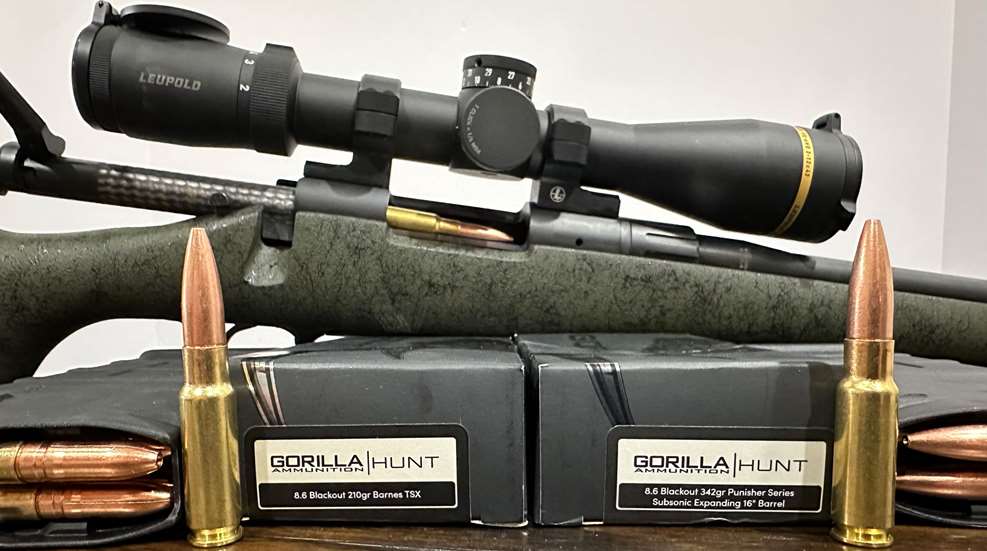
We know the longer a bullet, the tighter twist a barrel needs to stabilize said bullet. That’s what the 8.6 BLK does extremely well: spins bullets incredibly fast. Why is this beneficial? Think about it from a terminal-ballistics perspective. The faster a projectile spins, the more damage it can do as it passes through tissue like lungs and heart muscle. I tested two loads provided by Gorilla Ammunition. One features a 210-grain Barnes TSX load (MSRP: 54.99/Box of 20), which has an advertised velocity of nearly 2,000 fps, and a second offering uses a 342-grain subsonic hunting load—found in its “Punisher” line—which comes in at an advertised speed of 1,000 fps.
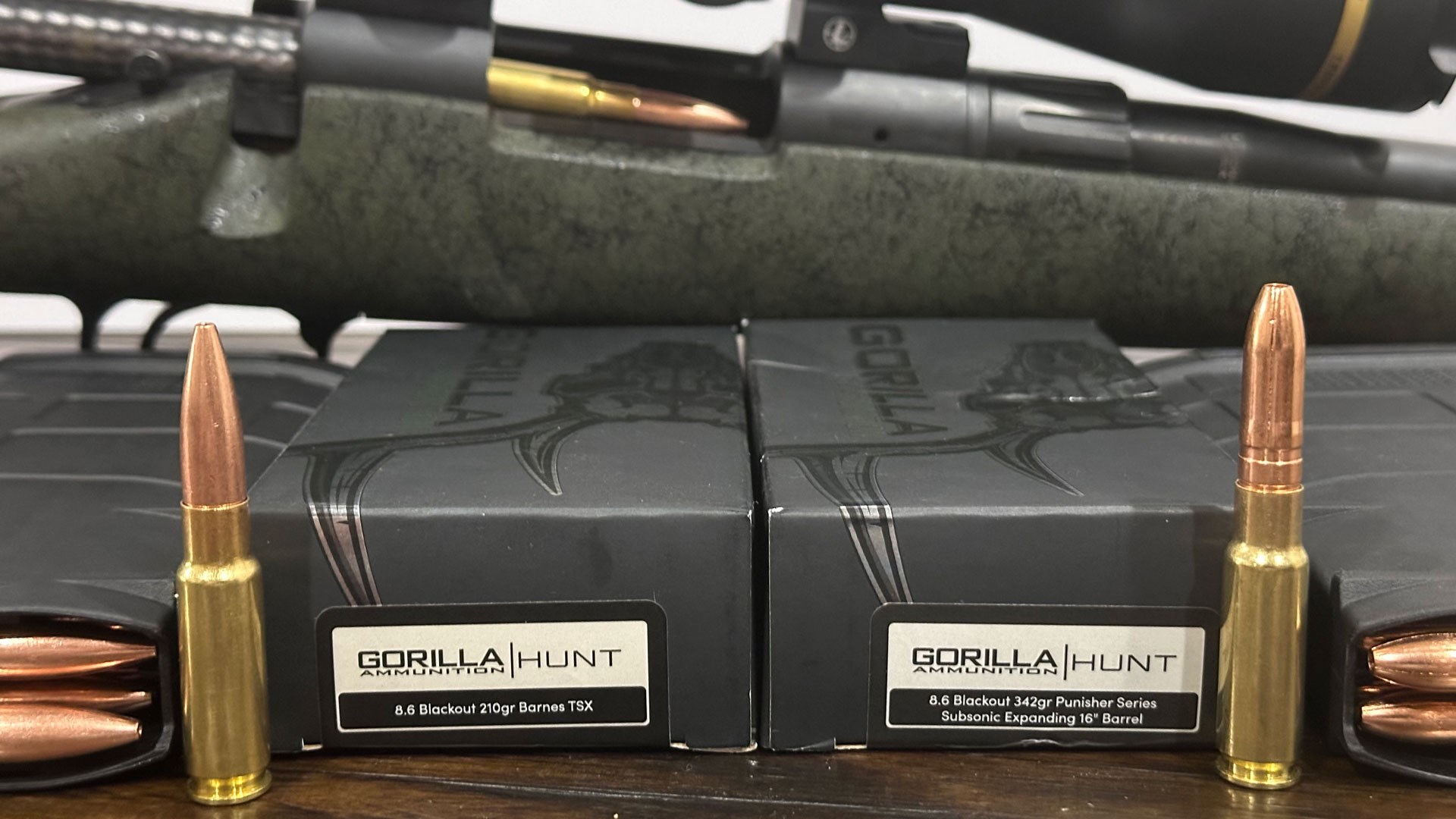
I took a box of each of the two loads mentioned above and ran them through a 16-inch Remington 700 (the rifle was this publication’s 6.5 Creedmoor originally). Upon chronographing the loads, I got 2,116 fps from the 210-grain Barnes load, and just over 1,000 fps (1,002 fps to be exact) using the subsonic load. This is where the fast twist comes in—the 210-grain Barnes bullet was spinning at over 500,000 (507,840) RPM, and the subsonic bullet was spinning at 240,000 RPM. With all that lateral force helping rip the bullet open as it spins through tissue (imagine the pulling sensation on a merry-go-round going at half a million RPM), velocity isn’t nearly as important as it once was in getting copper bullets to open. This is why all-copper bullets are necessary for the 8.6 BLK: these rotational speeds will rip bullets apart if pushed too fast. Combine that with impacting dense bone, and lead-core bullets don’t hold up well with all that force, considering how soft lead is as a bullet material. This rotational speed is what makes the 8.6 BLK so lethal; as a bullet opens, all those revolutions are going to turn those sharp copper edges of the expanded bullet into blender blades, cutting tissue as it spins along its path through an animal’s vitals.
Reloading
I mentioned brass availability before, and noted reloading for the 8.6 BLK is more than efficient—reloading data can be found on Faxon Firearms website. A cool thing about Faxon’s data: they list velocities for 8-, 12- and 16-inch barrels, so you can get an idea of performance based on those metrics, rather than have to worry about the math it takes going from a 24-inch barrel like most reloading manual standards use. Furthermore, while the intent of the 8.6 BLK was to be used with a suppressor, Faxon offers some interesting data using Barnes’ 160-grain TTSX bullet. This load reportedly clocks in at 2,400 fps from a 16-inch barrel for those wanting a flatter trajectory. I can’t confirm the velocity for this one, but it sounds interesting to say the least.
Conclusion
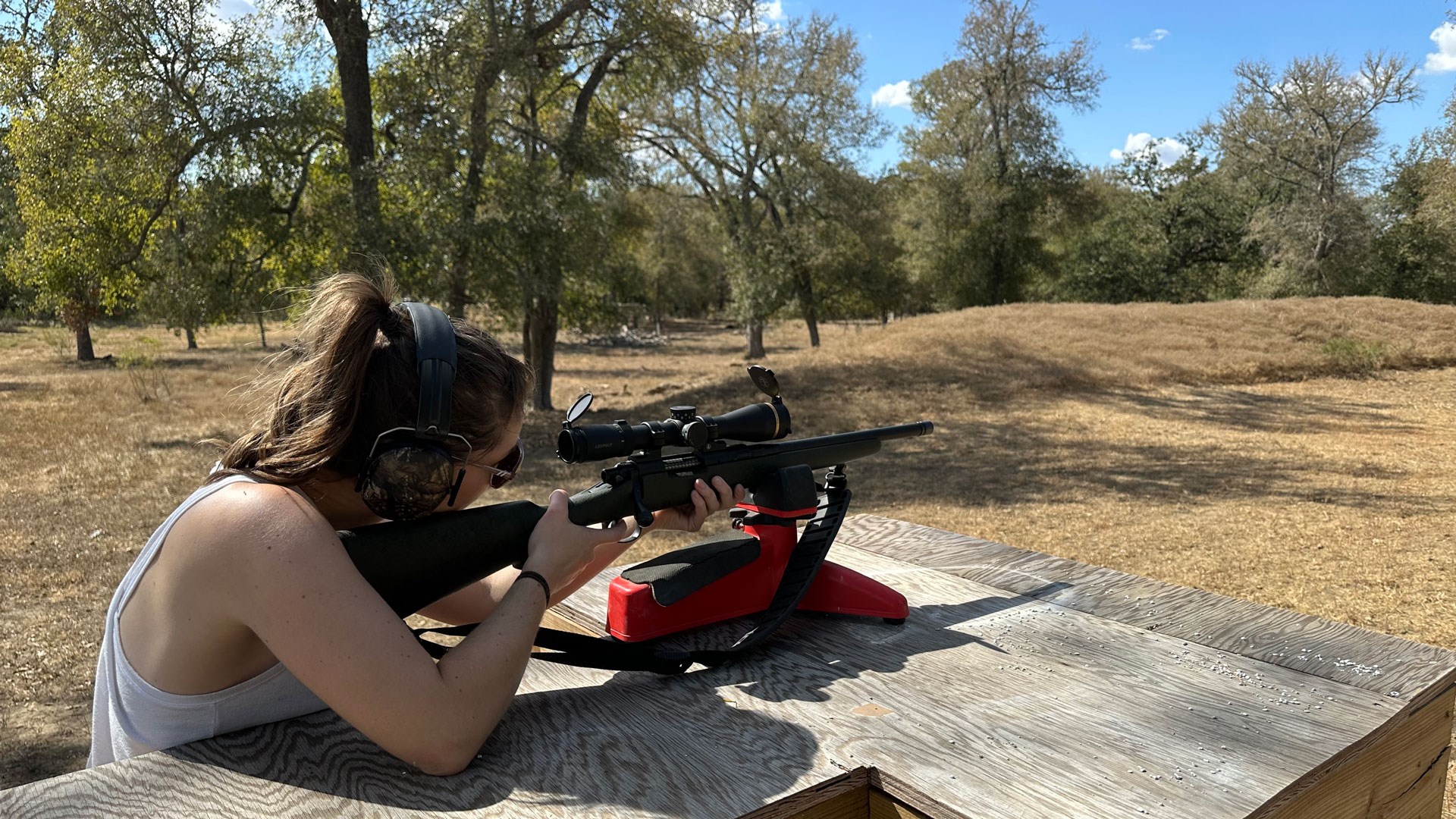
As much as I like the 8.6 BLK for how it looks on paper, I must admit, I haven’t been able to test it on game … yet. Here’s hoping this season will provide ample opportunity. But if the physics are any indication, I should be a happy camper, considering I’ll get blender-like terminal ballistic performance without the sound of blender ambience, thanks to the 8.6 BLK’s subsonic capabilities when paired with my Silencer Central Banish 46 V2 suppressor.