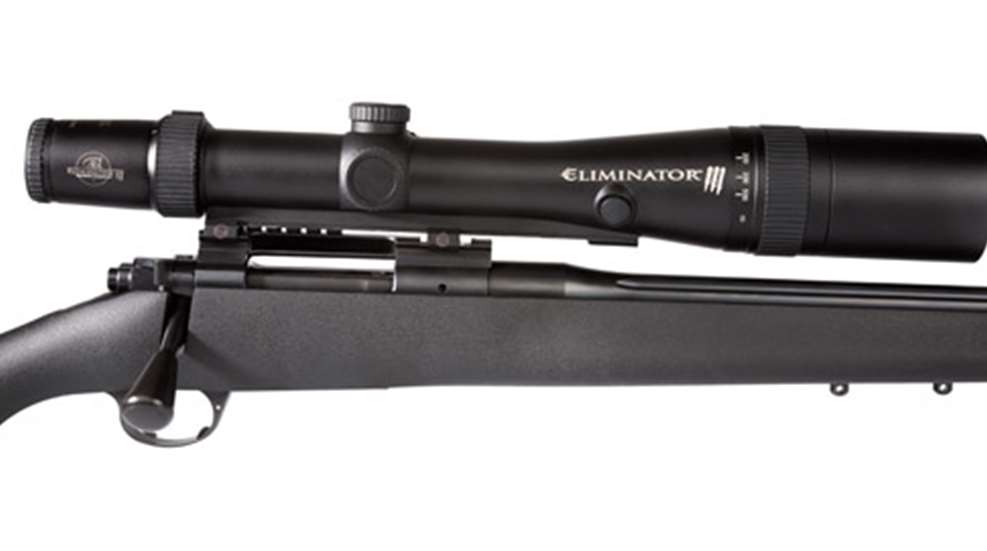
Burris range-finding scopes have changed considerably in just a few years. The original version, the 4x-12x Laserscope, had a rangefinder combined with Burris’ Ballistic Plex reticle. It worked well but in 2007 was superseded by the Eliminator, a more sophisticated version with 38 LED dots on the vertical crosshair. The correct dot for the range lit up when the laser was activated, providing an instant aiming point. The scope’s internal program also automatically compensated for the angle of the shot. It also worked well, but the maximum range was about 500 yards.
The Eliminator III appeared in 2012, with an improved ballistic program, 96 LED dots and a maximum range of 1,200 yards on reflective targets. The field of view includes a correction number for a 10 mph breeze at 90 degrees to the shot; when combined with the hashmarks of the X96 reticle the readout provides a more accurate compensation for wind drift.
The scope’s ballistic program also has been improved, providing a more precise trajectory to match the extra dots. Once you get used to punching the buttons, resetting the bullet’s velocity and ballistic coefficient (BC) takes maybe a minute, though it’s most easily done with the rifle on a steady rest. The scope can even be set to compensate for elevation changes by tweaking the BC, since higher elevations result in a higher BC.
I tested the 4x-16x-50mm Eliminator III on the FTW Ranch in the Hill Country of Texas, where owner Tim Fallon, retired Navy SEAL Doug Prichard and guides Carlos Franco and Fredo Ruben have trained hundreds of shooters. The steep hills and winding canyons of the ranch provide plenty of opportunity for shooting at various ranges and angles.
The test gun was Ruger’s new American rifle in .308 Winchester. Like earlier Burris laserscopes, the Eliminator III has a rail attached to the rifle with a pair of brackets fitting Picatinny or Weaver bases. In this instance Weaver bases were used, and the rifle proved accurate with Hornady 168-grain BTHP match ammo.
The scope is set up by first zeroing dead-on at 100 yards. The shooting was done from prone with a Harris bipod, and at first the 1/8" clicks acted a little wonky. The adjustments settled down after a box of ammo, however, which sometimes happens with new scopes, and initial testing was done out to 500 yards on 9-inch gongs using only the scope’s adjustments. (The battery on a laser scope can die in the field, so it helps to know how to use the scope manually.)
 Like many scope turrets these days, the Eliminator has hash-marked tops that can be reset to zero after sighting-in, and the scope returned to zero after every time it was cranked up and down. The manual adjustments also came in handy in the next trial, out to 1,000 yards.
While the Eliminator III’s maximum LED range is 1,200 yards, it only applies to flatter-shooting rounds. With my .308 load, starting off at about 2700 fps, the longest-distance dot to light up was at 800 yards.
Out to 800 the dots worked fine, though the elevation turret had to be tweaked a little at 400 yards. (Refining the 100-yard sight-in is standard procedure in any long-range scope, and suggestions are included in Burris’ instructions.) At 900 yards the bottom crosshair in the X96 reticle was spot-on, and at 1,000 yards cranking the elevation turret up a full turn allowed use of the same crosshair.
After returning home to Montana, I mounted another Eliminator III on one of my most accurate long-range rifles, an E.R. Shaw Mark VII semi-custom rifle chambered for the wildcat 6.5-06 with a 26-inch medium-heavy barrel. With handloads using the 140-grain Berger Hunting VLD, this rifle will average ½ MOA.
After zeroing at 100 yards (the clicks on this scope worked perfectly right away), I started by shooting at a 9-inch, white-painted gong at 400 to refine the zero. The rifle was dead on, probably because I knew the exact muzzle velocity from lots of previous shooting. The BC came from range tests done by Bryan Litz for his fine book Applied Ballistics for Long-Range Shooting, adjusted for the 4,000-foot elevation.
I then backed off to 800 yards and shot the gong again, missing the first time due to a slight breeze, then hitting solidly with two more shots. At 1,200 yards I didn’t hit the gong as easily (it looked tiny even at 16x).
Burris says the scope will sometimes range even farther, and I did get a reading and a dot at 1,350 yards with the scope on the 6.5-06, though I didn’t try a shot. The dots also range correctly no matter what magnification the scope’s set on, unlike the second focal-plane reticles in most variable scopes.
Next I removed the scope from the rifle and froze it overnight, then dunked it completely in 100-degree water. This expands the gas inside the scope, with any leaks shown by a stream of bubbles. The scope didn’t leak, and only showed the normal, slight amount of interior fogging, which dissipated within two minutes. (The inside of scopes cannot be kept completely dry; all gas purging does is guarantee they’re dry when leaving the factory.) The laser worked fine after the exterior of the objective lens was dried and cleaned. In my night-time brightness test, done on a custom chart, the scope tested 6+, which is better than average for modern multi-coated scopes. This is very impressive since extra doodads like laser reticles normally reduce transmitted light slightly. A flashlight test of eye relief showed it matched the published specifications of 4.0 inches at 4x and 3.5 inches at 16x.
The Eliminator III works exactly as advertised. Even the experienced long-range shooters at FTW Ranch were pretty impressed—well, except for Fredo Ruben, who still prefers to dial-in his scopes. But you can also dial in the Eliminator III!
Technical Specifications:
Type: laser rangefinding riflescope
Magnification: 3.5x-10x; 4x-12x; 4x-16x (tested)
Objective Lens Diameter: 40mm, 42mm, 50mm (tested)
Focusing Range: 50 yds.-infinity
Eye Relief: 3.5 "-4.0" (Burris specifications)
Exit Pupil: 12.5mm-3.1mm
Field of View @ 100 yds: 25'-7' feet
Coatings: fully multi-coated
Length: 15.75"
Weight: 26 ozs.
Construction: aluminum main tube; gas-purged; black matte finish
Accessories: lens caps
MSRP: $2,413