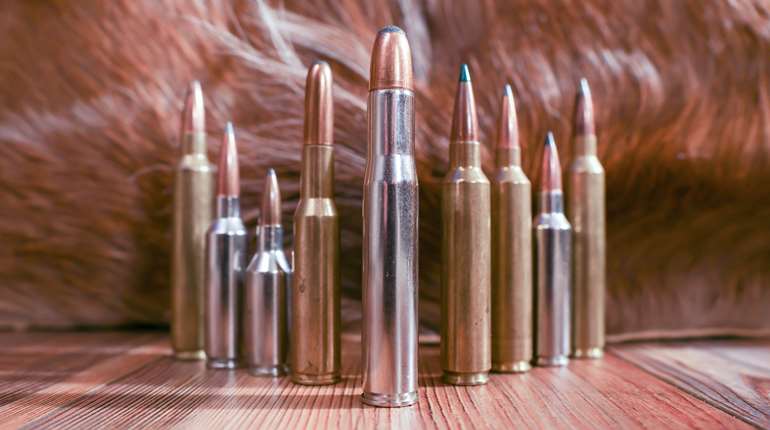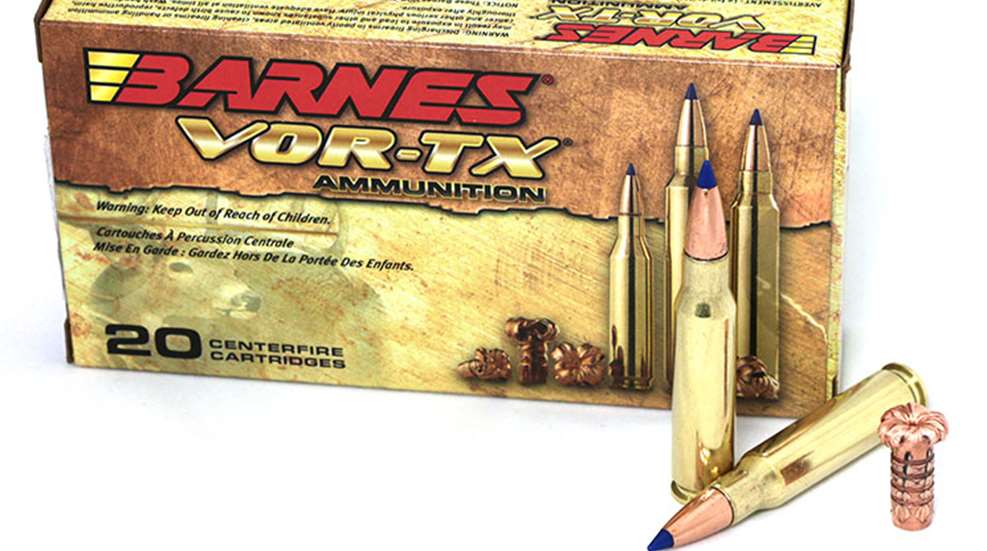
The Tipped Triple-Shock is a descendant of the original Barnes X-Bullet. Like the X-Bullet the Triple-Shock is an all-copper projectile with a small hollow cavity at the front. But, unlike its predecessor, the caliber diameter body of the Tipped Triple-Shock is ringed with grooves to help reduce fouling and improve accuracy. It also has a Delrin—acetal resin—tip to increase ballistic coefficient and promote expansion.
 The Tipped Triple-Shock was introduced in 2008, so by bullet standards it’s relatively new and not all hunters have had the opportunity to try them. They generally shoot like a laser, very flat and into itty-bitty groups. The pointed tip helps with the trajectory and it enhances expansion by exposing a larger meplat and cavity for fluids to enter. If there’s a down side to the Tipped Triple-Shock design it's that they are, like all mono-metal copper or gilding metal bullets, addicted to velocity. By that I mean, the faster they hit, the better they work.
Though it varies from bullet to bullet, a Tipped Triple-Shock needs to impact at about 2,000 fps in order to fully expand. Hunters need to be conscious of this when taking shots. I’d loaded some 110-grain Tipped Triple-Shocks for my .30 Remington AR and took it pronghorn hunting. This was a one-hole load at 100 yards, and when presented with a shot at a tad over 400, I didn’t hesitate. The pronghorn went down at the shot but got up and staggered off. The problem was the bullet had slowed to about 1,800 fps by the time it hit the speed goat and expansion was minimal. I had to get closer and shoot him again.
On the other hand, when these bullets hit with velocity they are pure copper wickedness. I put an 80-grain Tipped Triple-Shock from my .243 Winchester through an antelope at about 240 yards. It impacted at about 2,700 fps and the antelope nose dived into the Wyoming dirt and never moved again. On another occasion, a Tipped Triple-Shock from a .300 Win. Mag. pushed through a warthog end to end. His nose found the Africa dirt in a hurry.
Tipped Triple-Shocks will not dump a lot of energy inside a critter—generally about 50 percent—but because of this they penetrate very deep, even though they usually expand to double diameter. This means they make a wide hole, through and through. You won’t recover a lot of Tipped Triple-Shock bullets but you will recover a lot of game. And, since they are bleeding out both sides, the blood trails are easy to follow.