Undoubtedly, one of the most influential rifle cartridges of the 20th century was the .30-06 Springfield, serving its country proudly in two World Wars, and setting the hunting and shooting world on its ear. However, shortly after the First World War, the U.S. Army began to look at a shorter cartridge that could deliver ballistic performance similar to the veteran ’06, but in a compact package. Starting with the .300 Savage—a fine round for its time, and still a viable hunting cartridge—experimentation would continue into the 1950s, when engineers unveiled the T65. Maintaining the same case head diameter as the .30-06, but in a case shortened to 2.015”, and a 20˚ shoulder instead of the Springfield’s 17.5˚ shoulder. While the military version—the 7.62x51mm NATO—wouldn’t see duty until 1954, Winchester couldn’t keep a secret, and released the new .308 Winchester in 1952, in their Model 70 bolt-action rifle and Model 88 lever gun.
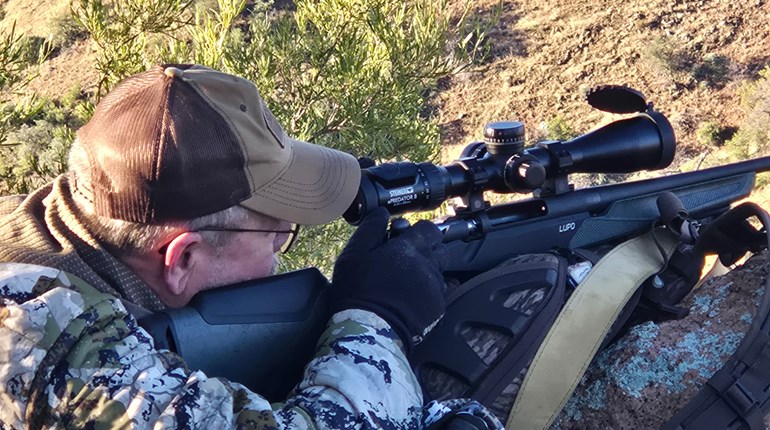
 It was an immediate success, being offered in a shorter rifle with a compact receiver, and delivering fantastic accuracy in a case ½-inch shorter than the Ought-Six. But, as the shooting community is so wont to do, the comparisons flared and the writers chose sides, and well, those debates still rage on. Some feel the .30-06, with its larger case and slight velocity advantage, makes for a vastly superior hunting round. Others see the lighter weight of a short-action rifle, coupled with the accuracy potential of the short, squat powder column, makes up for the slower velocity, and gives the .308 the edge. Both sides are right, and there is room for both cases in the shooting world. However, I feel I know a bit about the good old .308 Win., having hunted with one for decades throughout the United States and Canada. I’ve killed deer with it from New York to Texas, used it for black bear in Canada and the Adirondacks, and loaded it for my dad’s rifle for wild boar and caribou. It worked just fine on all counts.
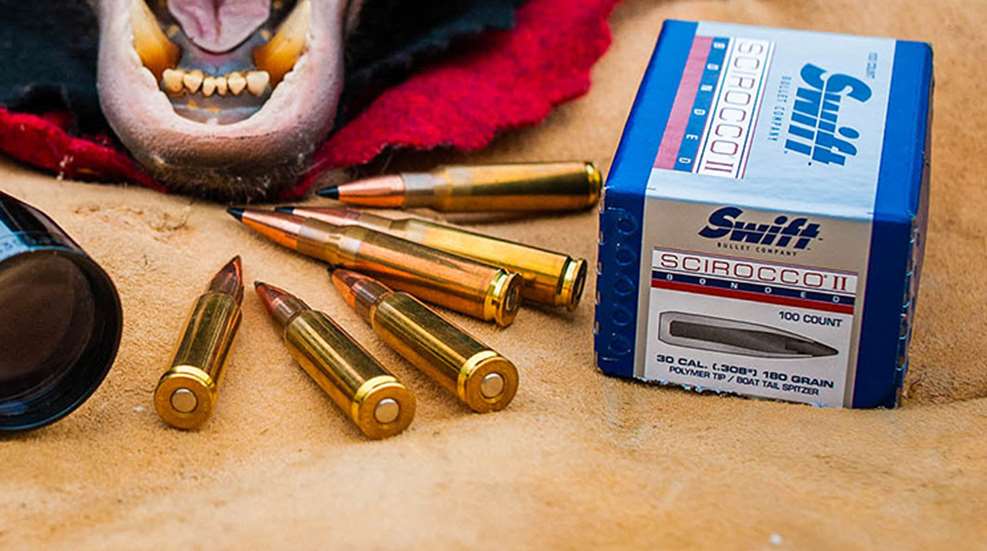
Aside from the case capacity issue, the .308 Win. suffered early-on from a major issue; one that would cause a bit of misunderstanding: the twist rate of the rifles. While the .30-’06 predominantly uses a 1:10” twist rate (fully capable of stabilizing the longest .30 caliber bullets), the .308 Win. came out with a 1:12” twist rate, which would limit the bullet weight to 200-grains and lighter. Is that an issue? Not really, at least not in the hunting fields. With the modern developments in bullet and powder technology, the .308 Win. has become an even better cartridge than it was in 1952. The premium projectiles in weights that the .308 likes best—the 150, 165 and 180-grain bullets—will pretty much handle anything that you’d sensibly use a .30 caliber rifle for. Bullets like the Swift A-Frame and Scirocco II, the Speer Grand Slam, the Hornady GMX and the Barnes TSX will greatly improve the performance of the .308 Win. on animals larger than deer. The Nosler Ballistic Tip and Sierra Game King will still perform well at .308 Win. velocities, which generally run 100 fps or so behind the .30-06. It’ll push a 150-grain bullet over 2800 fps, a 165 at 2700 fps and the 180s at right around 2,600 fps. If you truly need the 220-grain and heavier .30 caliber bullets, the .308 Win. may not be for you, but the shooters using those bullets seem to be dwindling, and it may not be a bad idea to increase the caliber instead.
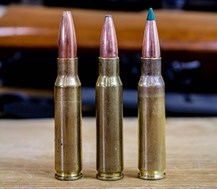 As a target rifle, there are plenty of good .30 caliber choices for the .308 Win., and the diminutive case will reach out to 1,000 yards without too much trouble, though it is treading on sub-sonic turf at distances exceeding that mark. However, it is one of the most accurate .30 caliber cases, and that fact coupled with moderate recoil make for a good choice. It’s true, a .300 Win. Mag. will provide a flatter trajectory and buck the wind a bit better, but for a long shooting session, the .308 Win.—or as my pal Marty Groppi calls it, the “7.62 Just-Enough”—will allow you to shoot accurately longer.
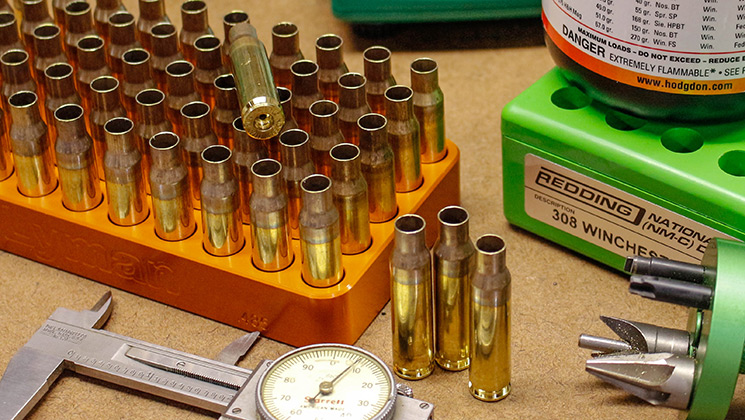
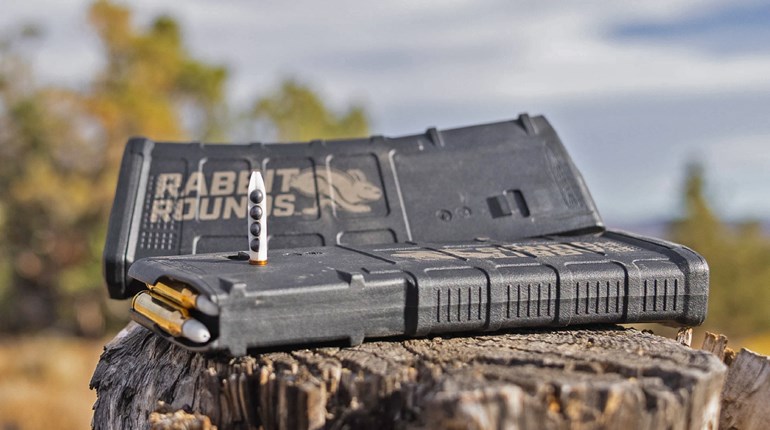
It’s also an easy cartridge to handload for, and by rolling your own you can often enhance the accuracy even further. There are a good many boutique bullets, like North Fork, Cutting Edge Bullets, Peregrine and others, that can only be utilized through handloading. Even in 1952, the ballistic engineers knew they wanted a powder that would maximize the smaller case capacity, and that remains the situation today. Certain ball powders, such as Hodgdon’s H380, will certainly make using the longer bullets a bit easier, as the powder will take up less room on the already small case. Ideally, the .308 Winchester runs on medium-burning powders like Reloder 15, IMR4064, H380 and VARGET. It is an efficient case, running on roughly 80% of the powder that the ’06 uses, yet only running 100 fps slower.
If the .308 Winchester has one major flaw, it’s that it lacks the look of reach. Once a shooter gets beyond the appearance, and really digs into the true performance of the cartridge, he or she will realize that they have a deer/pronghorn rifle, a black bear rifle, and even a rifle well-suited to elk and moose. It has fathered many successful children, like the .243 Win., .260 Rem., 7mm-08 Rem., .338 Federal and .358 Win. However, America always has and probably always will have a love affair with .308”-diameter bullets, and the .308 Win. uses all but the heaviest of them very well. You can split hairs about the differences between 7mm and .30, you can make the case for more impact energy and flatter trajectories, but I’ve learned this hard truth: for 90 percent of the world’s game animals, if you place a .308 Win. bullet of suitable construction in the right place, you’ll be posing for a photo.