Ask any rifleman–no matter their chosen discipline or passion–what the common denominator among us all is, and I have no doubt that the answer will be the .22 Long Rifle. From the competition shooters, to the recreational target folks, to small-game hunters, all the way up to those who prefer to chase the largest, most dangerous game animals on earth, all will tell you they either started with or still train with a gun chambered for .22 Long Rifle.
My first rimfire was a gift from my father, on Christmas 1985. He’d picked out a Ruger 77/22, because it was built like a scaled-down big-game rifle, and it remains my favorite rimfire to date. There are others, including a Mannlicher-stocked Ruger 10/22, but that little bolt gun and I have a whole ton of memories. The .22 Long Rifle has long been a favorite of hunters and shooters alike, from its release in 1884, as it offers a reasonably flat trajectory with virtually no recoil. Like many of the 19th century designs, the .22 Long Rifle uses a heeled projectile—one where the bullet diameter is the same as the case—with a stem of lesser caliber extending into the case. The .44 Special and .38 S&W are other examples of cartridges which use heeled bullets.

Billions of .22 Long Rifle cartridges are produced each year, and the cartridge is as good as it ever was, but that heeled design does have some shortcomings, including Ballistic Coefficient and the difficulty of manufacturing. Winchester has chosen to give the classic cartridge an update, in the form of the new 21 Sharp cartridge, which is the .22 Long Rifle case, mated with a non-heeled bullet.

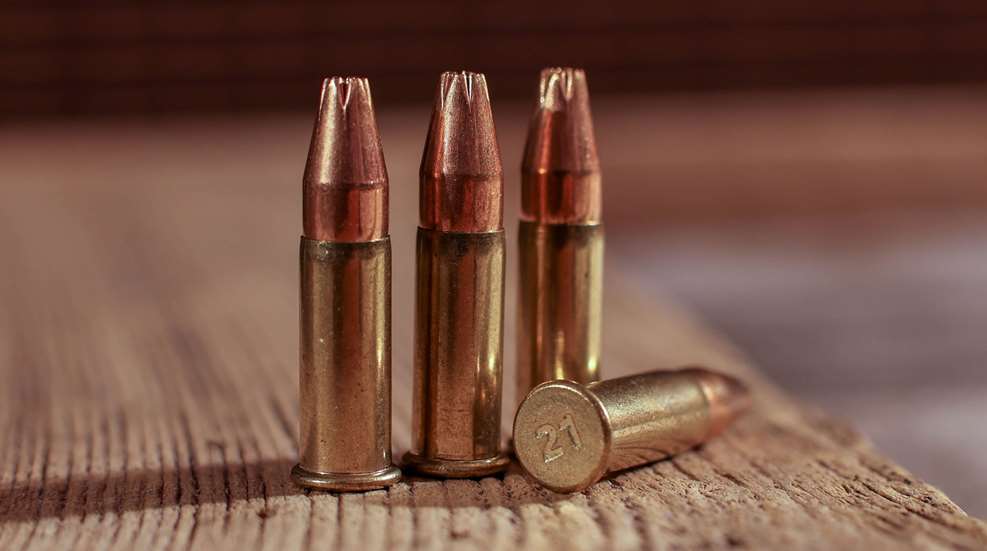
Whereas the .22 Long Rifle has a bullet the same diameter as the case, the 21 Sharp uses the conventional method of slipping a bullet into the case, and this has resulted in a projectile measuring .210 inches in diameter. Winchester offers four loads for the 21 Sharp, including the 34-grain jacketed hollowpoint, a 37-grain copper-plated lead bullet, a 42-grain FMJ, and (solving a big problem for those areas which require the use of lead-free ammunition) a 25-grain Copper Matrix monometal copper bullet. That lead-free bullet should prove a welcome addition, running at a muzzle velocity of 1,750 fps. The lead-based projectiles are loaded to velocities of 1,500 fps for the 34-grain load, 1,335 fps for the 37-grain copper-plated bullet, and 1,330 fps for the 42-grain FMJ.

So, looking at the case design, you’ll find it is identical in every way to the venerable .22 Long Rifle. The same .278-inch rim diameter is carried over, as is the case length of .613 inches. The .22 Long Rifle has a maximum cartridge overall length of an even 1.000 inches, and the 21 Sharp adheres to that number as well; even the Copper Matrix load measures 0.985 inches long. To visually differentiate the 21 Sharp ammunition from the regular .22 Long Rifle stuff, Winchester has imprinted a bold “21” in the center of the case head. I can even read it without my reading glasses.
Will a 21 Sharp chamber in a .22 Long Rifle firearm? The answer is yes. In fact, the 21 Sharp will fire in a gun chambered for .22 Long Rifle, though assuredly that bullet is barely touching the lands (if at all) and accuracy will be non-existent. However, if the design of your rifle allows you to easily change the barrel, any .22 Long Rifle gun can be changed out to a 21 Sharp barrel, and there are plenty of rifles announced for production this year, including a number of variants of the Winchester Xpert bolt-action rifle, and four different offerings from Savage.

Looking at the exterior ballistics of the 21 Sharp, you’ll see a trajectory similar to that of the .22 Long Rifle, though the Sharp’s projectiles will offer a better Ballistic Coefficient, and the lighter Copper Matrix load at a higher velocity will surely stand out. Comparing the 25-grain Copper Matrix to the nearest variant of the .22 Long Rifle—the 32-grain CCI Stinger—you see both cartridges strike within ½-inch at 100 yards. The 25-grain 21 Sharp will drop 3.4 inches and the Stinger 3.8 inches at that distance, so there is no huge difference with the Sharp, other than the lead-free alternative.

I truly believe that the .22 Long Rifle will remain the most popular rimfire cartridge ever produced, and that any attempt to usurp the throne will be futile. But there is room for others in the rimfire market, as the .22 WMR and .17 HMR have proven. I think the 21 Sharp is a sound design, filling a niche, but I also feel that is the role it will be playing: that of a niche cartridge. It delivers the accuracy rimfire shooters like and has a slight velocity advantage over the .22 Long Rifle, but it’s going to be very difficult to compete with the track record of the .22 Long Rifle, as well as the millions of firearms produced for it.