For a good number of hunters in the East, the idea of needing to adjust for trajectory can be completely foreign; talk to any Western hunter, and they will make the idea of holdover as common as loading the rifle itself. Prior to having made my first safari to South Africa, I had never had a shot at big game which required any level of holdover. All the shots at deer in my native Upstate New York woods and fields were inside of 225 yards, which was a dead hold for my .308 Winchester. We simply didn’t have the space to need to adjust for bullet drop.
South Africa quickly opened eyes, and the (now seemingly) crude holdover chart I had prepared for my .300 Winchester Magnum and .375 H&H actually saved my bacon, when an eland bull stood at the other end of 400 yards of painfully open terrain. Leaning on an anthill, settling into the Model 70 and cleanly breaking the trigger, I couldn’t have been happier when I heard the whunk of a 300-grain .375 bullet strike the eland’s shoulder, but realized there had to be a better way to adjust for holdover than just guesstimating what may be the proper amount, or chanting the mantra “six inches at 300, 18 at 400” (that being the trajectory of my .300 with 180-grain bullets).
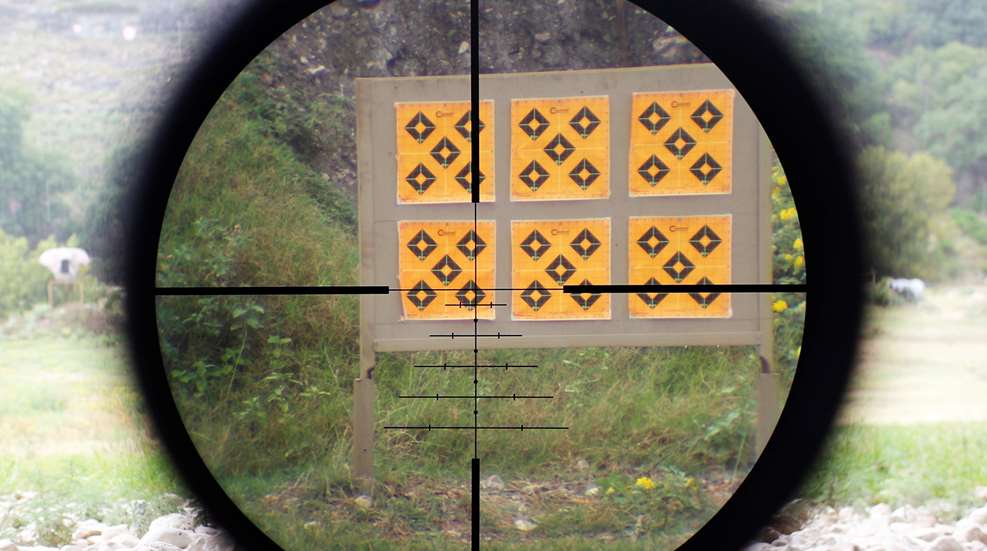
Dialing for elevation changes—at least among big-game hunters—is a relatively new thing; in fact, many hunters and shooters of my father’s generation still don’t agree with the concept of an exposed elevation turret, which could move out of adjustment at the most inopportune time. I’ve already discussed the arguments for and against dialing versus holdover, but for our purposes here, I’d like to discuss how a holdover reticle works, as for hunters who stay inside of 500 yards, it can be a quick and effective means of precision holdover without taking your eye out of the scope.
Even the simple Duplex reticle—a crosshair which grows thicker at a certain distance—can be used for holdover, but there are so many nicely designed ‘Christmas Tree’ reticles which can get the job done that, if you are interested in this style reticle, you can become very proficient with. Some reticles are more complex than others, but the concept is the same: the varying crosshairs will subtend a certain amount of angle, and that will translate to a particular amount of elevation adjustment.
Here’s the first caveat—in a first focal plane reticle, where the reticle size increases or decreases as the magnification is changed, the values of the angles subtended are the same at any magnification range. In the more common second focal plane reticles—much more popular here in the U.S.—the scope will need to be used at either maximum magnification, or at a magnification value prescribed by the manufacturer. The latter is the most comfortable to me, but I've also missed some 450- and 500-yard shots at steel because I was set to the wrong magnification level. I mention this early on because it may influence your choice of scope magnification; a 350-yard shot with a scope with a top end of 24x can be a problem if the mirage is excessive.
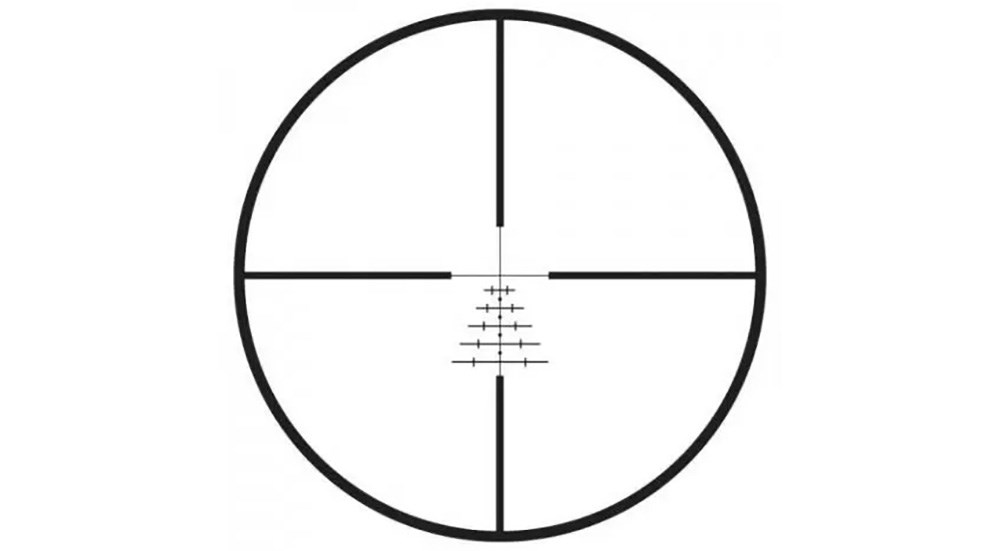
So, you’ve got a reticle with a main crosshair—just like any conventional scope—and a series of lower crosshairs running perpendicular to the lower vertical hair. The distance between those lower hairs is usually some even unit of measure, depending on whether your scope is calibrated in minutes of angle or in milliradians.
We should probably touch on that quickly to help avoid confusion. Both are the measure of an angle, with one minute of angle (MOA) being 1/60th of a degree, and a milliradian (MRAD or mils) being 1/1,000th of a radian (taking you back to geometry class, a radian is a part of a circle where the arc length is equal to the radius). Think of it as Imperial versus Metric if you choose, but just realize that both are just a means of measuring an angle. You’ll often hear that the arc subtended by one MOA is equal to one inch at 100 yards, and that’s true (it’s actually 1.04 inches), so that is a nice round number, with most scope adjustments being ¼-MOA per click. One MRAD subtends 3.6 inches at 100 yards, and the scope’s adjustment is usually in 1/10th MRAD per click. I’m a Land Surveyor by trade and have dealt with degrees-minutes-seconds on a daily basis since before I had to shave, so I am much more comfortable using the MOA system. The concept is the same, and you may easily convert from one system to another if you so choose.
When I’m hunting, I prefer a 200-yard zero, as it results in a dead hold out to that distance, and the vast majority of my shots are inside of that mark. Beyond that, the bullet will (according to the laws of gravity and definition of a trajectory arc) being to drop, and you will need to compensate for the amount of drop at a prescribed distance. For example, let us suppose that the antelope of your dreams has decided to pose broadside at 350 yards, in the bright Wyoming sunshine. You’re carrying your trusty .30-06 Springfield, loaded with Hornady’s 165-grain SST load. Plugging the data (zero range, Ballistic Coefficient, muzzle velocity, etc.) into their Ballistic Calculator, you’ll quickly see that you need 3.4 MOA of elevation (raising the barrel) to compensate for the 12.6 inches of bullet drop. If your scope was equipped with a simple and unobtrusive reticle—like the Leupold TMOA Illuminated, which has ten MOA along the four hairs, in 1-MOA increments—you could simply hold halfway between the third and fourth hashes, let that breath out and squeeze the trigger.
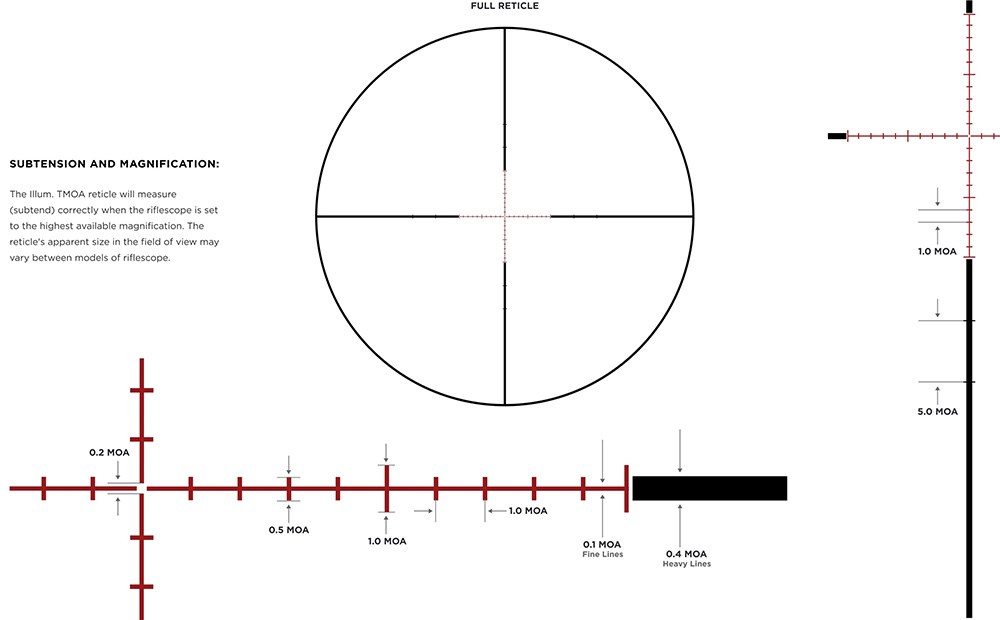
Let’s suppose you had all sorts of confidence and training, and were confident in taking things out 500 yards; that Leupold reticle will take you out to just past 550 yards before you need more than 10 MOA, and even then there are more hash marks along the thicker part of the duplex reticle, in 5-MOA increments. Bottom line: for most hunting scenarios, this simple holdover reticle is a great help.
Many of the European scopes have a reticle marked in MRADS (mils), as that system seems to be more popular over there. The Swarovski BXR-1 reticle is a mixture of crosshairs and dots along the lower vertical hair, in 0.5 mil increments, with several hashes on the lower horizontal hairs used for wind adjustments. In that same Wyoming antelope scenario, the Hornady chart will indicate that you’ll need exactly one mil of elevation; hold the first dot below the main crosshair and you should be smiling in your trophy photo.
I like the holdover reticles for a simple solution at hunting ranges; if you have a chart made for your chosen load and a good rangefinder, you can confidently make hits at to 350 or 400 yards with a bit of practice. It’s that last word—practice—which I’d like to emphasize, because no matter how precise the mathematics seem to be, only real-world experience will prove how precise the aiming system is. I highly recommend truing your rifle/reticle combination before shooting at game, especially outside of 350 yards.