African cartridges are fascinating. Steeped in nostalgia, the very term conjures images of faded yellow and red Kynoch ammo boxes with the pungent stench of cordite. The subject is so broad that entire books have been written about calibers for the Dark Continent, the classic being “African Rifles & Cartridges” by John “Pondoro” Taylor. Craig Boddington has penned not one but two books about African rifles in which a good deal of thought is given over to the best calibers for the African game. In fact, it’s due to a recommendation from Craig that I hunted this past month in South Africa with a real oddball of an African cartridge.
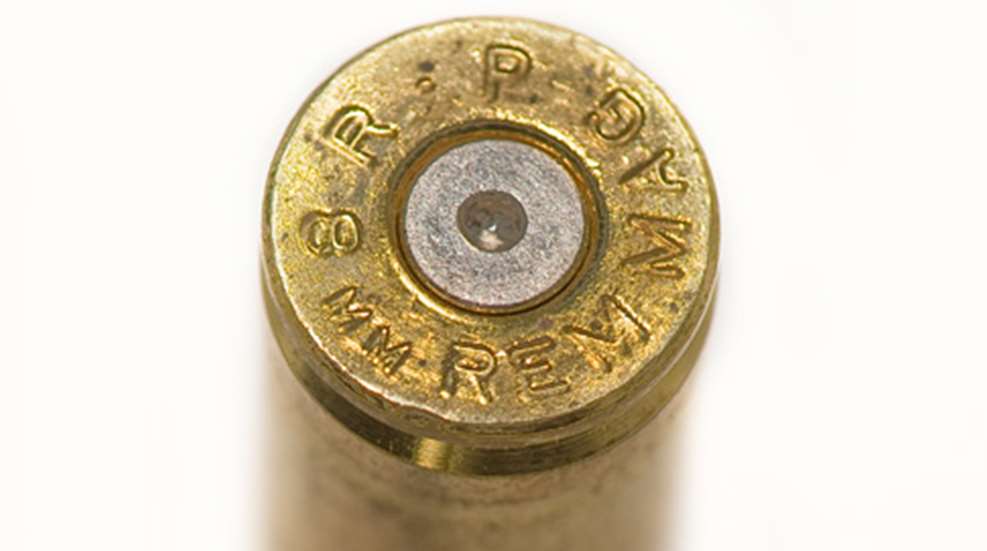
Craig has long sung the praises of the obscure 8 mm Rem. Mag., and I finally decided that I needed to try one. I’ve always liked oddball cartridges and of course I respect Craig’s opinion enormously, so the long-lost 8 mm appealed to me.
My reason was also sentimental. I’ve shot eight of the nine principal species of spiral-horn antelopes. When I get number nine, I’ll become the third American gunwriter to shoot all nine. Warren Page was the first and Craig was the second— the cad, he’s done it twice!
As I contemplated the prospect, I realized it would be a fitting tribute to a man I consider as much a mentor as a friend. I intend to shoot my final spiral-horn with Craig’s pet caliber.
The 8 mm Rem. Mag. splits the middle ground between a .300 Win. Mag. and a .338 Win. Mag. In English terms, it’s a .323 caliber. The standard 8 mm bullet weight is 200 grains, which is a nice compromise between a 180 grain .30 caliber projectile and a 225-grain .338 slug.
Remington conjured up the 8 mm Magnum in 1978, but it was quickly greeted by a collective yawn from American hunters. Metric calibers have always been a tough sell in the U.S.—notwithstanding the notable exception of Remington’s immortal 7mm Rem. Mag.— and long-action magnums haven’t fared well either. Combine the two and you have a recipe for failure.
Today, Remington doesn’t chamber the Big Eight in a production rifle, although the Custom Shop can whip one up. You know you have a dead horse of a cartridge when its inventor doesn’t even bother to offer it. (Remington still manufactures 8 mm Rem. Mag. ammo, however.)
Be that as it may, I took Craig’s pet caliber on a trial run to South Africa for, yes, more spiral-horns but not the magic ninth one. What I found was indeed a fantastic plains game cartridge. With a 200-grain bullet whistling along at 3,000 fps, it shoots flatter than the deck of an aircraft carrier and hits like a battleship.
I ordered my 8 mm from Mel Forbes at Ultra Light Arms with a 26-inch barrel to take full advantage of the large case capacity. The Big Eight holds one grain shy of 100 grains of water, which is copious indeed. The parent case, like virtually every belted magnum, is the .375 H&H with a straighter body and much sharper shoulder than that wonderful antique British number. Mel makes a special stock for his rifles with 26-inch barrels—apparently I’m not the first to order one—with a slightly lengthened fore-end to give the rifle the right perspective so it actually doesn’t look like it has such a disproportionately long barrel.
My handload, using Hodgdon H4350 and a 200-grain Barnes Triple Shok, zips over the skyscreens of my PACT chronograph at 3,050 fps. If a .323 caliber 200-grain solid copper projectile at 3,000 fps doesn’t qualify as darn near perfect “paper ballistics” for large African plains game, I don’t know what does.
The late Col. Charles Askins agreed. Charlie was a big proponent of the 8 mm Rem. Mag., more so than Craig, and used it on a number of African safaris. He shot zebra and eland with his left-handed 8 mm. Now that I think of it, both Craig and Charlie, the two most well-known advocates of Remington’s ill-fated cartridge, are lefties. Coincidence.
In yet another example of how big bruisers can be astonishingly accurate, my Ultra Light 8 mm shot its first three-shot group of 0.61 inches at 100 yards. Just before my April safari, I zeroed it at 200 yards and it delivered five shots into a group just a hair less than an inch. At 200 yards, that’s half minute of angle.
To digress momentarily, a 200-yard zero is the perfect zero for Africa because of the 200-50 rule. The 200-50 rule says that with a rifle zeroed at 200 (assuming a normal height of scope-above-bore mounting) the gun will simultaneously be spot-on at 50 yards. For the mid-point of 100 yards, it will be 2 inches high and at 300 it will be 5 inches low, again assuming a magnum caliber with muzzle velocity in the 2,850 to 3,000 fps range. Shots are rarely out to 300 in Africa, but I was hunting in the mountains of the Eastern Cape where, yes, distances can be that far.
Finally in the field, I delighted in the feathery heft of Mel’s true-to-its-name Ultra Light rifle. My 8 mm weighs 7¾ pounds with a Zeiss Conquest 4.5-14x scope. My first opportunity with the 8 mm came with a bontebok, the “purple antelope” with a curious dark coloration on his lower flanks that shines like a really deep black-purple in the sunlight. The bontebok stays in the big wide open, like springbok or topi, and feels most comfortable when he can survey his surroundings for miles around. Consequently, putting the sneak on him over flat ground is difficult.
Cullen Kelly, my PH, got me to 276 yards and I settled into sitting with my set of Stony Point “short” shooting sticks. At the shot, the bontebok ran about 50 yards in a semi-circle and collapsed. This was to be the “messiest” of the 8 mm’s work. The rest dropped on the spot.
A Cape kudu came next, one of five greater kudu in the spiral-horn hierarchy. We had a heck of a time finding a mature bull due to unseasonable rain, but we finally spotted just the horns sticking above a bush on a hillside. After closing the distance, the bull decided to move to a greener bush and sauntered uphill. Cullen set up his tall shooting sticks and I settled behind the Big Eight and waited for the bull to show himself. As he stepped out from behind a bush, I tracked him in the Zeiss reticle and considered a spine shot for a moment because he was going directly away from me uphill, but then he turned and gave me his shoulder.
The Timney trigger broke and the bull collapsed in his tracks. Thus began the first of five successive “on the spot” kills that the Big Eight went on to make. The kudu slug was the only bullet I recovered on the trip. The 200-grain TSX hit the shoulder and coursed up into the neck, breaking the vertebrae (hence the instant drop) and was found under the skin in the far side of the neck.
Next I moved up to the Limpopo area and was hunting with Dean Robinson of Adventures Africa. Four impala, all for leopard bait, went down to the 8 mm DRT—Dead Right There. Dean whistled as the third impala in a row fell like a puppet with its string cut. He’d never seen a client with an 8 mm Rem. Mag. “That’s not a cartridge,” he said with astonishment, “That’s a death ray!”