When it comes to selecting a rifle in a factory caliber, everyone has their favorite and any choice can start an argument at deer camp. While I could never argue against choices like the .30-06 Sprg., .243, or .308 Win., that doesn’t mean they are the end-all be-all choices either. Call me an odd-ball or eccentric, but for me, lesser-known calibers are what get my wheels turning. These factory-made cartridges may be under-the-radar, but they are certainly not short on punch or distance, making them excellent choices for game of all sizes.
.257 Roberts
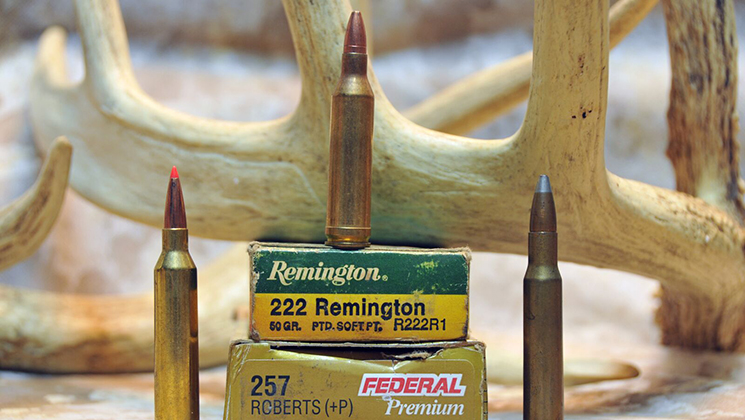
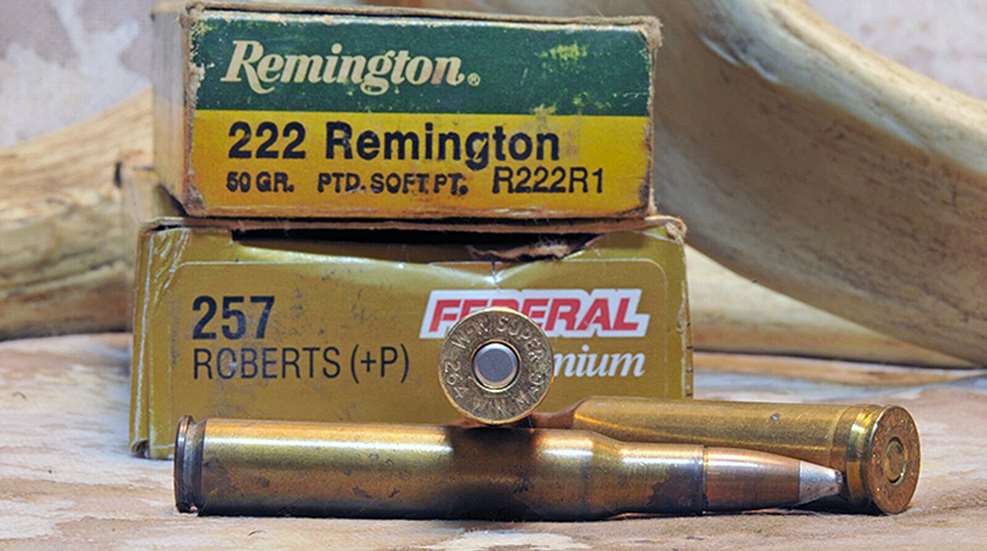
Using a .25-caliber bullet and the venerable 7x57mm Mauser case, Ned Roberts developed a cartridge that, while originally wildcat, was introduced into production with some modification by Remington Arms in 1934. Despite strong early interest and the fact that it was introduced 21 years prior to the .243 Winchester, the quarter-bore .257 Roberts quickly fell out of favor after the 6mm’s introduction. Today, the caliber is seemingly only available in over-the-counter rifles during limited production runs, and has apparently lost its “like” status amongst new-age hunters. None of them seem to know it even exists. While it has certainly fallen off the radar, there is still a small niche of whitetail hunters that have seen what it is capable of and done a fair job introducing it to the next generation. I am personally one of those dreamers that believes in a .257 revival and owns a Roberts in the ever-so-fine Remington 700 SA Mountain Rifle. If you have ever dreamed of the perfect combination of balance, recoil and performance, this little package topped with a 2-7 Leupold will swiftly do the job in any tight-quarters or backpack hunting situation. Not to mention, with a 100-grain bullet it can reach speeds of over 3000 fps making it a fine choice for long-range shooting on antelope, whitetails and mule deer.
.264 Winchester Magnum
If you want to get me excited, ask me about the .264 Winchester Magnum. After being gifted an old, cracked-stock Remington 700 ADL from the 70’s in .264, it didn’t take me long to fall into love with the caliber. I quickly changed out the stock and sent the gun out for some lightening and custom work and it has since taken more than eight different big game species, from antelope to a 450-pound black bear. Designed using a belted case derived from the .375 H&H, the .264 Win. Mag. was introduced in the late 1950’s with other the early Win. Mags., including the .300 and .458. What makes the .264 so sweet is that it pushes the superb-in-ballistic-coefficient 6.5mm (.264) bullet as fast you can dream. That makes it a sweet long-range caliber with minimal drop and wind deflection. In addition to the ballistic efficiency, felt recoil is less than a .30-06, making it an excellent choice for super-lightning for those high-elevation mountain hunts. The downfall of the caliber is that it eats barrel throats for lunch and if you like to shoot a lot at the range for fun, it will go through a few barrels. But who cares, right? Fast cars eat tires, and I don’t see anyone trading in their 70 SS for a smart car. Besides, who else can say they have a rifle that pushes a 130-grain 6.5 bullet at nearly 3200 fps?
6.5 Remington Magnum
If cartridges had politically incorrect nicknames, it would be the .264 Win. Mag.’s fat little brother. Like the .264 Win. Mag., the 6.5 Remington Magnum pushes the supremely efficient 6.5 bullet at walloping speeds, but in a short action variant. Call the 6.5 Rem. Mag. the granddaddy of short-mags if you will—it was introduced in 1966, long before the new and extremely popular WSM series. Built again using a shortened .375 H&H case, the 6.5 Rem. Mag. uses the same case design as the shoulder pounding .350 Rem. Mag., just necked down to 6.5mm. The two keys to this cartridge are that it uses a short action and saves weight and it pushes an exceptional bullet quickly, with minimal felt recoil. Slightly, but only minimally, slower than its .264 Win. Mag. big brother, the 6.5 Rem. Mag. can push a 130-grain bullet over 3000 fps. Where it really shines is with a 120-grain bullet, with which it can provide the perfect lethal combination of speed and energy. For those that vaguely remember the cartridge, it was available in the short-barreled and outer-space looking Remington 600 that had that awful-looking plastic rib.
.35 Whelen
I was first introduced to the .35 Whelen by someone who described it as a click-boom-dead caliber. Built off likely the best and most efficient case platform ever designed, the .30-06 Springfield, the .35 Whelen case is simply a necked-up .30-06. It is not a magnum cartridge, despite shoulders feeling that way after firing one, and it was designed as a Wildcat in 1922 by Colonel Townsend Whelen. Commercially, it wasn’t made available until the late 1980’s, when it was offered by Remington Arms and was made part of their Classic series of 700 rifles. While it does pack a felt-recoil punch, what makes it fringy popular is that it can push heavy bullets with less felt recoil than a .338 Win. Mag. or .375 H&H. This makes it more than suitable for taking the largest of North American game up to and including Kodiak brown bears for those like myself that are “small” boned. While it is difficult to obtain in a factory rifle, for those that choose a custom route, the .35 Whelen can be built on any standard-sized .30-06 action giving the rifle builder plenty of less-expensive options. Pushing a 250-grain bullet at nearly 2600 fps, the .35 Whelen creates plenty of energy with manageable drop out to 200 yards
.222 Remington
I know, I know—everyone loves their .223’s and .22-250’s. This isn’t me attempting to make a case for a cartridge that performs as-well-as another. Instead, I am simply trying to pander to the available .222-chambered rifles from an era when rifles were made at the highest level. Personally I cringe when I hear about someone wanting to re-chamber a classic rifle to a .223 from .222 because of the larger choices in factory ammo. I get it, .222 factory ammo choices are bleak, but that doesn’t mean that the caliber is any less potent. For starters, what cooler nickname for a cartridge is there than the triple deuce? Just saying it makes me feel so much more a part of the “in” crowd. In addition to the cool name, the .222 Rem. is an odd ball for this list because it was developed and introduced in 1950 using its own case, not a Frankensteined one. While it was originally intended to be the military’s small bore cartridge, it quickly turned into a relic when the 5.56 Nato and .223 cartridges were developed. In terms of ballistics, the .222’s lesser case capacity pushes the same bullet 200 fps slower when compared to the .223. That being said, for the intended hunting targets of the two calibers, both will do the same job and the .222 might even save some fur damage on those predators. If you are bored at work want something else to look at, check out the .222 Rem. Mag. for a more 223-like comparison.